Garden Leave vs PILON: What Is the Difference?
Garden leave and payment in lieu of notice can both mean you stop doing your normal job during the notice period, but legally they are very different. This guide explains the difference between garden leave vs PILON, including employment status, pay, benefits, tax, holiday accrual, restrictive covenants and the effect on redundancy.

Garden leave and PILON are often discussed together because both arrangements can result in an employee leaving the workplace before the normal notice period has finished.
But they are not the same.
The main distinction is whether the employment contract continues.
Garden leave: employment continues until the notice period expires.
PILON: employment can end immediately and the employee is paid instead of working the notice period.
Garden Leave vs PILON: Main Difference
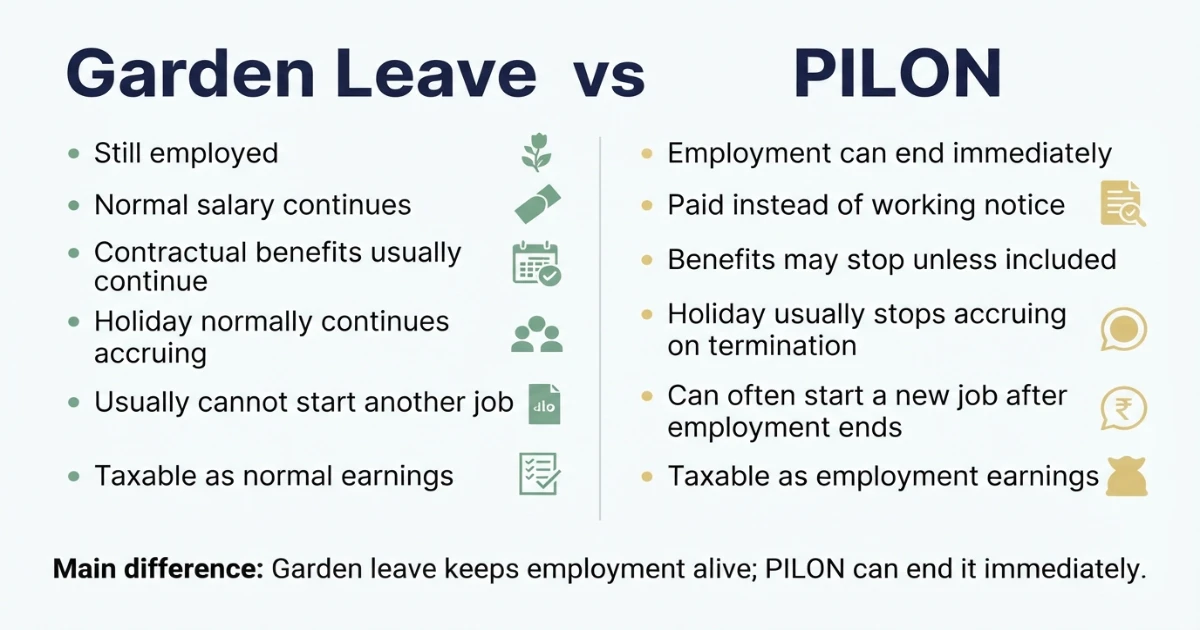
Garden Leave
- You remain employed.
- You are normally paid as usual.
- Contractual benefits usually continue.
- You normally do not attend work.
- Holiday can continue accruing.
- Restrictive covenants generally continue to operate according to the contract.
PILON
- Employment can end immediately.
- You receive payment instead of working notice.
- Future benefits may stop unless included in the PILON terms.
- You are free from normal work duties.
- Holiday normally stops accruing when employment ends.
- Post-termination restrictions depend on the contract and circumstances.
Garden Leave vs PILON Comparison Table
| Feature | Garden Leave | PILON |
|---|---|---|
| Employment continues? | Yes, normally until notice expires | Can end immediately |
| Employee works? | Usually no | No |
| Salary | Normal salary continues | Notice pay provided as a payment |
| Benefits | Normally continue under the contract | May stop unless covered by PILON terms |
| Holiday accrual | Normally continues while employed | Normally stops when employment ends |
| Tax | Taxable employment income | Taxable employment income |
| National Insurance | Normally Class 1 NICs | Normally Class 1 NICs |
| Can start a new job? | Usually restricted while still employed unless employer agrees | Often possible once employment has ended, subject to restrictions |
What Is Garden Leave?
Garden leave, sometimes called gardening leave, is when an employee has been given notice but the employer tells them not to carry out their normal work during some or all of the notice period.
The employee remains employed.
Acas says an employee on garden leave must be paid as usual during the notice period, including contractual work benefits.
Employers often use garden leave where they do not want a departing employee to have continued access to:
- confidential information;
- clients or customers;
- pricing information;
- commercial strategy;
- systems or databases; or
- other sensitive business material.
What Is PILON?
PILON means payment in lieu of notice.
Instead of requiring the employee to work through their notice period, the employer makes a payment covering the notice period and employment can end straight away.
Acas explains that a contractual PILON clause can allow the employer to use this arrangement. Where there is no PILON clause, the employer can ask the employee to agree to it.
If the employee agrees, they should receive full notice pay according to the applicable terms.
Are You Still Employed on Garden Leave?
Yes.
This is one of the most important differences between garden leave and PILON.
Even though you are not attending work, your employment contract remains in force during garden leave.
That usually means you remain subject to contractual obligations such as:
- confidentiality;
- good faith duties;
- restrictions on working for competitors;
- availability requirements; and
- other contractual terms.
Are You Still Employed After PILON?
Normally, no.
Where PILON is used to terminate employment immediately, the employment relationship ends on the termination date.
You receive money instead of continuing in employment through the notice period.
This difference can affect:
- benefits;
- holiday accrual;
- pension contributions;
- continuous employment;
- bonus eligibility; and
- the date you can potentially start a new job.
How Are You Paid on Garden Leave?
An employee on garden leave normally continues receiving their usual salary during the notice period.
HMRC treats this as ordinary salary because employment continues.
Even if the employer pays the notice-period salary as a lump sum while the employee remains on garden leave, HMRC guidance says it is still salary for the notice period rather than a true PILON.
Do Benefits Continue on Garden Leave?
Normally, contractual benefits continue while the employee remains employed, subject to the wording of the contract.
This can include:
- company car;
- private medical insurance;
- pension contributions;
- life assurance;
- mobile phone;
- other contractual benefits.
This can make garden leave financially more valuable than a simple PILON where the PILON clause only covers basic salary.
Does PILON Include Benefits?
Not automatically.
Acas notes that when employment ends immediately through PILON, it is unlikely that an employee will continue receiving other contractual benefits unless the agreement or PILON clause provides for them.
A PILON clause might specify:
- basic salary only;
- salary plus car allowance;
- salary plus contractual benefits; or
- another defined calculation.
Does Holiday Continue to Accrue?
Garden Leave
Because employment continues during garden leave, statutory and contractual holiday can normally continue accruing through the notice period.
PILON
Where employment ends immediately, holiday normally stops accruing after the termination date.
Any holiday already accrued but untaken should be dealt with separately when employment ends.
Garden Leave vs PILON Tax
Both arrangements involve taxable employment earnings.
Salary paid during garden leave is ordinary salary and is subject to Income Tax and National Insurance.
PILON or other notice-equivalent earnings are also generally subject to Income Tax and Class 1 National Insurance.
The £30,000 termination-payment threshold that can apply to qualifying redundancy compensation does not simply make notice-related earnings tax-free.
Tax example
An employee receives:
- £15,000 qualifying redundancy compensation;
- £5,000 PILON.
The qualifying £15,000 redundancy compensation can potentially fall within the termination-payment threshold.
The £5,000 PILON remains taxable notice-related earnings.
What Happens to Restrictive Covenants?
This can be important for senior employees.
During garden leave, the employee remains employed and normal contractual restrictions continue to operate.
After PILON, employment has ended, so the position depends on any post-termination restrictive covenants in the contract and whether they remain enforceable in the circumstances.
The wording of the PILON clause can be important where an employer wants to preserve post-termination restrictions.
Can You Start a New Job During Garden Leave?
Usually not without the employer’s agreement.
You remain employed during garden leave and can still be bound by duties to your existing employer.
Starting work for a competitor without permission could breach the employment contract.
The safest approach is to get any early-release arrangement in writing.
Can You Start a New Job After PILON?
Potentially, yes.
If employment has ended, you are no longer employed by the previous employer.
However, you may still be subject to valid post-termination restrictions such as:
- non-compete clauses;
- non-solicitation clauses;
- confidentiality provisions; or
- restrictions relating to clients or staff.
Garden Leave vs PILON in Redundancy
Both arrangements can be used when an employee is made redundant.
An employer might:
- require the employee to work notice;
- put the employee on garden leave; or
- make a PILON and end employment earlier.
The redundancy payment itself remains a separate entitlement from notice pay.
Which Option Affects Continuous Service?
Garden Leave
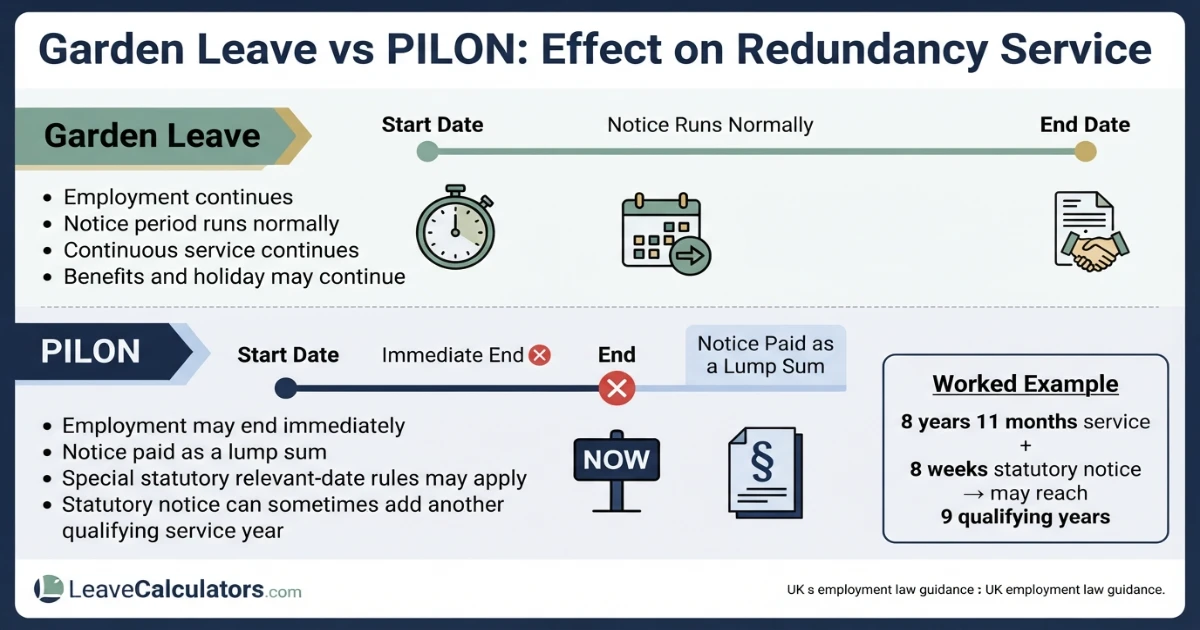
Because employment continues, continuous service normally continues until the garden-leave notice period ends.
PILON
Employment can end immediately, but statutory redundancy calculations can use special relevant-date rules.
In some redundancy cases, the statutory notice period can still be added when determining qualifying service even though PILON was paid.
An employee has 8 years and 11 months of service when the employer ends employment immediately.
Their statutory notice entitlement is 8 weeks.
For statutory redundancy purposes, those statutory notice weeks can potentially move the relevant date beyond the 9-year point.
The employee may therefore qualify for redundancy pay based on 9 complete years.
Which Option Uses the Notice Period?
Garden leave uses the actual notice period because the employee stays employed until the end of notice.
PILON replaces working the notice period with a payment and can end employment before that period would naturally expire.
For the statutory notice scale, see: Statutory Notice Periods in the UK Explained .
What Happens to Bonuses and Commission?
The answer depends heavily on the contract.
On garden leave, employment continues, so bonus and commission rights may continue subject to the scheme rules.
With PILON, employment may end before a bonus or commission date is reached. A PILON clause might or might not compensate for that lost entitlement.
Employees should check:
- bonus scheme rules;
- commission terms;
- active-employment requirements;
- termination provisions; and
- PILON wording.
What Happens to Pension Contributions?
During garden leave, pension contributions normally continue according to the contract and scheme because the employee remains employed.
With PILON, future employer contributions may stop on the termination date unless the PILON arrangement includes compensation for them.
Is Garden Leave Better Than PILON?
There is no universal answer.
Garden leave can be financially attractive where the employee continues to receive:
- salary;
- pension contributions;
- private medical cover;
- car benefits;
- holiday accrual; and
- other contractual benefits.
PILON can be attractive where the employee wants a clean and immediate break and the payment fairly covers notice-period entitlements.
The best comparison is therefore the total financial and contractual effect, not simply the headline salary payment.
Why Do Employers Use Garden Leave?
Employers often use garden leave to protect the business while keeping an employee bound by the employment contract.
Typical reasons include:
- protecting confidential information;
- preventing contact with key clients;
- restricting access to commercial systems;
- keeping the employee away from competitors for the notice period; and
- managing an orderly handover.
Why Do Employers Use PILON?
PILON can provide a quicker and cleaner termination.
An employer might prefer PILON where:
- there is no need for the employee to remain employed;
- the working relationship has broken down;
- the employer wants immediate departure;
- the redundancy role has ended immediately; or
- the contract specifically gives the employer a PILON right.
Common Garden Leave vs PILON Mistakes
1. Assuming garden leave means employment has ended
It normally has not. The employee remains employed throughout garden leave.
2. Assuming PILON includes every benefit
The PILON clause may only cover specified amounts such as basic salary.
3. Assuming garden leave pay is tax-free
Garden-leave salary is ordinary taxable employment income.
4. Treating PILON as tax-free redundancy compensation
PILON is normally taxable notice-related earnings.
5. Starting a competing job during garden leave without permission
The employee remains bound by the employment contract and could breach their duties.
How to Compare Garden Leave and PILON in Your Contract
- Check your contractual notice period.
- Check whether the contract contains a PILON clause.
- Check whether the employer has a garden-leave clause.
- Confirm your actual termination date.
- Check which benefits continue during garden leave.
- Check what the PILON calculation includes.
- Check holiday accrual and unused holiday pay.
- Check bonus and commission rules.
- Review restrictive covenants.
- Separate notice pay from redundancy compensation.
Also Check Your Redundancy Entitlement
Garden leave and PILON deal with notice. Statutory redundancy pay is a separate calculation based on age, weekly pay and qualifying service.
Use the UK Redundancy Pay CalculatorFrequently Asked Questions
What is the main difference between garden leave and PILON?
On garden leave, the employee remains employed during the notice period and is normally paid with contractual benefits continuing. With PILON, employment can end immediately and the employee receives payment instead of working notice.
Do you get paid on garden leave?
Yes. An employee on garden leave must normally receive their usual pay during the notice period, along with contractual benefits.
Is garden leave taxable?
Yes. Garden-leave salary is normal employment income and is subject to Income Tax and National Insurance.
Is PILON taxable?
Yes. PILON is generally treated as employment earnings and is normally subject to Income Tax and Class 1 National Insurance.
Do benefits continue during garden leave?
Normally yes, where the benefits form part of the employment contract, because the employee remains employed during garden leave.
Do benefits continue after PILON?
Not automatically. Employment can end immediately, so benefits may stop unless the contract or PILON arrangement provides compensation for them.
Can I start a new job while on garden leave?
Usually not without agreement from the existing employer because you remain employed and subject to your employment contract.
Can I start a new job after receiving PILON?
Potentially yes once employment has ended, although post-termination restrictive covenants can still apply.
Does garden leave count toward redundancy service?
Normally yes because employment continues until the garden-leave period ends.
Can PILON affect redundancy service?
Yes. Special statutory relevant-date rules can sometimes add the statutory notice period when calculating qualifying redundancy service even though employment ended immediately.
Final Answer: Garden Leave vs PILON
The biggest difference between garden leave vs PILON is what happens to the employment relationship.
On garden leave, the employee remains employed until the notice period ends. They normally continue receiving salary and contractual benefits but are told not to work.
With PILON, employment can end immediately and the employee receives payment instead of working through notice.
Both garden-leave salary and PILON are normally taxable employment earnings. They should not be confused with qualifying redundancy compensation that may benefit from the £30,000 termination-payment threshold.
Garden leave can preserve benefits, pension contributions, holiday accrual and continuous service through the notice period. PILON can provide a faster exit, but those continuing employment benefits may stop unless the PILON terms compensate for them.
In a redundancy situation, the choice can also affect the service date used in the redundancy calculation, so employees close to another complete year of service should check the relevant-date rules carefully.