Can You Get Redundancy Pay and Notice Pay Together?
Yes, redundancy pay and notice pay are normally separate entitlements. If you qualify for statutory redundancy pay, your employer must still give you the correct notice period or, in appropriate circumstances, pay you instead of requiring you to work that notice. This guide explains how the two payments work together, including working notice, PILON, tax and employer insolvency.

A redundancy package can contain several different payments, which is why it is easy to confuse redundancy pay with notice pay.
They are not the same thing.
Statutory redundancy pay compensates an eligible employee for losing their job because the role is redundant. Notice pay relates to the period between being given notice and the date employment legally ends.
This means an employee can often be entitled to both.
Can You Get Redundancy Pay and Notice Pay Together?
Yes.
UK redundancy rules require an employer to give an employee the appropriate notice before employment ends.
If the employee also meets the statutory redundancy-pay conditions, the redundancy payment is additional to that notice entitlement.
In simple terms: redundancy pay does not normally replace notice pay, and notice pay does not normally replace redundancy pay.
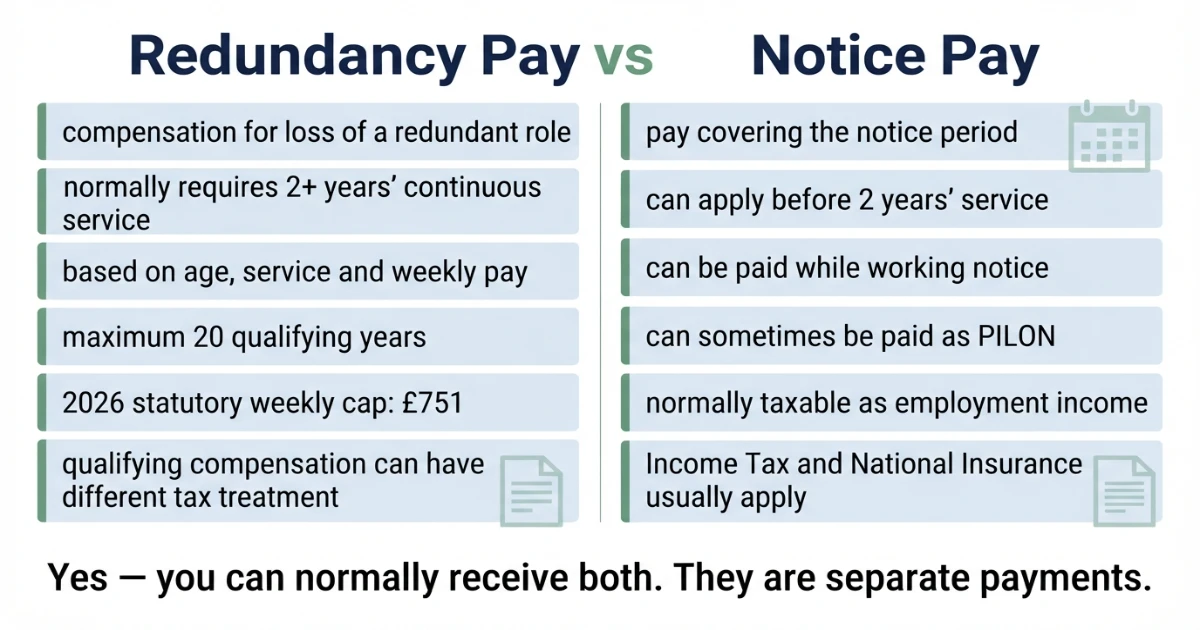
Redundancy Pay
A payment based on qualifying service, age and applicable weekly pay when an eligible employee is made redundant.
- Usually requires at least 2 years’ continuous service.
- Uses age-based statutory multipliers.
- Maximum 20 qualifying years.
- 2026 weekly statutory cap: £751.
Notice Pay
Pay relating to the notice period the employee is entitled to before the employment ends.
- May be received while working notice.
- Can sometimes be paid as PILON.
- Based on notice entitlement and pay.
- Normally taxable as employment income.
What Is Statutory Redundancy Pay?
Statutory redundancy pay is the legal minimum redundancy compensation for an eligible employee.
Employees will normally need:
- employee status;
- at least two years of continuous employment; and
- a genuine redundancy dismissal.
The statutory calculation is based on age, complete years of qualifying service and weekly pay.
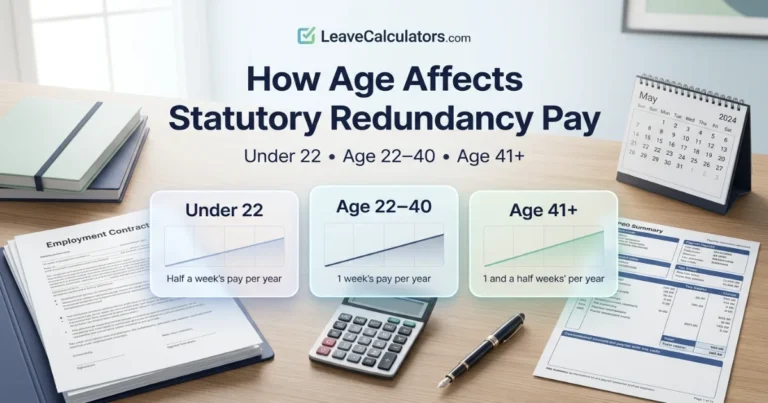
| Age During Qualifying Year | Statutory Entitlement |
|---|---|
| Under 22 | 0.5 week’s pay for each complete qualifying year |
| Age 22 to 40 | 1 week’s pay for each complete qualifying year |
| Age 41 or over | 1.5 weeks’ pay for each complete qualifying year |
What Is Redundancy Notice Pay?
When an employer makes an employee redundant, they must normally give the employee notice before employment ends.
During a normal working notice period, the employee remains employed and continues to receive pay.
The employer may alternatively end employment sooner and pay for the notice period instead, depending on the circumstances.
How Much Redundancy Notice Must an Employer Give?
The statutory minimum notice period depends on continuous service.
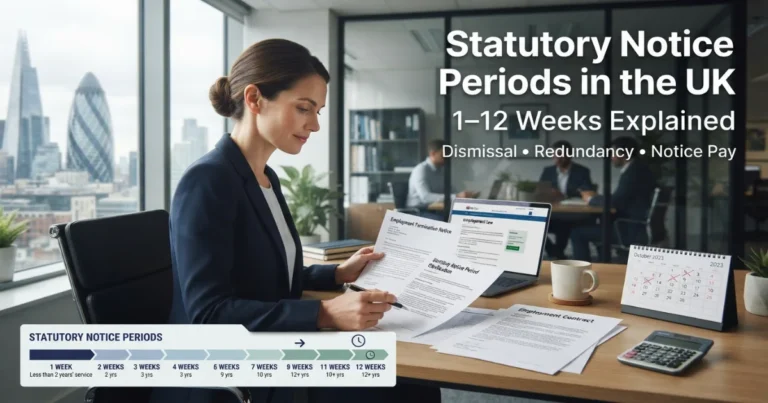
| Length of Service | Minimum Statutory Notice |
|---|---|
| 1 month to less than 2 years | At least 1 week |
| 2 to 12 years | 1 week for each complete year of service |
| 12 years or more | 12 weeks |
Your employment contract can provide a longer notice period than the statutory minimum.
An employer cannot normally reduce a contractual notice entitlement simply because the dismissal is a redundancy.
What Happens If You Work Your Notice Period?
If you work your full notice period, you normally remain employed until the notice ends.
During that period you continue to receive your normal notice pay according to the applicable rules.
When employment ends, you may then receive your statutory or enhanced redundancy payment separately.
An employee has:
- 8 years of continuous service;
- an 8-week statutory notice period;
- statutory redundancy entitlement of £5,000.
The employee works the 8-week notice period and receives normal pay during those 8 weeks.
When employment ends, the employee also receives:
The notice wages and redundancy payment are separate.
What Is Payment in Lieu of Notice?
Payment in lieu of notice is commonly shortened to PILON.
Instead of requiring you to work through the notice period, the employer can end employment earlier and pay an amount relating to the notice you would otherwise have worked.
Where PILON is used, the employee should normally receive the basic pay they would have received during the relevant notice period.
Depending on the contract, other benefits such as pension contributions or private medical cover may also need to be considered.
Can You Get PILON and Redundancy Pay Together?
Yes.
Receiving payment in lieu of notice does not by itself cancel an eligible employee’s statutory redundancy entitlement.
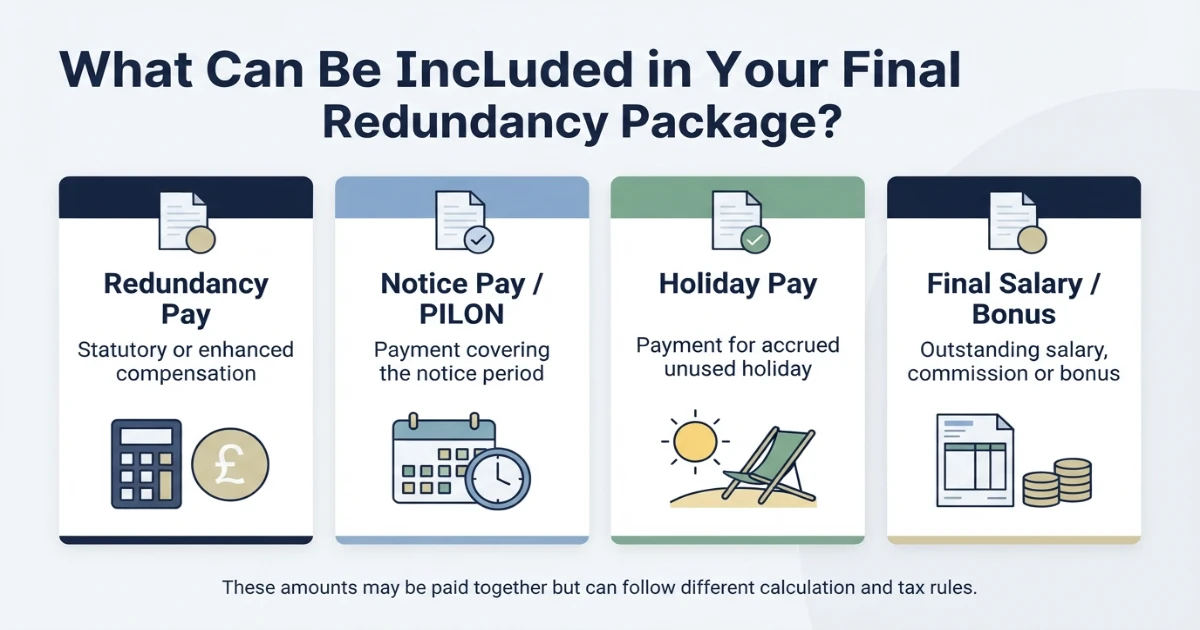
A final package might therefore contain:
- statutory redundancy pay;
- enhanced redundancy compensation;
- PILON;
- unused holiday pay;
- final salary;
- bonus or commission; and
- other contractual benefits.
Each component should be shown separately because the calculation and tax treatment can differ.
Worked Example: Redundancy Pay Plus PILON
Assume an employee:
- has 10 years of continuous service;
- is entitled to 10 weeks’ notice;
- earns £650 per week;
- has statutory redundancy pay of £6,500.
The employer decides that the employee will not work the notice period and instead pays full basic notice pay.
Statutory redundancy pay: £6,500
10 weeks’ PILON:
Combined gross payment before considering other components:
The fact that both payments are received together does not make them the same type of payment.
Are Redundancy Pay and Notice Pay Taxed Differently?
Yes. This is one of the most important distinctions.
Qualifying statutory redundancy and qualifying additional severance compensation can generally benefit from the combined £30,000 termination-payment threshold.
Notice-related earnings are different.
PILON and amounts treated as Post-Employment Notice Pay are normally taxable as employment earnings and are generally subject to Income Tax and National Insurance.
Important: Do not apply the £30,000 redundancy tax threshold automatically to PILON or notice-related earnings.
For a detailed explanation, read: Is Redundancy Pay Taxable in the UK?
What Is Post-Employment Notice Pay?
Post-Employment Notice Pay, or PENP, is a tax concept used when an employee receives less notice than they were entitled to and part of the termination payment effectively represents the basic salary that would have been earned during the unworked notice period.
HMRC treats PENP as employment earnings.
This means it does not simply use the £30,000 termination-payment threshold.
Employers are responsible for determining the relevant taxable notice amount where the PENP rules apply.
What If You Are Put on Garden Leave?
An employer may ask an employee not to attend work during part or all of the notice period while keeping the employment contract in force.
This is commonly called garden leave.
During garden leave, the employee remains employed and is normally paid under the employment contract.
That pay is ordinary employment income and should not be confused with statutory redundancy compensation.
What If You Want to Leave Before the Notice Period Ends?
Be careful if you want to leave early after receiving redundancy notice.
If you simply resign before the employer’s redundancy termination date, the effect on your redundancy entitlement can depend on the circumstances.
There are statutory procedures that can apply where an employee under redundancy notice wants to leave early.
Do not assume that leaving early automatically preserves the full redundancy and notice package.
If another job requires an earlier start date, discuss the proposed leaving date with the employer and get any agreement in writing.
What If Your Contract Gives More Notice?
The statutory notice rules are minimums.
If your employment contract provides a longer notice period, the contractual period can apply.
For example, an employee with six years’ service has a statutory minimum of six weeks’ notice, but a contract might provide three months.
The longer contractual entitlement may therefore be relevant.
How Is Notice Pay Calculated?
GOV.UK says notice pay is generally based on the average amount earned per week over the 12 weeks before the notice period starts.
The precise calculation can depend on:
- whether hours and pay are fixed;
- whether earnings vary;
- contractual overtime;
- commission or bonuses;
- contractual benefits; and
- whether PILON is being used.
Does the £751 Redundancy Cap Also Limit Normal Notice Pay?
Not in an ordinary solvent-employer redundancy calculation.
The £751 weekly cap from 6 April 2026 is the statutory weekly limit used for statutory redundancy pay.
Normal contractual notice pay is a separate entitlement.
However, if the employer is formally insolvent and the employee claims statutory notice pay through the Insolvency Service, the government payment is also subject to the applicable statutory weekly cap.
2026 Redundancy Pay Limits
For qualifying redundancies taking effect on or after 6 April 2026 in Great Britain:
- statutory weekly-pay cap: £751;
- maximum qualifying redundancy service: 20 years; and
- maximum statutory redundancy payment: £22,530.
These are statutory redundancy-pay limits, not a universal cap on every payment received when employment ends.
What If You Receive Enhanced Redundancy Pay?
An enhanced redundancy scheme may provide more than the statutory minimum.
You can still have a separate notice entitlement.
For example, an employer might provide:
- £18,000 enhanced redundancy compensation;
- 8 weeks’ PILON;
- unused holiday pay; and
- final salary.
The fact that all four appear in one settlement does not mean they are subject to the same calculation or tax rules.
Read: Enhanced vs Statutory Redundancy Pay .
Can You Get Holiday Pay as Well?
Yes. Accrued unused holiday can also be payable when employment ends.
Holiday pay is separate from redundancy pay and notice pay.
Unlike qualifying redundancy compensation, holiday pay is normally treated as taxable employment earnings.
What If Your Employer Is Insolvent?
If your employer is formally insolvent and cannot pay what you are owed, eligible employees may be able to claim through the Insolvency Service.
Potential government-backed claims can include:
- statutory redundancy pay;
- certain unpaid wages;
- qualifying holiday pay; and
- statutory notice pay.
These claims are calculated separately.
How Does Statutory Notice Pay Work if the Employer Is Insolvent?
If the employer is insolvent and you did not receive your full statutory notice entitlement, you may be able to make a separate claim for statutory notice pay, sometimes described as loss of notice pay.
The statutory notice period is normally:
- 1 week for each complete year of service between 2 and 12 years; and
- a maximum of 12 weeks for employees with 12 or more years’ service.
Government insolvency payments are subject to the statutory weekly cap, which is £751 for qualifying 2026 claims.
The notice-pay application is normally made after the statutory notice period has ended.
Can You Get Notice Pay if You Have Less Than Two Years’ Service?
Yes, potentially.
This is another important difference between notice pay and statutory redundancy pay.
Statutory redundancy pay normally requires at least two years of continuous employment.
Statutory notice rights can start much earlier.
An employee with between one month and two years of service is normally entitled to at least one week’s notice.
So an employee may have notice-pay rights even though they do not yet qualify for statutory redundancy pay.
Can Both Payments Arrive on the Same Day?
Yes.
An employer can process redundancy pay, PILON, holiday pay and other final amounts together or in separate payments.
The payment date does not determine what each component legally represents.
Check the payslip, settlement statement or redundancy calculation carefully to make sure each payment is clearly identified.
What Should Your Final Redundancy Breakdown Show?
Ask for a clear written breakdown showing:
- statutory redundancy pay;
- enhanced redundancy pay, if applicable;
- notice period;
- notice pay or PILON;
- final salary;
- unused holiday pay;
- bonus or commission;
- deductions for Income Tax and National Insurance; and
- any contractual benefits being paid or continued.
Common Redundancy Pay and Notice Pay Mistakes
1. Assuming redundancy pay includes notice pay
The two are separate entitlements and should normally be identified separately.
2. Assuming notice pay is tax-free
Notice-related earnings such as PILON and PENP are generally taxable as employment earnings.
3. Applying the £751 redundancy cap to all notice pay
The statutory redundancy weekly cap and ordinary contractual notice pay are different concepts.
4. Assuming less than two years means no notice entitlement
An employee may have statutory notice rights even without enough service for statutory redundancy pay.
5. Leaving during the notice period without checking the consequences
If you want to leave early for another job, confirm how that affects your redundancy and notice entitlements before doing so.
How to Check Your Redundancy and Notice Package
- Confirm your continuous employment dates.
- Calculate your statutory redundancy entitlement.
- Check your statutory notice period.
- Read your contract for any longer notice entitlement.
- Confirm whether you will work the notice period or receive PILON.
- Check whether any enhanced redundancy scheme applies.
- Keep notice pay separate from redundancy compensation.
- Check unused holiday, salary, commission and bonuses separately.
- Review the tax and National Insurance deductions on notice-related pay.
- If the employer is insolvent, check which amounts can be claimed through the Insolvency Service.
Calculate Your Statutory Redundancy Pay
Work out your statutory redundancy entitlement first, then add any separate notice, holiday and enhanced redundancy amounts to understand the complete leaving package.
Use the UK Redundancy Pay CalculatorFrequently Asked Questions
Can you get redundancy pay and notice pay together?
Yes. Statutory redundancy pay and notice pay are normally separate entitlements. An eligible employee can receive redundancy pay as well as pay during their notice period or payment in lieu of notice.
Does redundancy pay include notice pay?
No. Redundancy compensation and notice pay are normally separate elements of the final package.
Can you get PILON and redundancy pay?
Yes. Payment in lieu of notice can normally be paid alongside statutory or enhanced redundancy pay where the employee is entitled to both.
Is notice pay tax-free when you are made redundant?
No. Notice-related pay is generally treated as employment earnings and subject to Income Tax and National Insurance.
Is redundancy pay tax-free?
Qualifying statutory redundancy and qualifying termination compensation can generally use the combined £30,000 termination-payment threshold, subject to the detailed tax rules.
How much redundancy notice do I get?
The statutory minimum is normally one week for employees with between one month and two years of service, one week per complete year between two and 12 years, and 12 weeks for employees with at least 12 years’ service.
Can I get notice pay if I have less than two years’ service?
Yes, potentially. Statutory notice rights can apply before an employee has enough service to qualify for statutory redundancy pay.
Can you get redundancy pay, notice pay and holiday pay together?
Yes. A final leaving package can contain redundancy compensation, notice pay, accrued holiday pay and final salary as separate amounts.
Can I claim notice pay if my employer is insolvent?
Eligible employees may be able to claim statutory notice pay from the Insolvency Service if they did not receive the notice entitlement owed to them, subject to the relevant statutory limits and claim process.
Final Answer: Can You Get Redundancy Pay and Notice Pay Together?
Yes. In most qualifying redundancy situations, you can get redundancy pay and notice pay together.
The two payments perform different functions.
Redundancy pay compensates an eligible employee for the loss of their role. Notice pay covers the notice period before the employment ends or compensates the employee where the employer ends employment without requiring the full notice period to be worked.
An employer should therefore normally either pay you while you work your notice or provide the appropriate payment in lieu of notice, while separately paying any statutory or enhanced redundancy entitlement.
The tax treatment is also different. Qualifying redundancy compensation can potentially use the combined £30,000 termination-payment threshold, while notice-related pay is normally taxed as employment earnings.
For qualifying redundancies from 6 April 2026 in Great Britain, statutory redundancy weekly pay is capped at £751, no more than 20 years can count and the maximum statutory redundancy payment is £22,530.
Always ask for a written breakdown showing redundancy pay, notice pay, holiday pay and other final amounts separately so you can check both the calculations and deductions.