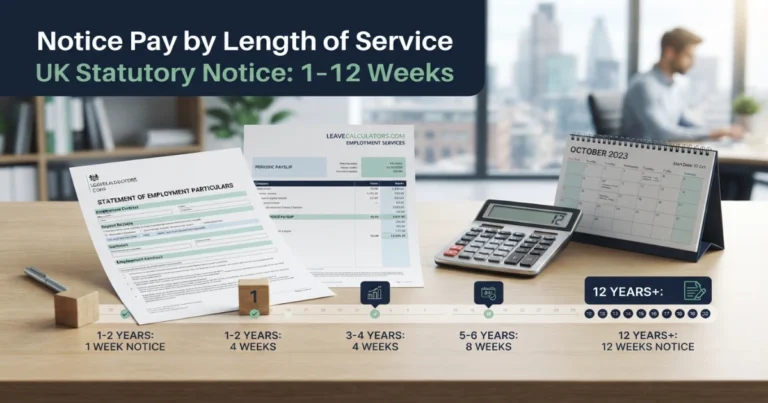
Statutory Notice Periods in the UK Explained
Statutory notice periods in the UK set the legal minimum notice an employee must receive when they are dismissed or made redundant. This guide explains the minimum notice by length of service, contractual notice, redundancy notice, notice pay, PILON, when notice starts and what happens if an employee wants to leave early.
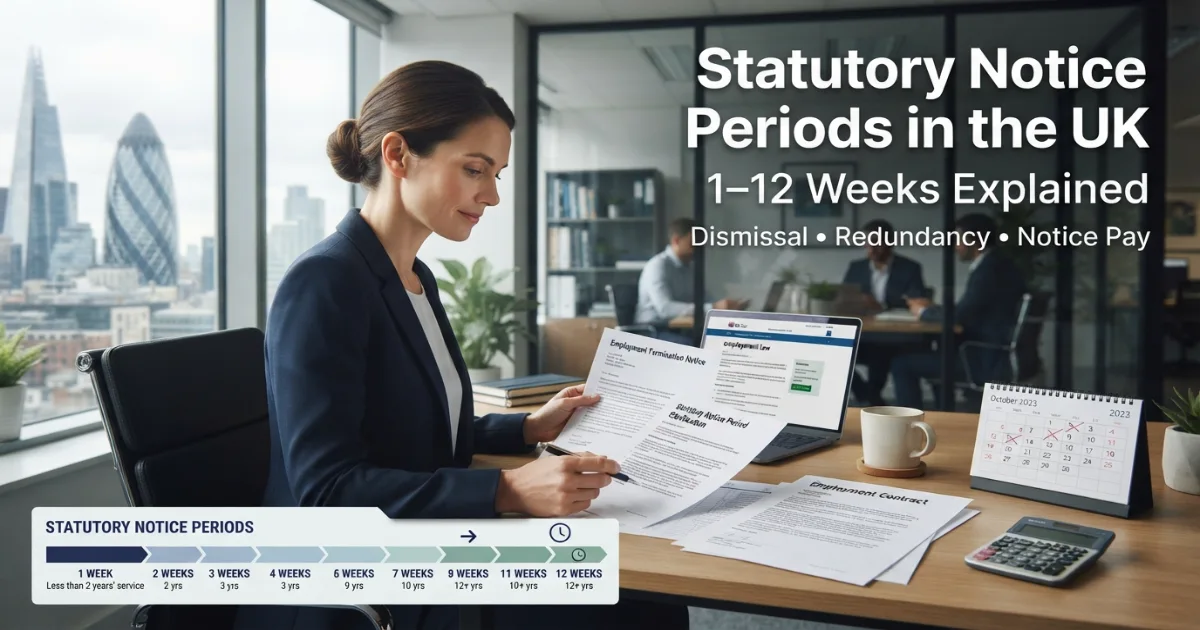
A notice period is the period between an employer confirming that employment will end and the employee’s final employment date.
If you are dismissed or made redundant, UK law provides a minimum notice period once you have completed the required amount of service.
Understanding statutory notice periods in the UK is especially important during redundancy because notice pay is separate from statutory redundancy pay.
An employee can therefore be entitled to both a redundancy payment and pay for their notice period.
What Are the Statutory Notice Periods in the UK?
The statutory minimum depends on how long you have continuously worked for the same employer.
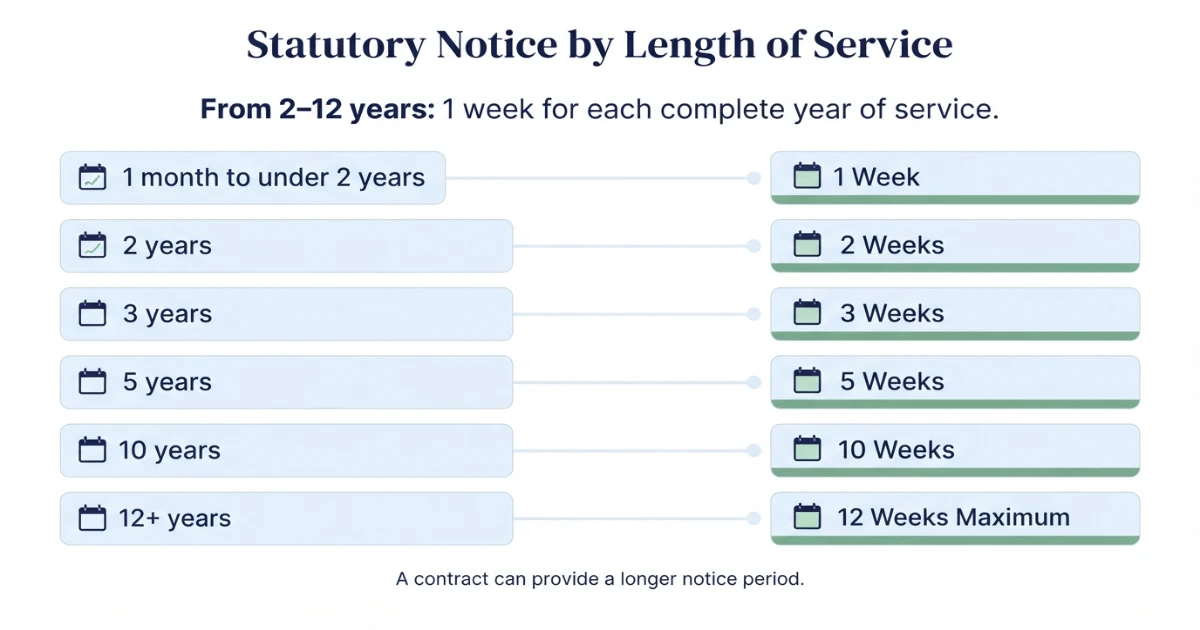
At least one week’s statutory notice.
One week’s notice for each complete year of employment.
Statutory notice is capped at twelve weeks.
| Length of Continuous Service | Minimum Statutory Notice |
|---|---|
| Less than 1 month | No general statutory employer notice entitlement under this rule |
| 1 month to less than 2 years | 1 week |
| 2 complete years | 2 weeks |
| 3 complete years | 3 weeks |
| 5 complete years | 5 weeks |
| 10 complete years | 10 weeks |
| 12 complete years | 12 weeks |
| 15 or 20 years | 12 weeks |
Statutory Notice Period Examples
An employee has worked continuously for 18 months.
The employee has four complete years of service.
The additional nine months do not create a fifth statutory notice week.
Although the employee has 14 years of continuous employment, statutory notice is capped.
Do the Same Notice Rules Apply to Redundancy?
Yes. If an employee is selected for redundancy, the employer must give the employee at least the statutory minimum notice period.
The employer should only give formal redundancy notice once the consultation and selection process has been completed.
The redundancy notice should normally confirm:
- the notice period;
- the employment end date;
- the redundancy payment;
- how the redundancy payment was calculated;
- any holiday pay or other amounts due;
- when payments will be made; and
- the appeal process, where applicable.
Statutory Notice vs Contractual Notice
Statutory notice is the legal minimum.
Contractual notice is the amount specified in your employment contract, written statement or relevant staff policy.
Key rule: An employer can give you more notice than the statutory minimum, but should not normally give you less.
| Service | Statutory Notice | Contractual Notice | Notice Normally Due |
|---|---|---|---|
| 4 years | 4 weeks | 1 month | At least contractual/statutory entitlement, whichever gives the greater lawful entitlement |
| 8 years | 8 weeks | 3 months | 3 months contractual notice |
| 15 years | 12 weeks | 6 weeks | At least 12 weeks statutory notice |
When Does the Notice Period Start?
Your contract might specify when notice starts.
Where it does not, Acas guidance says that if the employer tells the employee in person that they are being dismissed or made redundant, the notice period normally starts the following day.
Where notice is provided only in writing, the timing can depend on when the employee has had a reasonable opportunity to read it.
This can matter where the notice letter is posted, emailed while the employee is away, or received later than the employer expected.
What Is Notice Pay?
Notice pay is the pay you receive for the notice period.
It is separate from statutory redundancy pay.
In a redundancy situation, an employer should generally either:
- keep paying the employee while they work through the notice period; or
- make an appropriate payment instead of requiring them to work notice.
GOV.UK says notice pay is based on average weekly earnings over the 12 weeks before the notice period starts.
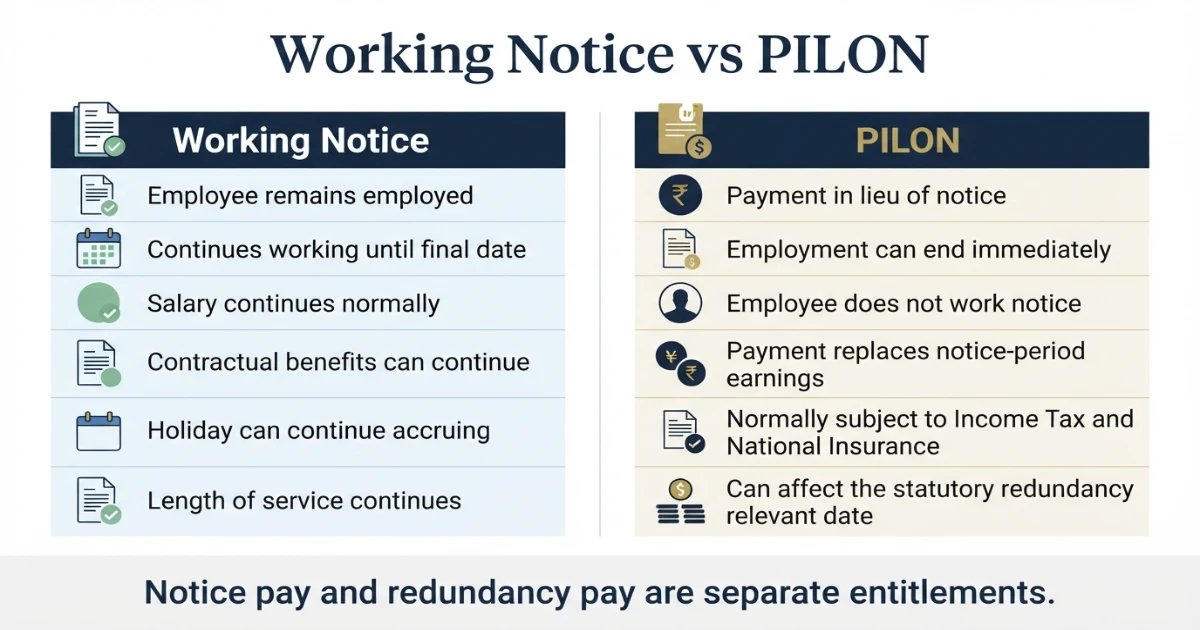
What Happens If You Work Through Your Notice Period?
In many redundancy cases, the employee continues working until the stated termination date.
During this period, the employment relationship continues.
This normally means:
- you continue receiving pay;
- your employment continues until the end date;
- contractual benefits can continue according to their terms;
- holiday can continue accruing; and
- your length of service continues increasing.
What Is Payment in Lieu of Notice?
Payment in lieu of notice is commonly called PILON.
Instead of requiring the employee to continue working for the notice period, the employer ends employment and makes a payment covering the notice period.
Where PILON is provided, the employee generally receives the basic pay they would have received during notice and may also receive contractual extras if the contract provides for them.
PILON is generally subject to Income Tax and National Insurance.
Can PILON Affect Statutory Redundancy Pay?
Yes, in some cases.
For statutory redundancy calculations, the employee’s qualifying service is worked out using a legally defined relevant date.
Acas explains that where an employee receives payment in lieu of statutory notice, the relevant date can be the date their employment would have ended if they had worked the statutory notice period.
This can push the employee over another complete year of qualifying service.
An employee has worked for the employer for: 8 years and 11 months.
Their statutory notice entitlement is: 8 weeks.
If they receive PILON and those eight statutory notice weeks are added when determining the relevant date:
The employee may therefore receive statutory redundancy pay based on 9 qualifying years rather than 8.
Is Garden Leave the Same as PILON?
No.
With garden leave, employment usually continues during the notice period, but the employee is told not to attend work or carry out their normal duties.
With PILON, employment can end immediately and the employee receives a payment instead of working the notice period.
This distinction can affect:
- the employment end date;
- continued benefits;
- holiday accrual;
- restrictive covenants;
- continuity of employment; and
- the redundancy calculation in some cases.
Is Notice Always Required?
Not always.
An employee dismissed for gross misconduct may lose entitlement to statutory notice and notice pay.
Gross misconduct is different from redundancy. A genuine redundancy is not a disciplinary dismissal.
Can You Leave Before Your Redundancy Notice Ends?
Possibly, but this needs care.
An employee might find a new job before the redundancy notice period finishes and want to leave early.
Acas guidance explains that an employee can use counter-notice during the relevant obligatory period to try to leave early while protecting their redundancy-pay entitlement.
The counter-notice should be given in writing.
Simply resigning and leaving without following the relevant process can put statutory redundancy pay at risk.
What Is Counter-Notice?
Counter-notice is notice given by an employee after their employer has already given redundancy notice.
It is used where the employee wants their employment to end earlier than the employer’s stated redundancy date.
The timing matters because the counter-notice normally needs to be given during the obligatory period.
That period is generally the employee’s normal notice period counted backwards from the redundancy dismissal date.
What If the Employer Does Not Want You to Leave Early?
The employer can object to the employee leaving early and may give further written notice requiring the employee to withdraw the counter-notice.
If the employee still leaves, a dispute can arise over redundancy pay.
In some cases, an employment tribunal may need to decide whether all, some or none of the redundancy payment is due.
Is Notice Pay Included in Redundancy Pay?
No. They are separate.
A typical redundancy package might contain:
- statutory redundancy pay;
- enhanced redundancy pay;
- notice pay or PILON;
- final salary;
- unused holiday pay;
- bonus or commission; and
- other contractual benefits.
The employer should provide a clear breakdown rather than simply giving one headline total.
Is Notice Pay Taxable?
Yes, notice-related earnings are normally taxable employment income.
PILON and other notice-related amounts are generally subject to Income Tax and National Insurance.
This is different from qualifying redundancy compensation, which can potentially benefit from the combined £30,000 termination-payment tax threshold.
For a detailed breakdown, see: Is Redundancy Pay Taxable in the UK? .
Do Part-Time Employees Get the Same Statutory Notice?
Yes. Statutory notice is based primarily on qualifying service, not whether the employee works full time or part time.
A part-time employee with eight complete years of service would generally have the same eight-week statutory notice period as a full-time employee with eight complete years.
Their notice pay can differ because their weekly earnings differ.
See: Redundancy Pay for Part-Time Workers .
What About Fixed-Term Employees?
Fixed-term employees can have notice rights depending on how the contract ends and the terms of the agreement.
If a fixed-term employee is dismissed before the agreed end date, notice rights can become especially important.
Where the contract simply expires at its agreed end point, different rules can apply.
The employee’s contract and circumstances should therefore be checked rather than assuming every fixed-term ending requires the same notice.
Do Employees on Probation Get Statutory Notice?
Probation does not automatically remove statutory notice rights.
If an employee has completed at least one month of employment, they can generally be entitled to at least one week’s statutory notice, unless an exception applies.
A contract may provide a longer probationary notice period.
Is Statutory Notice the Same When You Resign?
No. The employer’s notice obligation when dismissing or making someone redundant is different from an employee’s minimum notice when resigning.
When an employee resigns after at least one month of service, the statutory minimum they generally need to give is one week unless their contract requires more.
The 2-to-12-year sliding scale applies to employer notice on dismissal or redundancy, not to an employee’s resignation notice.
Why Does Statutory Notice Stop at 12 Weeks?
The statutory scheme has a maximum employer notice period of 12 weeks.
This means an employee with:
- 12 years;
- 15 years;
- 20 years; or
- 30 years
does not receive more than 12 weeks of statutory notice under the minimum notice rules.
A contract can still provide a longer notice period.
Does the Notice Period Count Toward Continuous Employment?
Where an employee remains employed and works their notice period, employment continues until the notice end date.
That can affect continuous service and sometimes whether another complete year has been reached by the relevant date.
This is particularly important where the employee is close to:
- two years of continuous employment;
- another complete qualifying redundancy year; or
- another service-based entitlement.
Statutory Notice Period vs Statutory Redundancy Pay
| Feature | Statutory Notice | Statutory Redundancy Pay |
|---|---|---|
| Purpose | Minimum notice before employment ends | Compensation for eligible redundancy |
| Minimum service | Generally 1 month | Normally 2 years |
| Main calculation | Based on length of service | Age + service + weekly pay |
| Maximum service effect | 12-week statutory maximum notice | Maximum 20 qualifying years |
| Can both be received? | Yes. Notice pay and redundancy pay are separate entitlements. | |
What If Your Employer Gives Too Little Notice?
If an employer gives less notice than the statutory or contractual minimum, the employee should raise the issue with the employer.
If the issue cannot be resolved, a claim may potentially arise for wrongful dismissal.
Depending on the jurisdiction and circumstances, claims can be brought through an employment tribunal or civil court route.
Strict time limits can apply, so employees should not leave a dispute until much later.
How to Check Your Notice Entitlement
- Confirm that you have employee status.
- Check your employment start date.
- Count your complete years of continuous service.
- Work out the statutory minimum notice period.
- Check your employment contract for longer contractual notice.
- Confirm the date your notice starts.
- Confirm the stated final employment date.
- Check whether you will work notice, receive PILON or be placed on garden leave.
- Check how notice pay will be calculated.
- Keep redundancy pay, notice pay and holiday pay as separate figures.
Also Check Your Redundancy Pay
Notice pay is separate from statutory redundancy pay. Use our calculator to estimate your redundancy entitlement based on age, weekly pay and qualifying service.
Use the UK Redundancy Pay CalculatorFrequently Asked Questions
What is the statutory notice period in the UK?
The statutory minimum is normally one week if you have worked between one month and two years, one week for each complete year if you have worked between two and 12 years, and 12 weeks if you have worked for 12 years or more.
What notice do you get after 5 years of employment?
The statutory minimum employer notice after five complete years is normally five weeks, although your contract may provide more.
What notice do you get after 10 years?
The statutory minimum is normally 10 weeks after 10 complete years of continuous employment.
What is the maximum statutory notice period?
The maximum statutory employer notice period is normally 12 weeks for an employee with 12 years or more of continuous service.
Can an employer give less notice than my contract?
An employer should comply with both statutory and contractual notice rights. If the contract provides more notice than the statutory minimum, the longer contractual entitlement may apply.
Is notice pay separate from redundancy pay?
Yes. Notice pay and statutory redundancy pay are separate entitlements. An eligible employee can receive both.
Is PILON taxable?
Yes. Payment in lieu of notice is generally treated as taxable employment earnings and is normally subject to Income Tax and National Insurance.
Can PILON increase my redundancy service?
Potentially. For statutory redundancy calculations, the relevant date can include the statutory notice period even where the employee receives PILON. This can sometimes move the employee into another complete qualifying year.
Can I leave early during redundancy notice?
Potentially, but leaving incorrectly can affect redundancy-pay entitlement. Employees who want to leave early should consider the counter-notice rules and obtain agreement in writing where possible.
Final Answer: Statutory Notice Periods in the UK Explained
Statutory notice periods in the UK provide the minimum notice an employer must normally give an employee before dismissal or redundancy.
The basic statutory scale is:
- 1 month to under 2 years: at least 1 week;
- 2 to 12 years: 1 week for each complete year;
- 12 years or more: 12 weeks maximum.
Your employment contract can provide more generous notice, but should not normally reduce the statutory minimum.
During redundancy, notice pay remains separate from redundancy compensation. The employee may work through notice or receive payment in lieu of notice depending on the contract and circumstances.
PILON can also affect the relevant date used for statutory redundancy pay and, in some cases, can move an employee into an additional complete qualifying year.
For that reason, anyone being made redundant should check the notice period, final employment date, statutory redundancy calculation and notice-pay breakdown together rather than treating them as unrelated figures.