Redundancy Pay for Part-Time Workers
Redundancy pay for part-time workers follows the same core statutory rules as for full-time employees. The main difference is that a part-time employee’s weekly redundancy pay is normally based on their own weekly earnings. This guide explains eligibility, the two-year service rule, weekly-pay calculations, fair selection and the 2026 statutory limits.

If you work part time and your role is being made redundant, you do not lose your statutory redundancy rights simply because you work fewer hours than a full-time colleague.
UK law protects part-time workers from being treated less favourably than comparable full-time workers merely because they work part time.
That principle also matters during redundancy. An employer should not select someone for redundancy simply because they are a part-time employee.
For statutory redundancy pay, the central questions are normally whether you are an employee, whether you have enough continuous service, how old you were during each qualifying year and what your applicable weekly pay is.
Can Part-Time Workers Get Redundancy Pay?
Yes.
A part-time employee can qualify for statutory redundancy pay in the same way as a full-time employee.
You will normally need to:
- have employee status;
- have at least two years of continuous employment;
- be dismissed because your role is genuinely redundant; and
- meet the other normal statutory conditions.
There is no special rule saying you must work a minimum number of hours per week to qualify for statutory redundancy pay.
Part-Time Employee vs Part-Time Worker
The word worker is often used casually, but employment status matters for statutory redundancy rights.
A person with employee status can potentially qualify for statutory redundancy pay.
Someone who has only the legal status of a worker, rather than an employee, will not normally have the same statutory redundancy entitlement.
Key point: Being part time does not stop you qualifying. The important issue is whether you are legally an employee and satisfy the normal redundancy conditions.
Do Part-Time Workers Need Two Years of Service?
Yes, normally.
Statutory redundancy pay generally requires at least two complete years of continuous employment.
The fact that you work 10, 20 or 25 hours a week rather than full-time hours does not mean your service counts more slowly.
Example
If you have worked 20 hours per week for the same employer for six continuous years, you normally have six years of service for redundancy purposes, not three years simply because your hours were roughly half of a full-time role.
Do Part-Time Employees Use the Same Redundancy Formula?
Yes. Eligible part-time and full-time employees use the same statutory age-and-service formula.
| Age During Qualifying Year | Statutory Entitlement |
|---|---|
| Under 22 | 0.5 week’s pay for each complete qualifying year |
| Age 22 to 40 | 1 week’s pay for each complete qualifying year |
| Age 41 or over | 1.5 weeks’ pay for each complete qualifying year |
A maximum of 20 complete years can be used in the statutory calculation.
How Is Weekly Pay Worked Out for a Part-Time Worker?
For statutory redundancy purposes, weekly pay is generally based on the employee’s own weekly earnings.
GOV.UK states that weekly pay is the average amount earned per week over the 12 weeks before the day the employee received redundancy notice.
That means a part-time employee is not normally given an artificial full-time salary for the statutory calculation.
Instead, their actual applicable weekly earnings are used, subject to the statutory weekly cap.
A part-time employee works 20 hours per week and earns: £320 per week.
They have 8 qualifying years, all in the age 22–40 band.
Estimated statutory redundancy pay: £2,560.
Why Can Part-Time Redundancy Pay Be Lower Than Full-Time Pay?
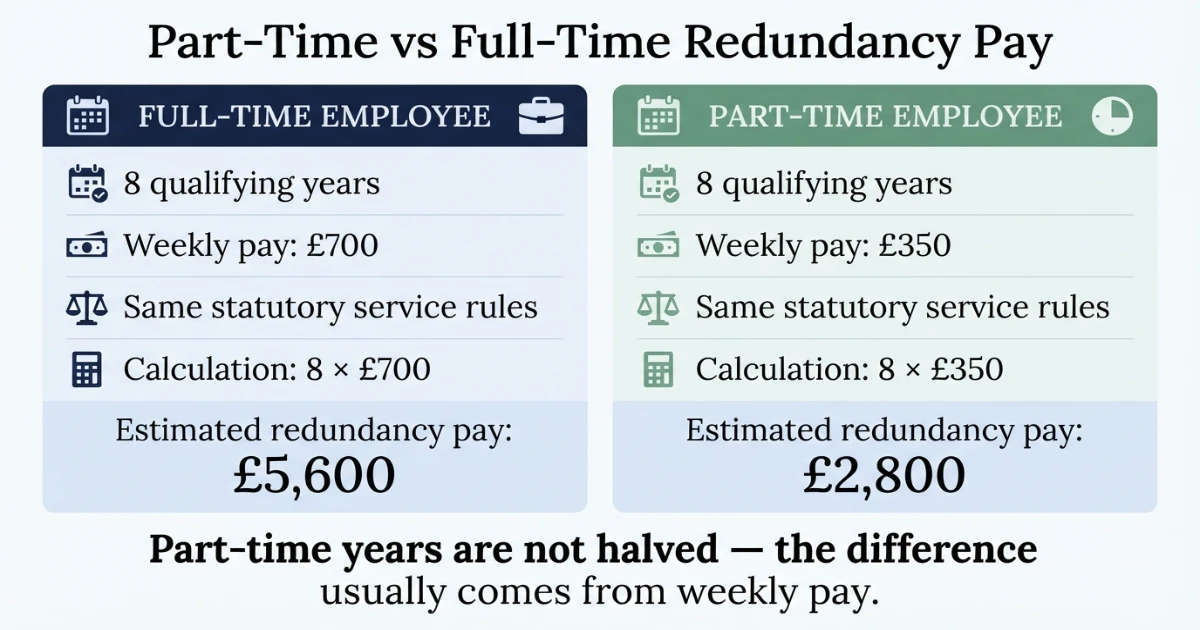
Part-time employees do not receive a smaller age or service multiplier merely because they work part time.
The difference usually comes from weekly earnings.
Full-Time Employee
Weekly pay: £700
8 qualifying years at one week’s pay:
8 × £700 = £5,600
Part-Time Employee
Weekly pay: £350
8 qualifying years at one week’s pay:
8 × £350 = £2,800
Both employees receive credit for eight complete years. The payment differs because their applicable weekly earnings differ.
Does the £751 Weekly Pay Cap Apply to Part-Time Workers?
Yes.
For redundancies taking effect on or after 6 April 2026 in Great Britain, statutory weekly pay is capped at £751.
This limit applies regardless of whether an eligible employee works full time or part time.
Most part-time employees whose weekly earnings are below £751 will simply use their lower applicable weekly figure.
| Part-Time Weekly Pay | Weekly Figure Used |
|---|---|
| £220 | £220 |
| £380 | £380 |
| £600 | £600 |
| £751 | £751 |
| £850 | £751 |
What Is the Maximum Statutory Redundancy Pay in 2026?
For qualifying redundancies from 6 April 2026 in Great Britain:
- weekly pay cap: £751;
- maximum qualifying service: 20 years;
- maximum age multiplier: 1.5 weeks per qualifying year;
- maximum statutory payment: £22,530.
Maximum statutory formula:
20 × 1.5 × £751 = £22,530
A part-time employee could theoretically reach the statutory maximum if their applicable weekly pay is at least the statutory cap and all other conditions produce the maximum calculation.
What If Your Hours Changed Before Redundancy?
This can be important.
If you moved from full-time to part-time work, increased your hours, reduced your hours or had variable working patterns, your current or recent weekly earnings may differ significantly from earlier periods of employment.
The statutory calculation does not normally take every historical salary and apply it separately to each year of service.
Instead, the applicable week’s pay is generally determined under the statutory weekly-pay rules at the time of redundancy.
Where earnings vary, the 12-week average can become especially important.
Example: Recently reduced hours
Suppose an employee has worked for the same employer for 10 years but recently reduced their normal working hours.
The 10 years of continuous service may still count, subject to the 20-year maximum. However, the weekly-pay figure used in the statutory calculation can reflect the applicable recent-pay rules rather than the salary earned many years earlier.
What If a Part-Time Worker Has Variable Hours?
Some part-time employees do not work exactly the same number of hours each week.
Where weekly earnings vary, GOV.UK’s redundancy guidance generally uses an average over the 12 weeks before redundancy notice.
This can be relevant for employees whose pay changes because of:
- different weekly hours;
- shift patterns;
- contractual overtime;
- commission;
- certain bonuses; or
- other contractual pay arrangements.
Can an Employer Select You for Redundancy Because You Work Part Time?
An employer should not select an employee for redundancy simply because they work part time.
Government guidance specifically lists being a part-time employee as an automatically unfair reason for redundancy selection.
An employer can use fair redundancy criteria such as:
- skills;
- qualifications;
- aptitude;
- performance;
- attendance, where used lawfully; and
- disciplinary record.
But part-time status itself should not be used as the reason to select someone for redundancy.
Important: A genuine business need to remove a particular role can still result in a part-time employee being redundant. The problem arises where the employee is selected simply because they work part time.
Part-Time Workers and Less Favourable Treatment
Part-time workers are protected from being treated less favourably than comparable full-time workers simply because they work fewer hours.
Government guidance says this principle applies to areas including:
- pay rates;
- holidays;
- pension opportunities;
- training;
- promotion and transfer opportunities; and
- selection for redundancy.
Some benefits can legitimately be applied on a pro-rata basis where that is appropriate.
Is Redundancy Pay Simply Pro-Rated for Part-Time Workers?
Not in the sense of taking a full-time redundancy payment and automatically halving it.
The statutory calculation uses the part-time employee’s own qualifying years, age multipliers and applicable weekly pay.
Because weekly earnings are often lower for part-time employees, the result can look similar to a pro-rata amount, but the underlying calculation is still the normal statutory redundancy formula.
Does Moving From Full-Time to Part-Time Break Continuous Service?
Normally, simply changing from full-time to part-time hours with the same employer does not by itself mean your employment has ended and restarted.
If continuous employment remains intact, earlier qualifying years can continue to count toward the redundancy calculation, subject to the usual rules and 20-year maximum.
This can be particularly important for employees who spent many years full-time and later reduced their hours.
Worked Example: Long-Service Part-Time Employee
Assume an employee:
- is 50 years old;
- has 12 qualifying years all falling in the age 41+ band;
- works part time;
- has applicable weekly pay of £420.
Estimated statutory redundancy pay: £7,560.
What If Your Service Crosses Different Age Bands?
Part-time employment does not change how age bands work.
Each complete qualifying year is allocated to the age band applying during that year.
For example, an employee with:
- 5 qualifying years aged 22–40; and
- 4 qualifying years aged 41+
would receive:
Those 11 weeks are then multiplied by the applicable weekly-pay figure.
For more detail, read: How Age Affects Statutory Redundancy Pay .
Can Part-Time Workers Get Enhanced Redundancy Pay?
Yes, depending on the employer’s scheme.
An employer can provide redundancy terms that are more generous than the statutory minimum.
A part-time employee should not automatically be excluded from an enhanced redundancy scheme merely because they work part time.
However, some elements of an enhanced scheme may legitimately be calculated in proportion to salary or working hours, depending on the scheme terms and applicable law.
See: Enhanced vs Statutory Redundancy Pay .
Part-Time Work vs Short-Time Working
Permanent part-time employment should not be confused with short-time working.
A permanent part-time employee has agreed working hours that are lower than a comparable full-time role.
Short-time working usually means an employer temporarily provides less work than the employee’s normal contractual arrangement.
Separate statutory rules can allow eligible employees to claim redundancy after qualifying periods of lay-off or short-time working.
GOV.UK states that a claim may potentially arise after:
- 4 or more consecutive weeks of qualifying lay-off or short-time working; or
- 6 or more qualifying weeks within a 13-week period, subject to the statutory rules.
Do Part-Time Employees Get Redundancy Notice?
Yes. Part-time status does not remove the normal statutory notice entitlement.
The statutory minimum notice period generally depends on continuous service:
- at least one week if employed between one month and two years;
- one week for each complete year if employed between two and 12 years; and
- 12 weeks if employed for 12 years or more.
A contract can provide more notice than the statutory minimum.
What Happens to Unused Holiday Pay?
Unused accrued holiday pay is separate from statutory redundancy pay.
A part-time employee’s holiday entitlement is commonly calculated in relation to their working pattern, but any qualifying accrued holiday owed when employment ends should be considered separately from the redundancy payment.
Is Part-Time Redundancy Pay Taxable?
The tax rules do not create a separate part-time redundancy regime.
Qualifying redundancy and termination compensation can generally benefit from the combined £30,000 termination-payment threshold.
Salary, holiday pay, bonuses and notice-related earnings can be taxed separately.
For a detailed explanation, see: Is Redundancy Pay Taxable in the UK? .
What If the Employer Is Insolvent?
If an employer is formally insolvent and cannot pay what is owed, eligible part-time employees can potentially claim statutory amounts from the National Insurance Fund through the Insolvency Service.
Part-time status does not remove eligibility.
Potential payments can include:
- statutory redundancy pay;
- certain unpaid wages;
- qualifying holiday pay; and
- statutory notice-related compensation.
Statutory limits apply to these payments.
Common Part-Time Redundancy Pay Mistakes
1. Assuming part-time workers do not qualify
Eligible part-time employees can qualify for statutory redundancy pay.
2. Halving years of service because hours are part time
Continuous service is based on employment duration, not a full-time-equivalent conversion of years.
3. Using a full-time colleague’s salary
The statutory calculation normally uses the part-time employee’s own applicable weekly pay.
4. Assuming selection for redundancy can be based on part-time status
Part-time status itself should not be used as an unfair redundancy selection criterion.
5. Confusing permanent part-time work with short-time working
These are different arrangements and can trigger different legal rules.
How to Check Your Part-Time Redundancy Pay
- Confirm that you have employee status.
- Check your continuous employment start and end dates.
- Count complete qualifying years, up to the 20-year maximum.
- Identify your age during each qualifying year.
- Work out your applicable weekly pay.
- If pay varies, check the relevant 12-week average.
- Apply the £751 statutory cap where necessary.
- Compare the statutory amount with any enhanced employer scheme.
- Keep salary, holiday and notice pay separate from redundancy compensation.
- Check that your redundancy selection was fair and not based simply on part-time status.
Calculate Your Part-Time Redundancy Pay
Use the UK Redundancy Pay Calculator with your own weekly pay, age and qualifying service to estimate your statutory entitlement.
Use the UK Redundancy Pay CalculatorFrequently Asked Questions
Do part-time workers get redundancy pay?
Yes. A part-time employee can qualify for statutory redundancy pay if they meet the normal eligibility conditions, including usually having at least two years of continuous employment.
Do part-time workers need two years of service for redundancy pay?
Normally, yes. Statutory redundancy pay generally requires at least two years of continuous employment.
Are part-time years counted as full years for redundancy?
Yes. A complete year of continuous part-time employment is normally one year of qualifying service. It is not reduced simply because fewer weekly hours were worked.
Is part-time redundancy pay calculated pro rata?
The statutory calculation uses the employee’s own age, complete qualifying years and applicable weekly pay. Lower weekly earnings can produce a lower payment, but service years are not converted into full-time-equivalent years.
What weekly pay is used for part-time redundancy?
Weekly pay is generally based on the employee’s average weekly earnings over the 12 weeks before redundancy notice, subject to the statutory weekly limit.
What is the redundancy weekly pay cap in 2026?
For qualifying redundancies from 6 April 2026 in Great Britain, statutory weekly pay is capped at £751.
Can I be made redundant just because I work part time?
Part-time status itself should not be used as the reason for redundancy selection. Employers must use fair selection criteria and should not treat part-time workers less favourably simply because they work part time.
Does moving from full-time to part-time reset my redundancy service?
Normally, changing working hours with the same employer does not by itself break continuous employment. The exact circumstances should still be checked if there was a contractual break or termination.
Can part-time workers get enhanced redundancy pay?
Yes, where the employer’s enhanced or contractual redundancy scheme applies. The scheme may calculate some elements according to salary or working hours.
Final Answer: Redundancy Pay for Part-Time Workers
Redundancy pay for part-time workers follows the same core statutory framework as redundancy pay for full-time employees.
Part-time employees normally need at least two years of continuous employment, and each complete year of service counts as a complete year regardless of the number of weekly hours worked.
The final payment can still be lower than that of a comparable full-time employee because statutory redundancy pay uses the individual’s applicable weekly earnings.
For qualifying redundancies from 6 April 2026 in Great Britain, weekly pay is capped at £751, no more than 20 years of service can count and the maximum statutory redundancy payment is £22,530.
Employers should also select employees for redundancy fairly. Part-time status itself should not be used as the reason for selecting an employee for redundancy.
If your hours have recently changed or your weekly earnings vary, check the weekly-pay calculation carefully because the 12-week averaging rules can materially affect the final result.