Continuous Employment and Redundancy Pay
Your length of continuous employment can decide whether you qualify for statutory redundancy pay and how much you receive. This guide explains the UK rules, including the two-year qualifying period, breaks that still count, TUPE transfers, family leave, sickness and the 20-year statutory service limit.
Updated for UK redundancy rules and 2026 statutory limits.
When redundancy is announced, employees often focus first on salary, age and the statutory weekly pay cap. But another factor comes before all of those: continuous employment.
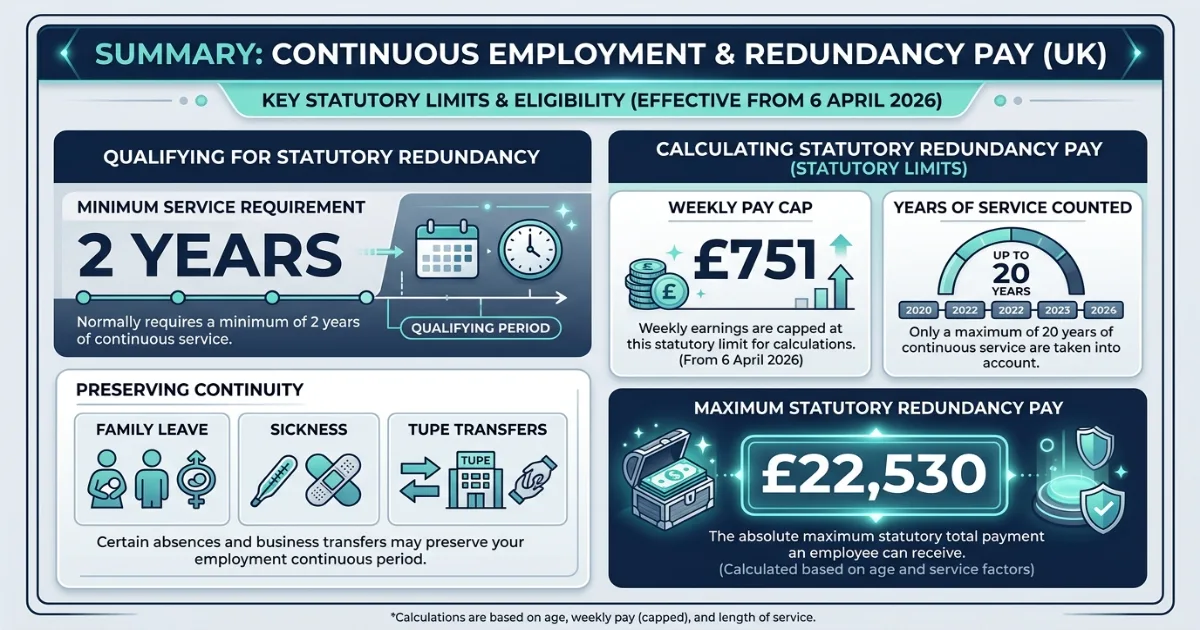
In most cases, you need at least two years of continuous service with your employer before you qualify for statutory redundancy pay. Your total qualifying service then helps determine how many weeks of redundancy pay you receive, subject to the statutory maximum of 20 years.

Continuous Employment and Redundancy Pay Explained
Continuous employment means employment that has continued without a break that legally ends the employment relationship. It usually starts on the employee’s first day of work.
This matters because statutory redundancy rights are closely linked to length of service. An employee who has worked continuously for less than two years will not normally qualify for statutory redundancy pay, while an employee with two or more qualifying years may be entitled to a payment based on age, service and weekly pay.
Continuous service is also relevant to other employment rights, so it should not be treated as simply the number of months or years since your most recent contract was signed.
The two-year continuous employment rule
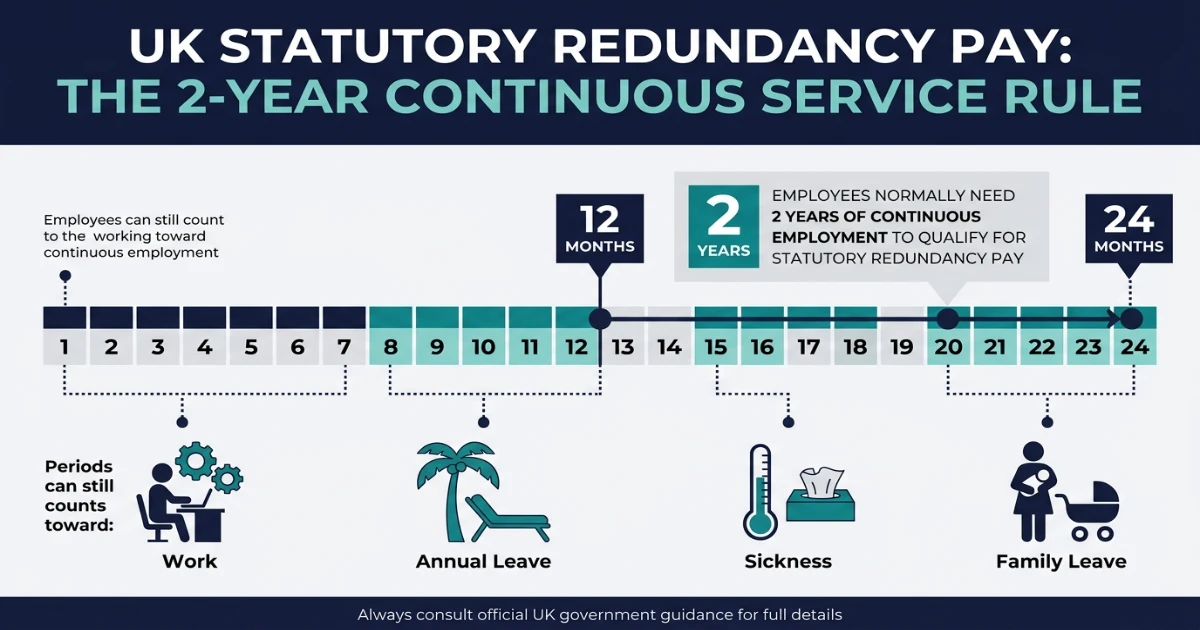
For statutory redundancy pay, an employee normally needs at least two years of continuous employment with the employer.
If your employment ends because of redundancy after only 18 months of continuous service, you will not normally have a statutory right to redundancy pay. If you reach two complete years, the statutory scheme can apply, provided you also satisfy the other eligibility requirements.
Example: 1 year and 11 months
An employee has worked continuously for 1 year and 11 months when their employment ends. In ordinary circumstances, they have not completed the two-year qualifying period and would not receive statutory redundancy pay.
Example: 2 years and 2 months
An employee has worked continuously for 2 years and 2 months. They have passed the two-year qualifying threshold. The statutory calculation is then based on complete qualifying years, age and weekly pay.
An employer can still choose to provide redundancy pay to someone with less than two years of service under a contractual or enhanced redundancy scheme.
What normally counts as continuous employment?
Continuous employment can include more than days physically spent at work. UK rules preserve continuity during several common absences and employment situations.
Periods that can normally count include:
- sickness absence;
- annual leave;
- maternity leave;
- paternity leave;
- parental leave;
- adoption leave;
- employment overseas with the same employer;
- temporary lay-offs;
- certain employer lockouts;
- some transfers between associated employers;
- business transfers where continuity is legally preserved; and
- certain periods linked to reinstatement following unfair dismissal.
The key point is that being away from your normal workplace does not automatically break continuous employment.
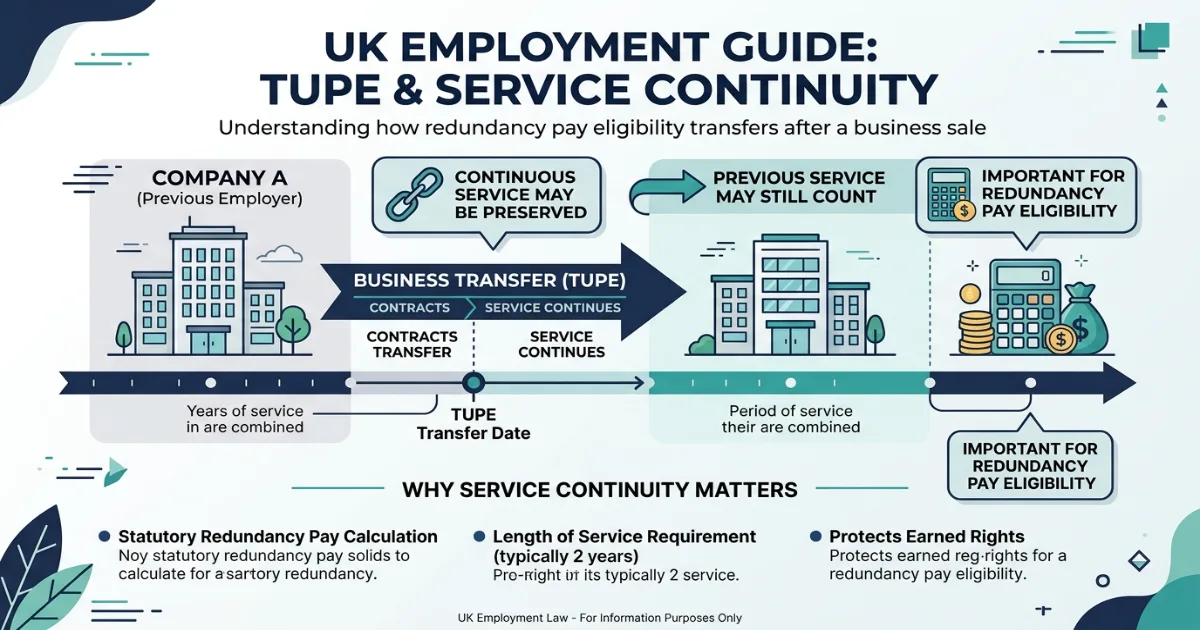
Does sickness break continuous employment?
Normally, no. A period of sickness can count toward continuous employment.
This can be particularly important for someone facing redundancy after a long period of ill health. For example, an employee who has worked for 18 months and then spends another 8 months on sick leave may still have more than two years of continuous employment by the time their employment ends, depending on the circumstances.
Sickness may affect pay or other employment issues, but it does not automatically reset the continuous-service clock.
Does maternity, paternity or parental leave count?
Yes. Statutory family leave does not normally break continuous employment.
This includes maternity, paternity, parental and adoption leave. An employee can therefore continue building qualifying service for redundancy purposes while on these forms of leave.
Example: maternity leave and redundancy
An employee has worked for 3 years before starting maternity leave and is made redundant after returning. The period of maternity leave does not normally wipe out or restart their continuous service. Their qualifying service continues from the original employment start date.
Does annual leave affect continuous employment?
No. Taking paid annual leave does not break continuous employment.
This sounds obvious, but it matters when someone is close to an important service threshold. A holiday does not interrupt the employment relationship and does not restart the employee’s service date.
What about temporary lay-offs or short-time working?
A temporary lay-off does not necessarily break continuous employment. This can matter because employees who are laid off for qualifying periods may in some circumstances be able to claim statutory redundancy pay.
Government rules allow eligible employees to make a redundancy claim following certain periods of lay-off or short-time working, provided the statutory conditions are met.
So an employee should not assume that weeks without normal work automatically erase previous continuous service.
Does TUPE reset continuous employment?
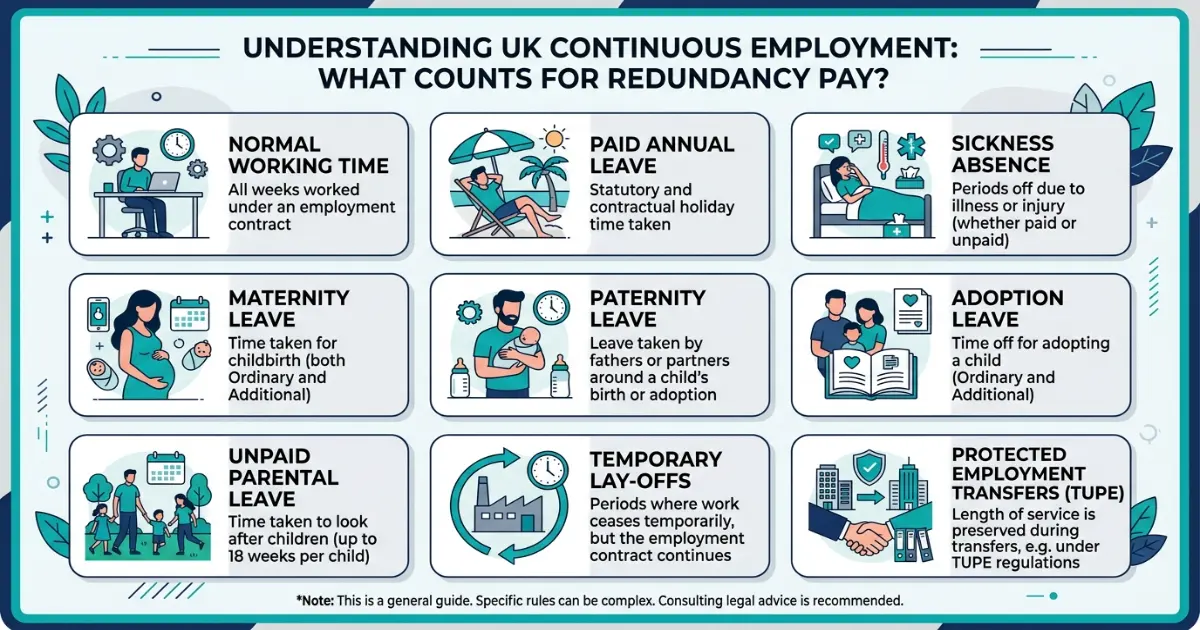
Normally, no. Where a business transfers and employment continuity is legally preserved, the employee’s service can carry across to the new employer.
This is especially important in outsourcing, business sales and service-provider changes. An employee may technically have a new employer but still keep the original continuous employment date for statutory purposes.
Example: service before and after a business transfer
An employee works for Company A for 6 years. The business transfers to Company B and the employee continues in the same role with continuity preserved. Two years later, Company B makes the role redundant.
The employee may have 8 years of continuous service rather than only the 2 years worked under Company B’s name.
This can arise within a group of connected companies. The legal position depends on the relationship between the organisations and how the transfer occurred, so employees should check their contract, transfer documents and employment history rather than assuming a move within a group reset their service.
Signing a new written contract, receiving a promotion or changing job title does not necessarily create a fresh period of employment. The important question is whether the employment relationship remained continuous.
For example, moving from one permanent role to another within the same company would not normally reset continuous service simply because a new contract was issued.
The label “fixed-term” does not by itself prevent statutory redundancy rights.
What can break continuous employment?
A genuine termination of employment followed by a sufficiently separate period before re-employment can break continuity, unless a statutory rule preserves it.
That is why gaps between contracts or periods away from work should be examined carefully. The legal rules around continuity can be more complicated than simply counting calendar days.
Questions to check include:
- Was the employment contract actually terminated?
- Was there an agreement to return?
- Was the employee temporarily laid off rather than dismissed?
- Was the business transferred?
- Did the employee move between associated employers?
- Was the absence protected by law?
If your redundancy entitlement depends on whether a specific gap broke continuity, professional or Acas guidance may be worth obtaining.
For example, if an employee remains employed throughout a strike, the employment relationship can remain continuous even though the relevant strike days are excluded when calculating the length of service.
How many years of continuous employment count for redundancy pay?
Even if you have worked continuously for more than 20 years, statutory redundancy pay only uses a maximum of 20 qualifying years.
| Total continuous service | Maximum service used for statutory redundancy |
|---|---|
| 1 year 11 months | Normally no statutory entitlement |
| 5 years | 5 qualifying years |
| 12 years | 12 qualifying years |
| 20 years | 20 qualifying years |
| 27 years | 20 qualifying years |
For employees with more than 20 years of service, the calculation generally works back from the relevant termination date and uses the most recent 20 qualifying years.
Continuous service and age bands
Length of service tells you how many qualifying years may be included, but your age during those years determines the multiplier used.
| Age during each qualifying year | Statutory multiplier |
|---|---|
| Under 22 | 0.5 week’s pay |
| 22 to 40 | 1 week’s pay |
| 41 or over | 1.5 weeks’ pay |
This means two employees with the same length of continuous employment can receive different statutory redundancy payments if their qualifying years fall into different age bands.
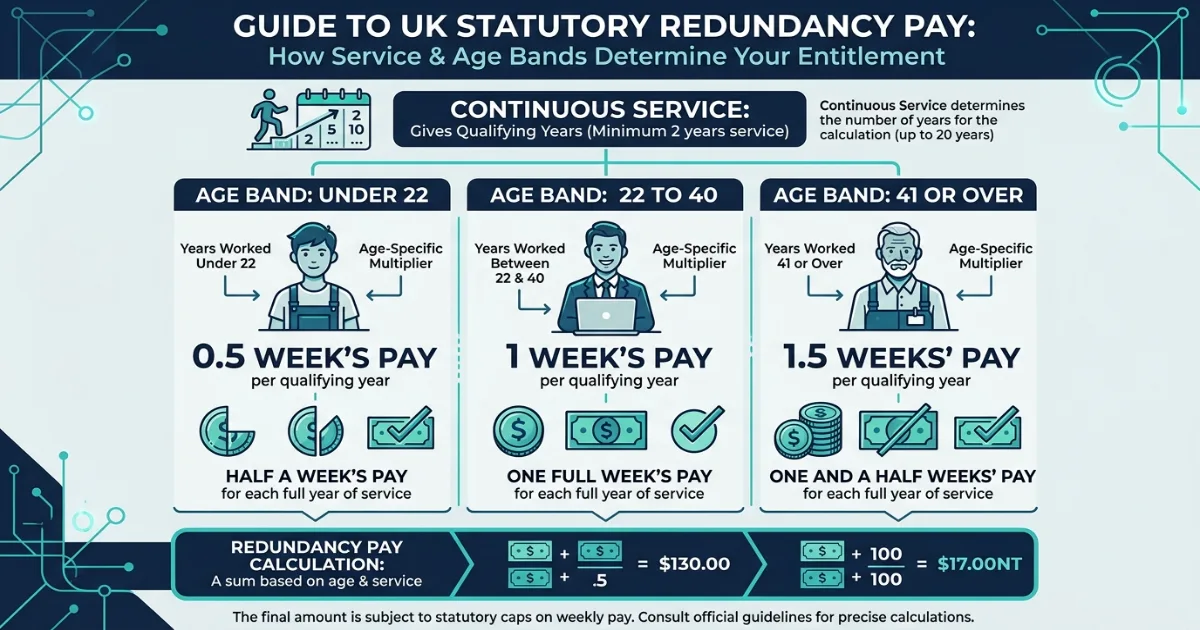
How continuous employment affects your redundancy calculation
The basic process is:
- Confirm whether you have at least two years of continuous employment.
- Work out how many complete qualifying years count, up to 20.
- Apply the relevant age multiplier to each qualifying year.
- Apply your qualifying weekly pay, subject to the statutory cap.
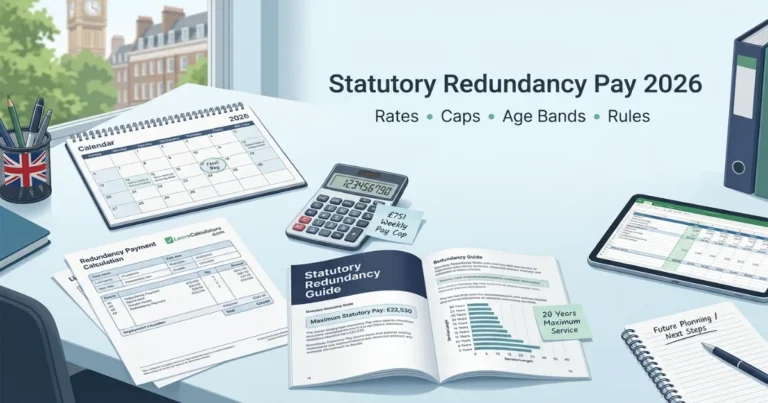
For redundancies taking effect on or after 6 April 2026, the statutory weekly pay cap in Great Britain is £751, and the maximum statutory redundancy payment is £22,530.
Example: 8 years of continuous employment
Assume an employee has 8 complete years of continuous service, all of which fall within the 22-to-40 age band, and earns £620 per week.
8 × 1 week × £620 = £4,960
Example: 12 years of service with different age bands
Assume an employee has 12 qualifying years and crossed age 41 during that period. The years before age 41 can attract one week’s pay, while later qualifying years can attract 1.5 weeks’ pay.
The service remains continuous, but the statutory multiplier changes as the employee moves through the age bands.
Do partial years of continuous employment count?
The statutory redundancy calculation is based on complete years of qualifying employment.
If you have worked for 7 years and 9 months, the basic statutory calculation normally uses seven complete years. However, the relevant termination date and statutory notice rules can sometimes affect the final service calculation.
This is particularly important where an employer ends employment immediately and makes a payment in lieu of notice.
Can notice affect your continuous service date?
Yes, in some situations the statutory notice period can affect the “relevant date” used when calculating redundancy service.
This can matter when an employee is just short of completing another full year of service. Acas guidance explains that where an employee receives payment in lieu of notice, the statutory notice period may still need to be considered when working out the relevant date for redundancy pay.
Enhanced redundancy schemes and continuous service
Employers can offer more generous redundancy terms than the statutory minimum.
An enhanced scheme may:
- pay employees with less than two years of service;
- count more years than the statutory formula would use;
- apply a more generous number of weeks per year;
- use actual salary instead of the statutory weekly cap; or
- recognise service that the statutory scheme might not count in the same way.
The employment contract, redundancy policy, collective agreement or staff handbook should explain how the employer’s scheme treats continuous service.
Common continuous-employment mistakes in redundancy
1. Assuming maternity leave created a break
Maternity and other qualifying family leave normally preserve continuous employment.
2. Counting only time with the latest company name
If the business transferred or you moved between associated employers, earlier service may still count.
3. Assuming a new contract reset service
A promotion or new written contract does not automatically restart continuous employment.
4. Counting every calendar year automatically
Statutory redundancy pay uses complete qualifying years and a maximum of 20 years.
5. Ignoring statutory notice
The relevant date can sometimes extend beyond the employee’s final day at work for redundancy calculation purposes.
6. Confusing statutory and enhanced redundancy rules
An employer’s enhanced scheme can use different service rules from the statutory minimum.
Estimate your statutory redundancy pay
Once you know your qualifying continuous service, age and weekly pay, use our UK Redundancy Pay Calculator to estimate your statutory payment.
Use the UK Redundancy Pay CalculatorContinuous employment and redundancy pay: quick summary
| Rule | What it means |
|---|---|
| Minimum continuous service | Normally at least 2 years |
| Maximum service used | 20 qualifying years |
| Sickness | Normally does not break continuity |
| Maternity, paternity, parental and adoption leave | Normally preserve continuity |
| Annual leave | Does not break continuity |
| TUPE/business transfer | Earlier service can normally remain continuous |
| Temporary lay-off | Can still count toward continuous employment |
| 2026 weekly pay cap | £751 from 6 April 2026 in Great Britain |
| 2026 maximum statutory redundancy pay | £22,530 |
Frequently asked questions
How much continuous employment do you need for redundancy pay?
You normally need at least two years of continuous employment to qualify for statutory redundancy pay.
Does sickness break continuous employment?
Normally, no. Sickness absence can count toward continuous employment.
Does maternity leave count toward redundancy service?
Yes. Maternity leave normally counts as part of continuous employment, as do paternity, parental and adoption leave.
Does TUPE reset my employment start date?
Normally no. Where employment transfers with continuity preserved, service with the previous employer can continue to count.
Does a promotion or new contract reset continuous service?
Not usually. If the employment relationship remains continuous, a change of role or new contract does not automatically restart service.
Can more than 20 years of continuous employment count?
You can have more than 20 years of continuous employment, but statutory redundancy pay only uses a maximum of 20 qualifying years.
Do partial years count toward statutory redundancy pay?
The statutory formula is generally based on complete qualifying years, although statutory notice can sometimes affect the relevant termination date.
Final takeaway
Continuous employment and redundancy pay are closely connected. Before calculating your statutory payment, first establish the date your continuous employment began and whether any apparent breaks actually ended continuity.
In most cases, employees need at least two years of continuous service to qualify for statutory redundancy pay. Sickness, annual leave, maternity and other family leave, temporary lay-offs and certain business transfers can all preserve continuous employment.
Once eligibility is established, statutory redundancy pay uses complete qualifying years up to a maximum of 20 years, together with your age during those years and your weekly pay. For redundancies taking effect from 6 April 2026 in Great Britain, the statutory weekly pay cap is £751 and the maximum statutory redundancy payment is £22,530.
If your service history includes a transfer, gap between contracts, long absence or payment in lieu of notice, check the continuity rules carefully before accepting the employer’s calculation.