Statutory Redundancy Pay 2026: Rates, Caps and Rules
If you are being made redundant in 2026, your statutory payment depends mainly on your age, complete years of continuous employment and weekly pay. This guide explains the 2026 limits, calculation rules and key points to check before accepting your final payment.
Updated for redundancies taking effect from 6 April 2026 in Great Britain.
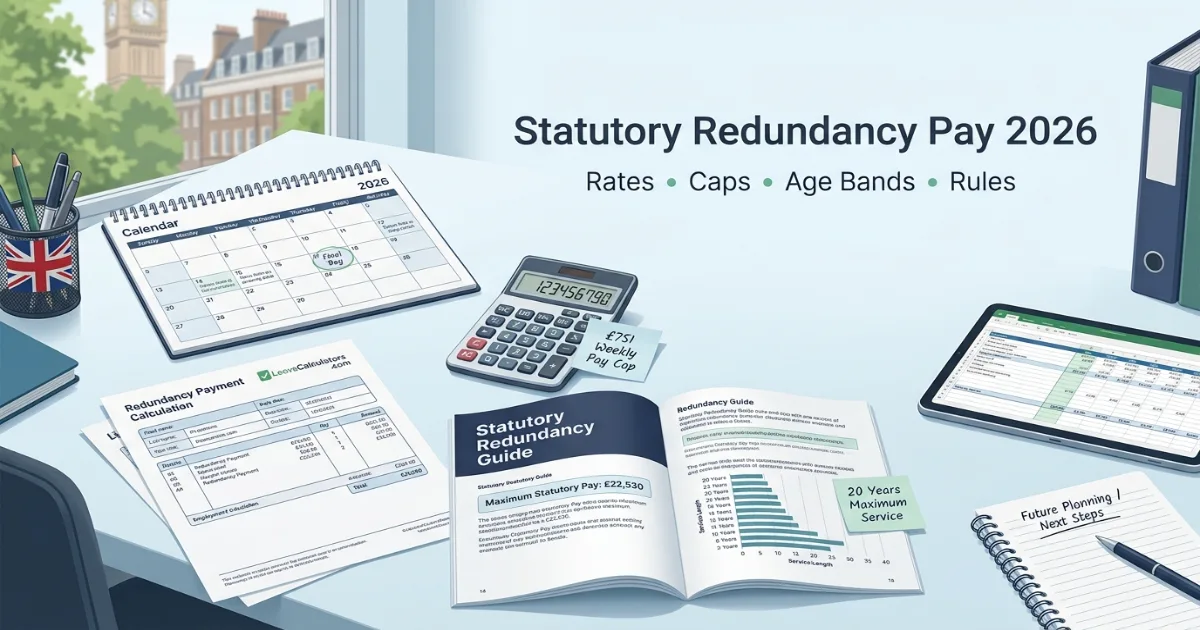
For redundancies taking effect on or after 6 April 2026, the maximum weekly pay that can be used to calculate statutory redundancy pay in Great Britain is £751.
This creates a maximum statutory redundancy payment of £22,530.
You normally need at least two years of continuous employment with your employer to qualify for statutory redundancy pay.
Statutory Redundancy Pay 2026: Rates and Age Bands
The statutory formula uses a different number of weeks of pay depending on your age during each complete qualifying year of employment.
| Your age during that year | Statutory entitlement |
|---|---|
| Under 22 | 0.5 week’s pay |
| Age 22 to 40 | 1 week’s pay |
| Age 41 or over | 1.5 weeks’ pay |
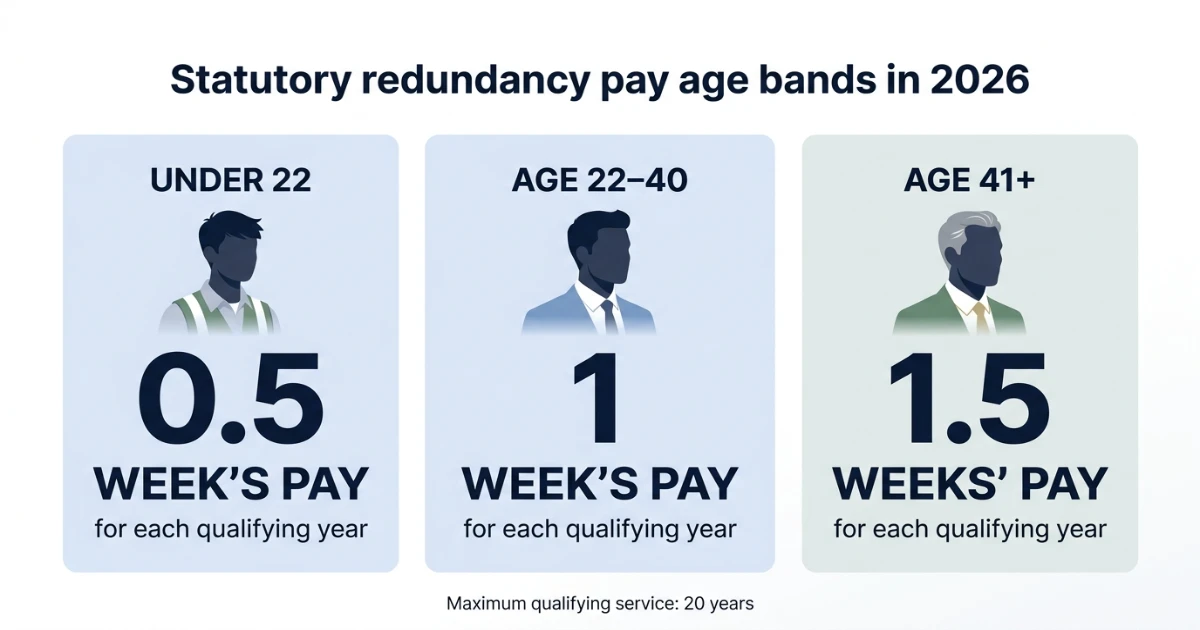
Only a maximum of 20 complete years of service can be included in the statutory calculation.
For a deeper explanation of how individual years move between these bands, see our guide to how age affects statutory redundancy pay .
What Is the Redundancy Pay Cap in 2026?
From 6 April 2026, statutory redundancy calculations in Great Britain use a maximum weekly pay figure of £751.
If you normally earn more than £751 per week, your full salary is not used in the statutory calculation. Instead, the weekly figure is capped at £751.
This means the maximum possible statutory redundancy payment under the 2026 Great Britain limits is £22,530.
For more detail about this limit, read our Redundancy Pay Weekly Pay Cap Explained guide.
Who Qualifies for Statutory Redundancy Pay?
You will normally qualify if you:
- have employee status;
- have worked continuously for your employer for at least two years; and
- are being dismissed because your role is genuinely redundant.
Some workers may not qualify under the statutory scheme if they do not have employee status. Contractual redundancy schemes can also provide rights above the statutory minimum.
How Is Statutory Redundancy Pay Calculated?
The number of qualifying weeks depends on your age during each full year of service. Your relevant weekly pay is then applied, subject to the statutory weekly cap.
Example 1: Employee Aged 35
Age: 35
Service: 8 complete years
Weekly pay: £600
Calculation: 8 × 1 × £600 = £4,800
Example 2: Employee Earning Above the Cap
Age: 39
Service: 10 complete years
Weekly pay: £1,000
The statutory calculation uses the £751 cap rather than £1,000.
Calculation: 10 × £751 = £7,510
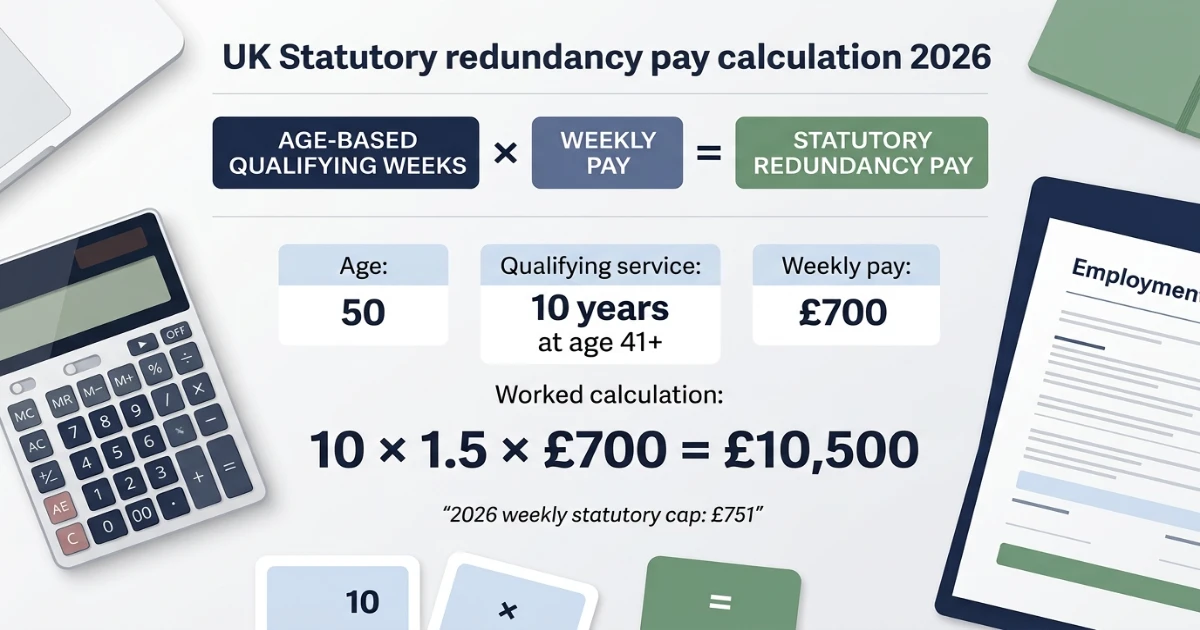
Example 3: Employee Aged 41 or Over
Age: 50
Service: 10 complete qualifying years at age 41+
Weekly pay: £700
Calculation: 10 × 1.5 × £700 = £10,500
What If You Moved Through Different Age Bands?
This is one of the most important parts of the statutory formula. Your entire service is not automatically calculated using your age on the date you are made redundant.
If some qualifying years were completed when you were under 41 and later years were completed at age 41 or over, those years can have different statutory multipliers.
The relevant qualifying years are calculated using the appropriate age bands and then combined.
How Is Weekly Pay Worked Out?
GOV.UK states that weekly pay is based on the average amount earned per week during the 12 weeks before the day you received your redundancy notice.
If your relevant weekly pay is below £751, that lower amount will normally be used.
If it is above £751, the statutory calculation is capped at £751 for redundancies taking effect on or after 6 April 2026.
How Many Years of Employment Can Count?
A maximum of 20 complete years of qualifying continuous employment can count.
| Continuous service | Maximum service used |
|---|---|
| 5 years | 5 years |
| 15 years | 15 years |
| 20 years | 20 years |
| 25 years | 20 years |
See our Continuous Employment and Redundancy Pay guide for a more detailed explanation of which service can count.
Do Partial Years Count?
Statutory redundancy calculations are generally based on complete years of service.
For example, 7 years and 8 months will normally provide seven complete qualifying years for the statutory calculation.
Notice arrangements can sometimes affect the relevant termination date, so employment dates should be checked carefully.
Is Statutory Redundancy Pay Taxable?
Qualifying statutory redundancy payments and certain other termination payments can generally fall within the combined £30,000 tax-free threshold.
However, not every payment you receive when leaving employment is treated as redundancy compensation.
Notice pay, wages, holiday pay and bonuses can have different tax treatment.
For a detailed breakdown, read Is Redundancy Pay Taxable in the UK?
Redundancy Pay Is Separate From Notice Pay
Redundancy pay does not replace your notice entitlement.
Depending on your circumstances, your final leaving package can include:
- statutory or enhanced redundancy pay;
- notice pay or payment in lieu of notice;
- unpaid salary;
- accrued but untaken holiday pay; and
- commission or bonuses already earned.
Can Your Employer Pay More Than the Statutory Amount?
Yes. Statutory redundancy pay is the legal minimum for eligible employees, not the maximum an employer is permitted to pay.
An enhanced scheme might offer more weeks of pay for each year of service, use your actual salary instead of the statutory weekly cap, or provide additional severance compensation.
Can You Lose Your Right to Redundancy Pay?
In some circumstances, refusing suitable alternative employment offered by your employer can affect your statutory redundancy entitlement.
Whether an alternative role is suitable can depend on factors such as:
- salary;
- working hours;
- location;
- responsibilities;
- seniority;
- skills required; and
- your personal circumstances.
What If Your Employer Becomes Insolvent?
If your employer is insolvent and cannot pay what is owed, eligible employees may be able to claim certain amounts through the government’s Redundancy Payments Service.
Potential claims can include statutory redundancy pay, certain unpaid wages, holiday pay and notice-related payments, subject to statutory rules and limits.
What If Your Employer Does Not Pay Redundancy?
If redundancy pay is missing, start by contacting your employer in writing and clearly setting out the amount you believe is owed.
- Confirm your employment start and end dates.
- Check your payslips and relevant weekly pay.
- Calculate the statutory amount.
- Compare it with your employer’s redundancy policy.
- Raise the issue promptly if the payment is missing or incorrect.
Employment claims can be subject to strict time limits, so it is sensible to seek advice promptly rather than waiting.
2026 Redundancy Pay Limits at a Glance
| Rule | 2026 position |
|---|---|
| Minimum continuous employment | Normally 2 years |
| Under age 22 | 0.5 week’s pay per qualifying year |
| Age 22–40 | 1 week’s pay per qualifying year |
| Age 41+ | 1.5 weeks’ pay per qualifying year |
| Maximum service counted | 20 years |
| Weekly statutory cap from 6 April 2026 | £751 |
| Maximum statutory redundancy payment | £22,530 |
| Qualifying tax-free termination threshold | Up to £30,000, subject to tax rules |
Frequently Asked Questions
What is the maximum statutory redundancy pay in 2026?
For redundancies taking effect on or after 6 April 2026 in Great Britain, the maximum statutory redundancy payment is £22,530.
What is the weekly redundancy pay cap for 2026?
The statutory weekly pay limit is £751 for redundancies taking effect on or after 6 April 2026.
Do I need two years of service to get redundancy pay?
Normally, yes. Employees generally need at least two complete years of continuous employment to qualify for statutory redundancy pay.
Does redundancy pay increase after age 41?
Each qualifying full year worked while aged 41 or over is normally worth 1.5 weeks of pay.
Is redundancy pay tax free?
Qualifying redundancy and certain termination payments can generally fall within the combined £30,000 tax-free threshold. Other payments, including notice pay, salary and holiday pay, can be taxed differently.
Can I get more than £22,530?
Your statutory redundancy payment is capped under the statutory formula, but an employer can provide additional enhanced or contractual redundancy pay.
Does more than 20 years of service increase statutory redundancy pay?
No. The statutory calculation only counts a maximum of 20 years of qualifying service.
Are notice pay and redundancy pay the same?
No. They are separate entitlements. Depending on your circumstances, you may be entitled to both redundancy pay and notice pay.
Calculate Your Redundancy Pay
Use the UK Redundancy Pay Calculator to estimate your statutory entitlement using your age, weekly pay and continuous service.
Use the UK Redundancy Pay CalculatorFinal Takeaway
For redundancies taking effect from 6 April 2026, statutory redundancy pay in Great Britain is based on your age, complete qualifying years of continuous service and weekly pay.
Weekly earnings are capped at £751 and qualifying service is capped at 20 years.
This creates a maximum statutory redundancy payment of £22,530.
Your final leaving package can still be higher if you are also owed notice pay, unused holiday pay, wages or an enhanced redundancy payment under your employment contract or employer’s scheme.