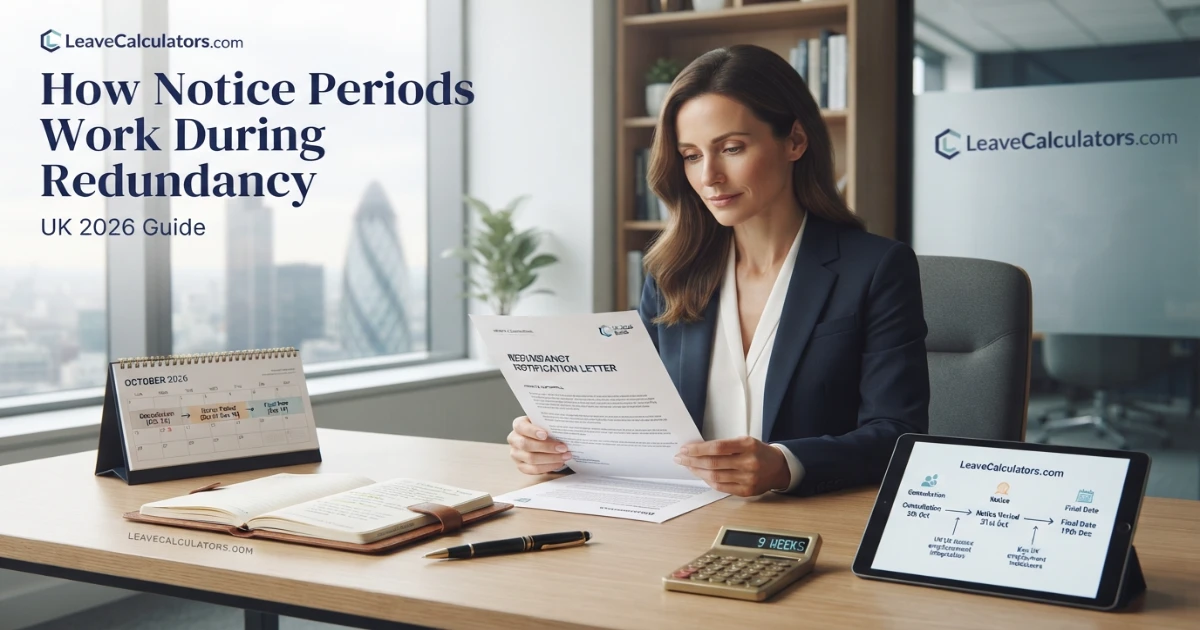
How Notice Periods Work During Redundancy
How notice periods work during redundancy depends on your length of service, your employment contract and whether you work your notice, receive payment in lieu of notice or are placed on garden leave. This guide explains statutory and contractual notice, notice pay, PILON, leaving early and insolvency rules in the UK.
A redundancy decision does not usually end employment immediately.
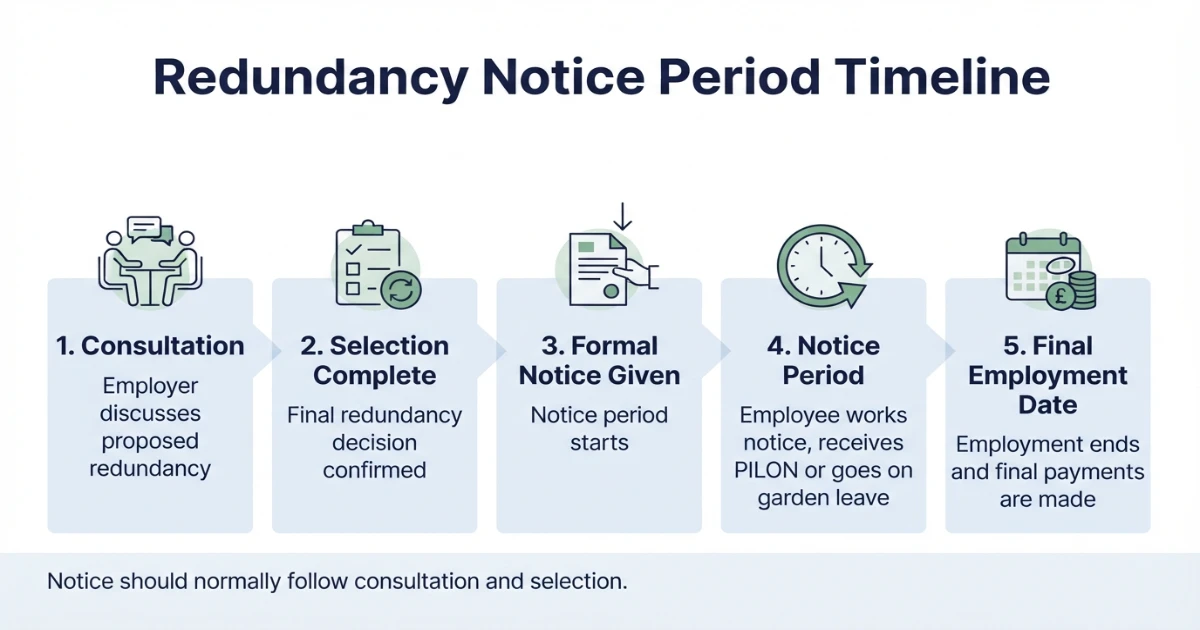
After an employer completes the consultation and selection process, the employee must normally be given notice telling them when employment will end.
This notice period matters because the employee normally remains employed, continues receiving pay and can retain contractual rights until the end date.
It also matters for the redundancy calculation itself in some situations, especially where payment in lieu of notice is used.
When Does the Redundancy Notice Period Start?
An employer should not normally give final redundancy notice before completing the required consultation and selection process.
Once the employer confirms the redundancy decision, it should tell the employee:
- that they are being made redundant;
- how long the notice period is;
- the date notice begins;
- the final employment date;
- whether the notice is statutory or contractual;
- whether the employee is expected to work during notice; and
- how final payments will be handled.
Acas also recommends getting important details such as the end date, benefits and any early-leaving arrangement in writing.
What Is the Statutory Notice Period for Redundancy?
Statutory notice is the minimum amount of notice an employee must normally receive when they are dismissed because of redundancy.
| Continuous Service | Minimum Statutory Notice |
|---|---|
| 1 month to less than 2 years | At least 1 week |
| 2 years to less than 12 years | 1 week for each complete year of service |
| 12 years or more | 12 weeks |
These are minimum periods. Your contract can give you more notice, but an employer cannot normally give less than the statutory minimum.
Statutory Notice Period Examples
An employee has worked continuously for 18 months.
An employee has 6 complete years of continuous service.
The employee has more than 12 years’ service.
What Is Contractual Notice?
Your employment contract, written statement or workplace policy can provide a notice period that is longer than the statutory minimum.
For example, an employee with 5 years’ service has a statutory minimum notice period of 5 weeks.
But if the employment contract gives 3 months’ notice, the contractual notice period may apply instead.
Key rule: contractual notice can be more generous than statutory notice, but an employer cannot normally use a contract to provide less than the legal minimum.
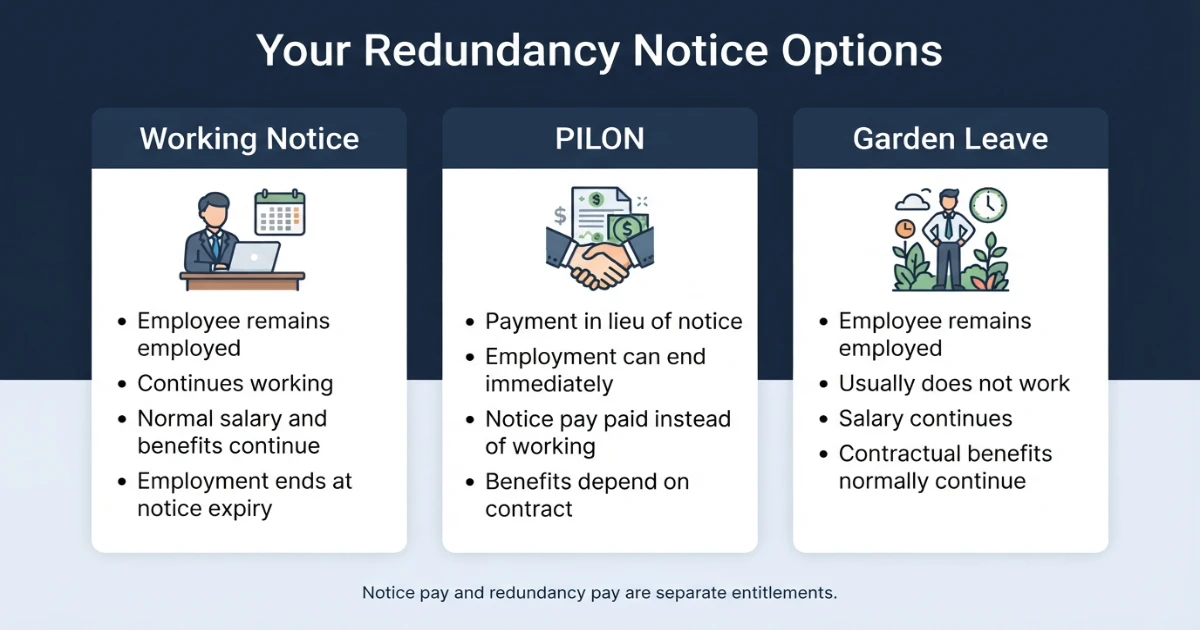
Do You Have to Work During Your Redundancy Notice Period?
Usually, yes.
In a standard redundancy process, you remain employed and continue working until the notice period ends.
You should normally continue to receive pay and contractual benefits during that period.
However, an employer may use another arrangement, such as:
- payment in lieu of notice;
- garden leave;
- an agreed earlier leaving date; or
- another contractual arrangement.
How Is Notice Pay Calculated?
GOV.UK says notice pay is generally based on the employee’s average weekly earnings over the 12 weeks before the notice period starts.
The calculation can be more complex where pay varies.
Relevant factors can include:
- basic pay;
- regular working hours;
- variable hours;
- contractual overtime;
- commission;
- bonuses; and
- other contractual earnings.
What Is Payment in Lieu of Notice?
Payment in lieu of notice is usually shortened to PILON.
Instead of keeping you employed while you work your notice period, the employer ends employment sooner and pays you for the notice period you would otherwise have worked.
Where a PILON clause exists in the employment contract, the employer may be able to use it to end employment immediately.
Where the contract does not contain a PILON clause, the employer may still ask you to agree to it.
The employee should normally receive the basic pay they would have received during the notice period and any other contractual elements required by the agreement or contract.
PILON Example
Assume an employee:
- has 8 years of continuous service;
- is entitled to 8 weeks’ statutory notice;
- earns £650 per week;
- is told to leave immediately.
The employee could receive £5,200 basic notice pay instead of working the 8-week notice period, subject to the exact contractual terms and applicable deductions.
Can PILON Affect the Redundancy Pay Calculation?
Yes, in some cases.
Acas explains that when statutory notice is paid in lieu, the redundancy-pay relevant date can be treated as the date employment would have ended if the employee had worked the full statutory notice period.
That can occasionally push the employee into another complete year of service for redundancy-pay purposes.
An employee has worked for the employer for: 8 years and 11 months.
They have 8 weeks’ statutory notice but receive PILON.
Adding those 8 statutory notice weeks produces more than 9 years of relevant service.
Contractual notice that exceeds statutory notice can involve a different relevant-date calculation, so the statutory notice period still needs to be identified separately.
What Is Garden Leave During Redundancy?
Garden leave means the employer tells you not to work for some or all of your notice period while keeping you employed.
You may be asked to stay at home or not access customers, systems or confidential business information.
During garden leave:
- you remain employed;
- your notice period continues;
- you should normally receive your usual pay; and
- contractual benefits normally continue.
Garden leave is therefore different from PILON because the employment relationship continues during garden leave.
PILON vs Garden Leave
| Feature | PILON | Garden Leave |
|---|---|---|
| Employment continues? | Usually ends immediately | Yes |
| Employee works? | No | Usually no |
| Notice pay | Paid instead of working notice | Paid normally during notice |
| Contractual benefits | Depends on contract/PILON terms | Normally continue |
| Employment end date | Usually immediate | End of garden-leave notice period |
Can You Leave Before Your Redundancy Notice Period Ends?
You can ask your employer if you can leave early.
Acas recommends getting any agreement in writing.
If you leave early without the employer’s agreement, you could be in breach of contract and the employer may only have to pay you up to the date you actually worked.
Leaving early can also affect redundancy entitlement in some situations, so do not simply resign without checking the consequences.
If you have another job lined up, agree the earlier leaving date with your employer first.
What If You Find a New Job During the Notice Period?
Finding another job does not automatically cancel the notice period.
You can:
- continue working notice until the agreed end date;
- ask the employer to release you early; or
- agree another arrangement in writing.
Do not assume that simply starting the new job immediately will preserve all notice and redundancy rights.
Can You Take Holiday During a Redundancy Notice Period?
Potentially, yes.
Holiday arrangements during notice depend on normal holiday rules, the employment contract and any directions given by the employer.
An employer may ask you to take unused holiday during the notice period, provided the applicable notice requirements for directing holiday are met.
Any accrued holiday still owed when employment ends should normally be dealt with separately in the final pay calculation.
Do Benefits Continue During the Notice Period?
If you remain employed during working notice or garden leave, contractual benefits normally continue unless the contract provides otherwise.
These might include:
- pension contributions;
- private medical insurance;
- company car;
- fuel card;
- mobile phone;
- bonus eligibility; or
- other contractual benefits.
If PILON is used, treatment of non-cash benefits can depend on the contract and the PILON clause.
What If You Are Sick or on Leave During Notice?
Notice pay can become more complicated if you are not working because of sickness, holiday, family-related leave or another authorised absence.
Acas states that entitlement can depend on the relationship between your contractual notice period and the statutory notice period.
For unusual cases, the employment contract and detailed notice-pay rules should be checked carefully.
Is Notice Pay Separate From Redundancy Pay?
Yes.
Notice pay and statutory redundancy pay are separate entitlements.
An eligible employee can receive:
- statutory or enhanced redundancy pay;
- pay during working notice or PILON;
- unused holiday pay;
- final salary; and
- other contractual amounts.
For a full explanation, read: Can You Get Redundancy Pay and Notice Pay Together?
Is Notice Pay Taxable?
Yes, notice-related pay is generally taxed as employment earnings.
PILON and amounts treated as Post-Employment Notice Pay are normally subject to Income Tax and National Insurance.
This differs from qualifying redundancy compensation, which can potentially benefit from the separate £30,000 termination-payment threshold.
See: Is Redundancy Pay Taxable in the UK?
What Happens to Notice Pay if the Employer Is Insolvent?
If the employer is formally insolvent and cannot pay the statutory notice entitlement, eligible employees can potentially claim statutory notice pay through the Insolvency Service.
You can claim if you:
- did not work a notice period;
- worked only part of the notice period; or
- worked an unpaid notice period.
Government statutory notice payments are capped at £751 per week for qualifying 2026 claims.
The statutory notice claim can cover up to 12 weeks, depending on length of service.
How Do You Claim Loss of Notice Pay?
If the employer is insolvent, you must normally make the redundancy and other money-owed claim first.
After that, the Insolvency Service provides the reference needed for the separate loss-of-notice claim.
The application may ask for:
- your National Insurance number;
- your loss-of-notice claim reference;
- money earned during the notice period; and
- unemployment benefits claimed during the notice period.
Amounts earned or certain benefits received during the relevant notice period can affect the final payment.
Can an Employer Withdraw Redundancy Notice?
Once an employer has formally given redundancy notice, including the employment end date, Acas says the employer cannot simply withdraw it unless the employee agrees.
If you agree to remain employed, continuity of employment continues and the redundancy dismissal does not take effect.
If circumstances change and the employer offers continued or suitable alternative work, redundancy entitlement can become more complex.
What If Your Employer Gives Too Little Notice?
If you believe your employer has not given you the correct statutory or contractual notice period, raise the issue with them promptly.
It is usually sensible to:
- check your continuous service;
- check the statutory minimum;
- read your employment contract;
- confirm the dates in writing; and
- ask the employer to correct any shortfall.
If the problem cannot be resolved, a wrongful-dismissal or breach-of-contract claim may potentially be relevant depending on the circumstances.
Common Redundancy Notice Period Mistakes
1. Assuming notice starts when consultation begins
Consultation and formal notice are separate stages. Notice is normally given after consultation and selection are complete.
2. Checking only the statutory notice period
Your contract may provide more notice than the legal minimum.
3. Confusing PILON with garden leave
PILON normally ends employment immediately. Garden leave keeps the employee employed through the notice period.
4. Leaving early without written agreement
This can affect notice pay and potentially other redundancy rights.
5. Assuming notice pay and redundancy pay are the same
They are separate entitlements and should appear separately in the final payment breakdown.
Redundancy Notice Period Checklist
- Confirm when consultation and selection finished.
- Check the date formal redundancy notice was given.
- Calculate the statutory notice period from continuous service.
- Check your contract for a longer contractual notice period.
- Confirm the final employment date.
- Find out whether you will work notice, receive PILON or go on garden leave.
- Check how notice pay has been calculated.
- Confirm what happens to contractual benefits.
- Get any early-leaving agreement in writing.
- Keep redundancy pay, notice pay and holiday pay separate in the final calculation.
Calculate Your Statutory Redundancy Pay Separately
Notice pay and redundancy pay are separate. Calculate your statutory redundancy entitlement first, then review your notice entitlement and other final payments.
Use the UK Redundancy Pay CalculatorFrequently Asked Questions
How much notice do you get when made redundant?
The statutory minimum is 1 week for service between 1 month and 2 years, 1 week for each complete year between 2 and 12 years, and 12 weeks for 12 years or more.
Can a redundancy contract give more notice?
Yes. A contractual notice period can be longer than the statutory minimum, but an employer cannot normally give less than the legal minimum.
Do you have to work your redundancy notice?
Usually, but an employer may use PILON, garden leave or another agreed arrangement instead.
What is PILON in redundancy?
PILON is payment in lieu of notice. Employment ends without the full notice period being worked and the employee receives payment relating to that notice period.
What is garden leave during redundancy?
Garden leave means the employee remains employed and paid during the notice period but is told not to work some or all of that period.
Is redundancy notice pay taxable?
Yes. Notice-related pay is generally taxed as employment earnings and can be subject to Income Tax and National Insurance.
Can PILON increase qualifying redundancy service?
Potentially. For statutory redundancy calculations, the relevant date can include the statutory notice period that would have been worked, which can sometimes create another complete qualifying year.
Can you leave early during redundancy notice?
You can ask your employer to agree an earlier leaving date. It is best to get the agreement in writing because leaving without agreement can affect pay and other rights.
Can you claim notice pay if the employer is insolvent?
Eligible employees can potentially claim statutory notice pay through the Insolvency Service if the employer is formally insolvent and did not pay the required notice entitlement.
Final Answer: How Notice Periods Work During Redundancy
Understanding how notice periods work during redundancy starts with your continuous service and employment contract.
The statutory minimum notice period is:
- 1 week for service between one month and two years;
- 1 week per complete year for service between two and 12 years; and
- 12 weeks for 12 or more years of service.
A contract can provide more notice, but normally not less.
You will usually work and be paid through the notice period. However, your employer may use PILON to end employment sooner or place you on garden leave while keeping you employed and paid.
Notice pay and redundancy pay are separate. Notice-related amounts are generally taxable as employment earnings, while qualifying redundancy compensation can have different tax treatment.
Where PILON is used, the statutory notice period can also affect the relevant date used for calculating complete years of redundancy service.
If your employer is insolvent and has not paid your statutory notice, you may be able to make a separate loss-of-notice claim through the Insolvency Service, subject to the statutory weekly limit.