Is Redundancy Pay Taxable in the UK?
Is redundancy pay taxable in the UK? Learn how the £30,000 termination-payment threshold works, which parts of a redundancy package are normally taxable, and how HMRC treats enhanced redundancy, holiday pay, PILON and post-employment notice pay.

If you are losing your job through redundancy, one of the biggest financial questions is likely to be: is redundancy pay taxable in the UK?
The answer depends on what your final payment actually contains. A redundancy package is rarely one single type of payment. It can include statutory redundancy pay, enhanced compensation, final salary, unused holiday pay, bonuses, commission and notice-related amounts.
HMRC does not treat all of those components in the same way. Genuine termination compensation can potentially benefit from the £30,000 threshold, while amounts that represent normal employment earnings are generally taxed through PAYE.
Is Redundancy Pay Taxable in the UK in 2026?
Redundancy pay is not automatically taxable in full. Qualifying termination payments can generally benefit from an Income Tax exemption on the first combined £30,000.
This can include statutory redundancy pay and qualifying additional severance or enhanced redundancy compensation.
If qualifying termination compensation exceeds £30,000, the amount above the threshold will generally be subject to Income Tax.
Key distinction: the £30,000 threshold applies to qualifying termination compensation. It does not automatically apply to everything on your final payslip.
How Does the £30,000 Redundancy Tax-Free Threshold Work?
The £30,000 threshold is combined across relevant qualifying termination payments. You do not normally receive a separate £30,000 threshold for each component.
Statutory redundancy pay:
£12,000
Qualifying enhanced redundancy payment:
£8,000
Combined qualifying amount: £20,000
Assuming both components qualify, the combined £20,000 is below the £30,000 threshold and can generally be paid without Income Tax.
Statutory redundancy pay:
£15,000
Qualifying enhanced compensation:
£25,000
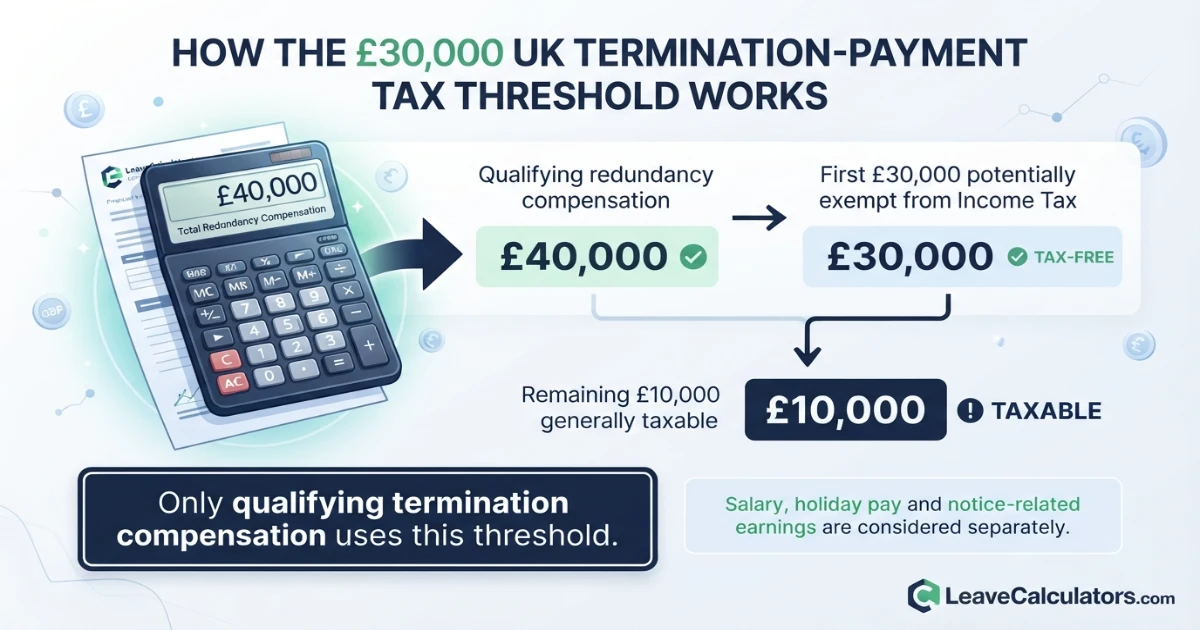
Combined qualifying amount: £40,000
The first £30,000 can potentially fall within the exemption. The remaining £10,000 would generally be subject to Income Tax.
Is Statutory Redundancy Pay Tax-Free?
Statutory redundancy pay can benefit from the termination-payment tax threshold. Because the maximum statutory redundancy payment in Great Britain for redundancies from 6 April 2026 is below £30,000, statutory redundancy pay on its own will commonly fall within that threshold.
Your statutory redundancy entitlement is calculated separately using age, qualifying years of service and weekly pay.
Calculate Your Statutory Redundancy Entitlement
Estimate your statutory redundancy payment first, then review the tax treatment of the other components in your termination package.
Use the UK Redundancy Pay CalculatorIs Enhanced Redundancy Pay Taxable?
A genuine enhanced or additional severance payment can also potentially form part of the combined £30,000 qualifying termination-payment threshold.
However, an employer cannot turn ordinary employment earnings into tax-free redundancy compensation simply by changing the label.
What the payment actually represents is what matters.
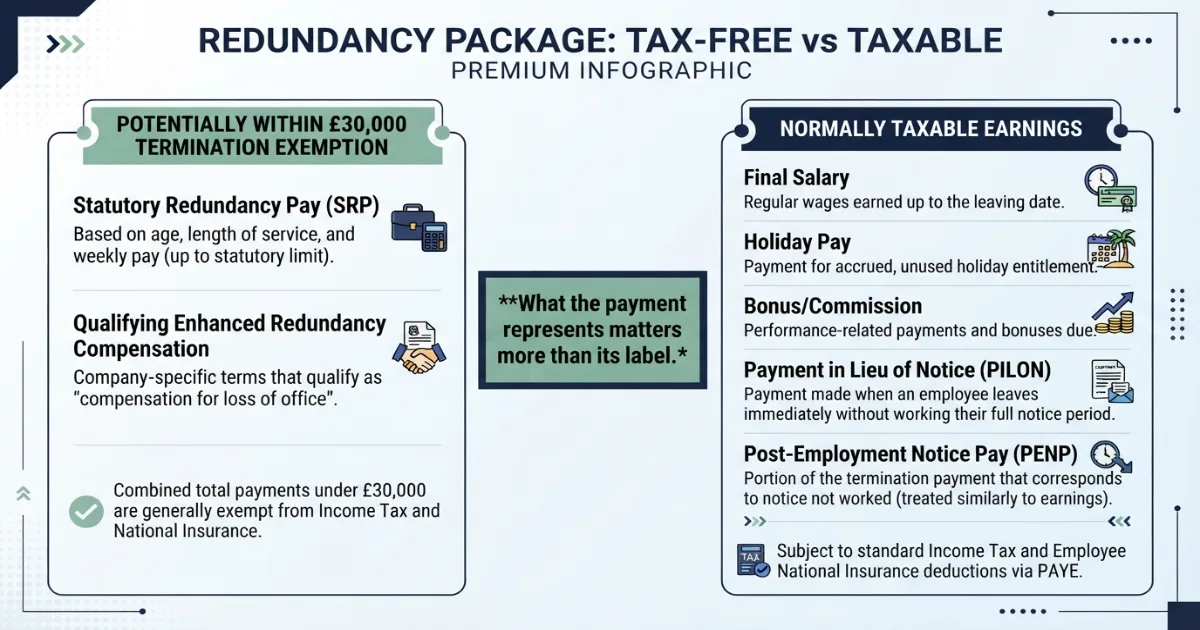
What Parts of a Redundancy Package Are Taxable?
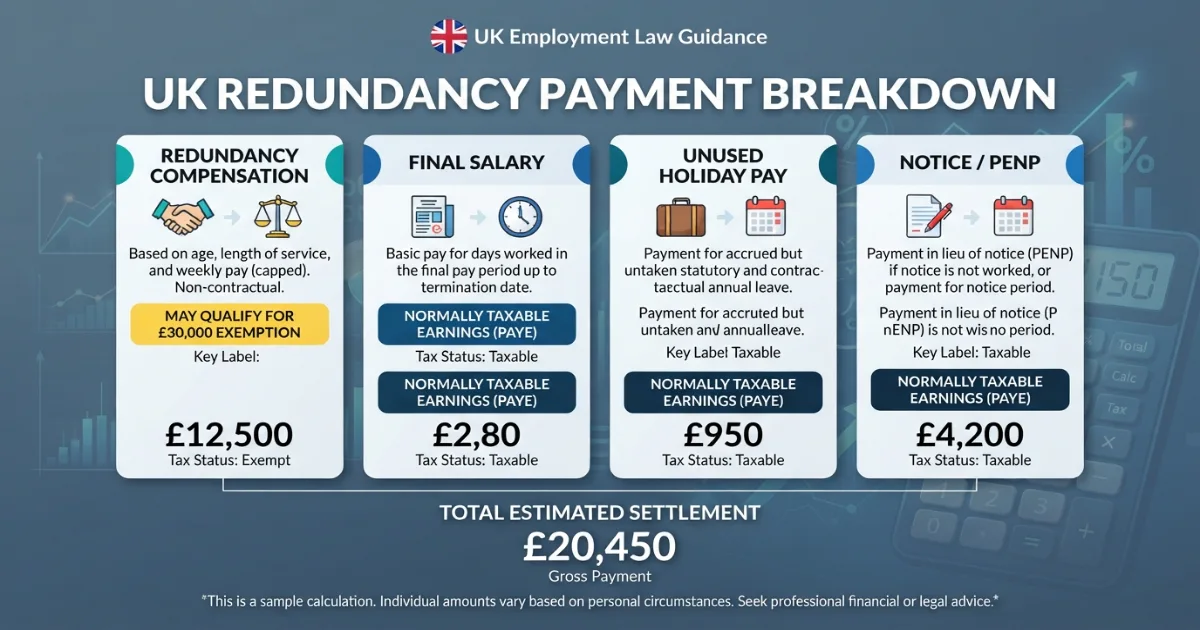
| Payment Type | Typical Tax Treatment |
|---|---|
| Statutory redundancy pay | Can benefit from the combined £30,000 termination-payment threshold. |
| Qualifying enhanced redundancy pay | Can also count toward the combined £30,000 threshold. |
| Final salary or unpaid wages | Normally taxable as employment earnings. |
| Unused holiday pay | Normally taxable as employment earnings. |
| Bonus or commission | Normally taxable where it represents employment earnings. |
| PILON / notice-related earnings | Normally subject to Income Tax and National Insurance. |
| Post-Employment Notice Pay (PENP) | Taxed as employment earnings and does not use the £30,000 threshold. |
Final Salary and Wages
Salary and wages earned before employment ends remain normal employment income. Being paid at the same time as redundancy compensation does not make them tax-free.
Unused Holiday Pay
Payment for accrued but unused holiday is normally treated as employment income and processed through PAYE.
Bonuses and Commission
Bonuses and commission arising from employment are normally taxable as earnings even when they appear in the same final payment as redundancy compensation.
Is Payment in Lieu of Notice Taxable?
Yes, notice-related earnings require separate treatment.
If you leave without working all of your notice and receive a payment representing earnings you would otherwise have received, that amount will generally be subject to Income Tax and National Insurance.
Do not assume PILON is covered by the £30,000 threshold merely because your overall settlement is below £30,000.
What Is Post-Employment Notice Pay?
Post-Employment Notice Pay, commonly called PENP, is the part of a relevant termination award treated as the basic pay you would have received during an unworked notice period.
HMRC treats PENP as employment earnings. It is therefore normally subject to Income Tax and National Insurance and does not benefit from the £30,000 termination-payment threshold.
Statutory redundancy pay: £10,000
Qualifying additional severance: £7,000
Taxable notice-related amount: £3,000
The overall package is £20,000, but it would be wrong to assume that the entire £20,000 is tax-free simply because the total is below £30,000.
The notice-related amount is considered separately as taxable earnings.
Example: Redundancy Package Under £30,000
Suppose an employee receives:
- £11,000 statutory redundancy pay
- £7,000 qualifying enhanced redundancy pay
- £2,000 unused holiday pay
- £3,000 final salary
The potentially qualifying termination compensation is:
£11,000 + £7,000 = £18,000
Assuming both amounts qualify, that £18,000 falls below the £30,000 termination threshold.
The £2,000 holiday pay and £3,000 final salary are normally employment earnings and taxed separately.
Example: Redundancy Compensation Over £30,000
Now assume an employee receives £14,000 statutory redundancy pay and £31,000 of additional qualifying termination compensation.
Combined qualifying amount: £45,000
The first £30,000 can potentially benefit from the threshold. The remaining £15,000 would generally be subject to Income Tax.
Do You Pay National Insurance on Redundancy Pay?
National Insurance treatment depends on the type of payment.
Ordinary employment earnings such as salary, holiday pay and PENP can be subject to employee and employer Class 1 National Insurance under the usual rules.
For qualifying termination awards above the combined £30,000 threshold, the employer can be liable for employer Class 1A National Insurance on the amount above £30,000.
That employer Class 1A liability is different from employee National Insurance deducted from ordinary earnings.
Can Redundancy Pay Affect Your Income Tax Band?
Only taxable income contributes in the ordinary way to your Income Tax position.
If you already have substantial taxable earnings in the year, additional taxable salary, bonus, holiday or notice-related amounts paid on termination can affect your overall tax liability.
Your final position can depend on your total earnings, tax code, income from a new job, pension contributions and other taxable income.
What Happens If a Taxable Payment Is Made After Your P45?
If an employer makes a taxable payment after issuing your P45, HMRC guidance instructs employers to use tax code 0T on a week 1 or month 1 basis for the payment, or the Scottish/Welsh equivalent where appropriate.
This can sometimes produce a relatively large initial deduction because no Personal Allowance is allocated to that particular payment.
The deduction shown at the time of payment does not necessarily represent your final tax position for the full tax year.
Can an Employer Make the Whole Package Tax-Free?
No. What matters is what each amount represents.
- Salary remains employment earnings.
- Holiday pay remains employment earnings.
- Bonuses and commission normally remain earnings.
- Notice-related amounts follow specific tax rules.
- Qualifying termination compensation can potentially use the £30,000 threshold.
What Should a Redundancy Payment Breakdown Include?
Ask your employer for a clear breakdown showing:
- Statutory redundancy pay
- Enhanced or contractual termination compensation
- Final salary
- Unused holiday pay
- PILON or other notice-related amounts
- Bonuses or commission
- Benefits
- Other termination compensation
Separating the components is far more reliable than applying the £30,000 threshold to the total final payment.
Can Redundancy Pay Be Paid Into a Pension?
Pension contributions can sometimes be relevant when structuring a substantial termination package, but pension tax rules and Annual Allowance limits need to be considered separately.
Do not assume that receiving cash personally and later contributing it to a pension creates the same tax outcome as an employer contribution.
For a high-value package, professional tax or financial advice can be useful before the settlement is finalised.
Are Settlement Agreement Payments Tax-Free?
A settlement agreement can contain several different categories of payment. The existence of the agreement does not determine the tax treatment.
Qualifying compensation for termination may potentially use the £30,000 threshold, while wages, holiday pay, bonuses and notice-related earnings remain taxable according to their normal rules.
Common Redundancy Tax Mistakes
1. Assuming everything below £30,000 is tax-free
The threshold applies to qualifying termination compensation, not automatically to every amount paid when employment ends.
2. Treating PILON or PENP as tax-free redundancy pay
Notice-related earnings are generally taxable employment earnings.
3. Looking only at the total package
A final payment can contain a mixture of qualifying termination compensation and taxable employment earnings.
4. Assuming employer Class 1A NIC is deducted from the employee
Class 1A NIC on qualifying termination awards above £30,000 is an employer liability, distinct from employee NIC on ordinary earnings.
Check Your UK Redundancy Pay
Calculate your statutory redundancy entitlement first, then compare it with the payment breakdown supplied by your employer.
Calculate Redundancy PayFrequently Asked Questions
Is redundancy pay taxable in the UK?
The first combined £30,000 of qualifying redundancy and termination payments can generally benefit from an Income Tax exemption. Salary, holiday pay, bonuses and notice-related earnings are normally taxed separately.
Is the first £30,000 of redundancy pay tax-free?
The first £30,000 of qualifying termination payments can generally be free from Income Tax. The threshold does not automatically apply to every payment in your final employment package.
Is statutory redundancy pay taxable?
Statutory redundancy pay can benefit from the £30,000 termination-payment threshold. It must still be considered together with other qualifying termination payments when applying that threshold.
Is holiday pay tax-free when you are made redundant?
No. Payment for unused holiday is normally treated as employment income and taxed through payroll.
Is payment in lieu of notice taxable?
Notice-related earnings, including amounts treated as PENP, are generally subject to Income Tax and National Insurance.
What happens if qualifying redundancy compensation is £40,000?
If the full £40,000 qualifies for the termination-payment rules, the first £30,000 may benefit from the exemption and the remaining £10,000 would generally be subject to Income Tax.
Final Answer: Is Redundancy Pay Taxable in the UK?
So, is redundancy pay taxable in the UK? The answer depends on what your payment represents.
The first combined £30,000 of qualifying redundancy and termination compensation can generally benefit from the Income Tax threshold.
Salary, unused holiday pay, bonuses, commission and notice-related earnings are generally treated as ordinary employment earnings and taxed separately.
If qualifying termination compensation exceeds £30,000, the excess is generally taxable. The employer can also have Class 1A National Insurance liability on qualifying termination awards above that threshold.
The safest approach is to obtain a detailed breakdown from your employer and identify what each payment represents before deciding whether it is taxable.