How Age Affects Statutory Redundancy Pay in 2026
Understanding how age affects statutory redundancy pay is essential if you are being made redundant in the UK in 2026. Your age can make a significant difference to your statutory redundancy payment. Learn how the under-22, age 22–40 and age 41+ bands work, how years of service are allocated between them, and how to calculate your entitlement using the 2026 redundancy rules.
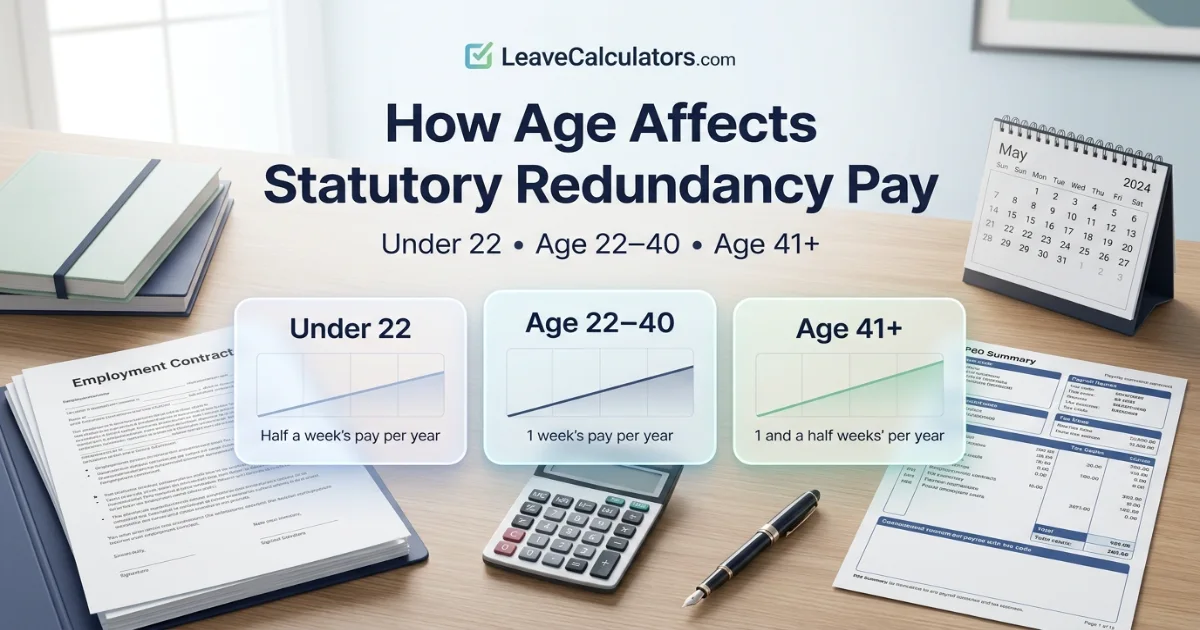
When calculating statutory redundancy pay in the UK, age is not simply a background detail. It directly affects how many weeks of pay each year of qualifying service is worth.
Two employees with the same salary and the same number of years with an employer can therefore receive different statutory redundancy payments if they worked those years at different ages.
Understanding how age affects statutory redundancy pay is especially important if you have worked for the same employer across more than one age band. Your entire employment history is not simply calculated using your age on the day you are made redundant.
Instead, qualifying years are calculated according to the relevant age band. This guide explains the age bands, practical calculations for different ages, what happens when you move between age bands, and how the 20-year service limit and statutory weekly-pay cap affect the final result.
How Age Affects Statutory Redundancy Pay in the UK
For statutory redundancy pay, qualifying years of employment are divided into three age bands.
Half a week’s pay for each complete qualifying year.
One week’s pay for each complete qualifying year.
One and a half weeks’ pay for each complete qualifying year.
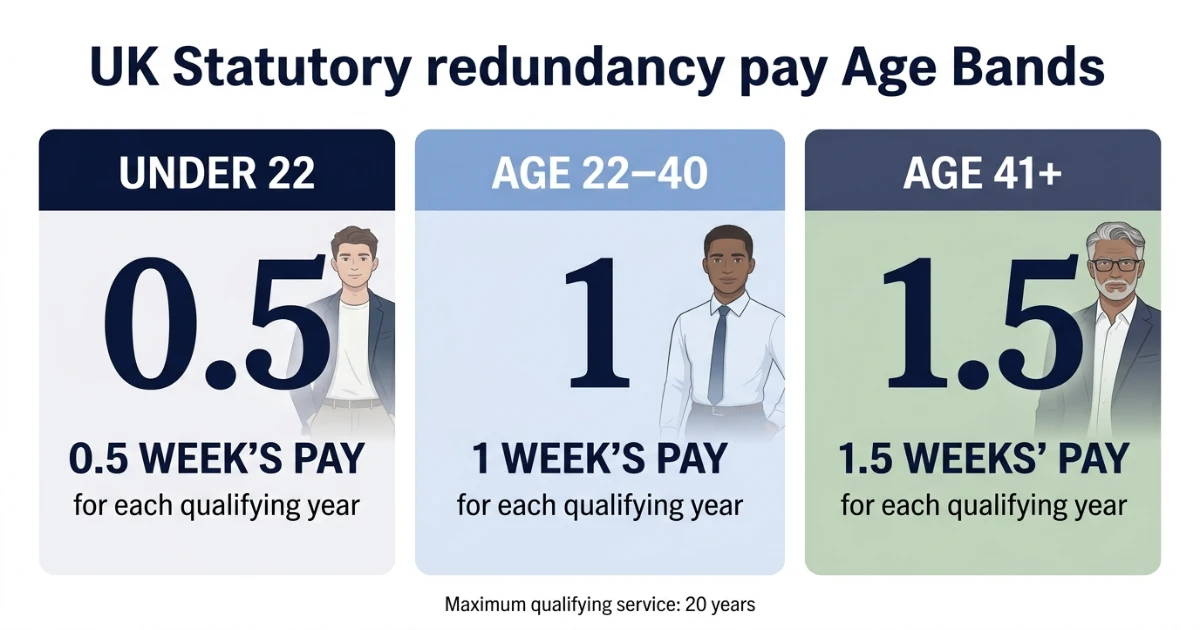
This means a qualifying year worked after age 41 can be worth three times as many weeks of statutory redundancy pay as a qualifying year worked while under 22.
However, your final payment also depends on your weekly pay and the number of qualifying years that can be counted.
What Is the Statutory Redundancy Pay Formula?
The basic calculation combines three main factors:
- Your age during each qualifying year.
- Your number of complete years with the employer.
- Your weekly pay, subject to the statutory limit.
Basic formula:
Qualifying weeks based on age × applicable weekly pay =
statutory redundancy payment.
For redundancies taking effect on or after 6 April 2026, statutory weekly pay is capped at £751.
This means that if your actual weekly earnings are £900 or £1,200, the statutory redundancy calculation will normally use the £751 limit instead.
If your normal weekly earnings are below the cap, your applicable weekly pay is generally used.
Redundancy Pay for Employees Under 22
For each qualifying year worked while under age 22, you receive:
Half a week’s pay for each qualifying year.
Imagine an employee is made redundant aged 21 after completing three qualifying years with the employer.
Applicable weekly pay: £500
Estimated statutory redundancy payment: £750.
Redundancy Pay for Employees Aged 22 to 40
For qualifying years in which you were aged 22 to 40, you receive:
One week’s pay for each qualifying year.
Suppose an employee has completed eight qualifying years and all eight fall within the 22–40 age band.
Weekly pay: £600
Estimated statutory redundancy payment: £4,800.
Redundancy Pay for Employees Aged 41 or Over
Each qualifying year worked from age 41 onwards receives the highest statutory multiplier:
One and a half weeks’ pay for each qualifying year.
Suppose an employee has 10 qualifying years that fall within the age-41-or-over band.
Weekly pay: £700
Estimated statutory redundancy entitlement: £10,500.
What If You Worked Across Different Age Bands?
This is one of the most important parts of the statutory redundancy calculation.
Your entire service is not simply multiplied by the rate applying to your age when you are made redundant.
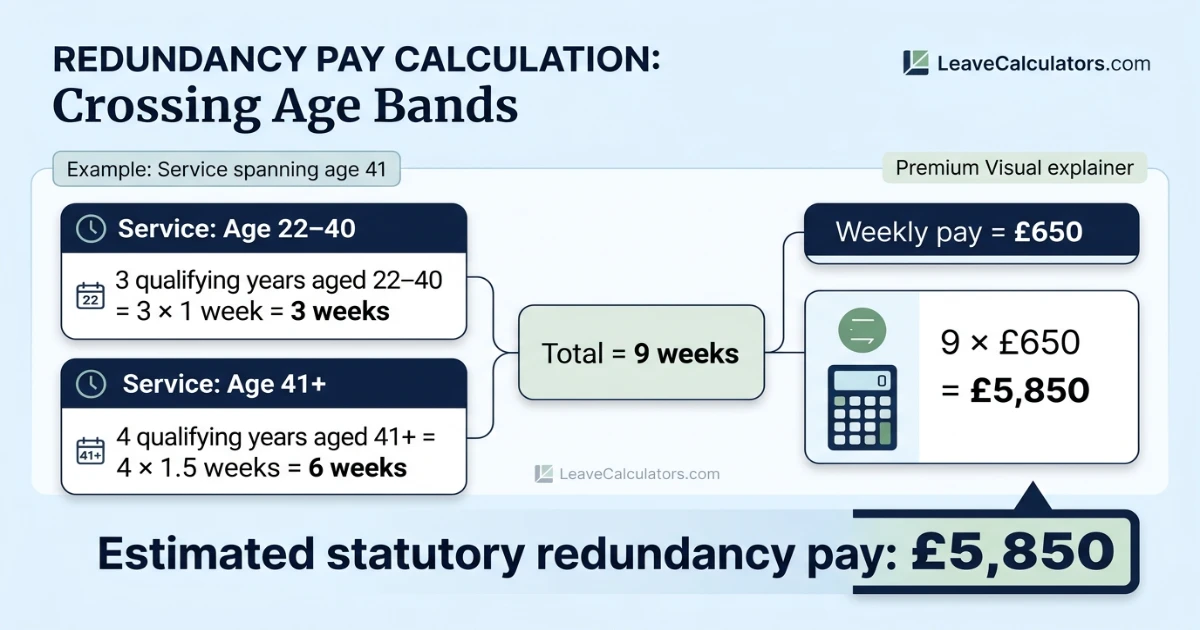
Your qualifying service may fall across different age bands.
Assume an employee has seven qualifying years:
- 3 qualifying years in the age 22–40 band
- 4 qualifying years in the age 41+ band
Weekly pay: £650
Estimated statutory redundancy pay: £5,850.
Statutory Redundancy Pay Age Table
| Age During Qualifying Year | Statutory Entitlement | Example at £600 Weekly Pay |
|---|---|---|
| Under 22 | 0.5 week’s pay | £300 per qualifying year |
| 22 to 40 | 1 week’s pay | £600 per qualifying year |
| 41 or over | 1.5 weeks’ pay | £900 per qualifying year |
Does Your Current Age Determine the Whole Payment?
No.
Being 45 when you are made redundant does not mean every qualifying year of your employment automatically receives the 1.5-week multiplier.
The correct multiplier depends on the age band applicable to each relevant qualifying year.
Example
Suppose you joined your employer when you were 30 and are made redundant when you are 45.
Qualifying years in your thirties are normally calculated at one week’s pay.
Qualifying years from age 41 onwards receive one and a half weeks’ pay.
What Happens When You Turn 41?
Turning 41 matters because qualifying service in the 41+ age band receives one and a half weeks’ pay instead of one week’s pay.
However, reaching age 41 does not mean all earlier qualifying years are recalculated at the higher rate.
What Happens When You Turn 22?
The same principle applies when moving from the under-22 age band into the 22–40 band.
Years in the younger age band are generally worth half a week’s pay.
Qualifying years in the 22–40 band are generally worth one week’s pay.
Suppose an employee has:
- 2 qualifying years in the under-22 band
- 4 qualifying years in the 22–40 band
Weekly pay: £500
Estimated statutory redundancy payment: £2,500.
Does Length of Service Still Matter?
Yes. Age is only one part of the statutory redundancy calculation.
Employees normally need at least two years of continuous employment to qualify for statutory redundancy pay.
Your number of qualifying complete years determines how many age-based multipliers can be included.
The 20-Year Service Limit
A maximum of 20 years of service can be counted when calculating statutory redundancy pay.
If you have worked for the same employer for longer than 20 years, not every year can be included in the statutory calculation.
Key rule: Statutory redundancy service is capped at 20 qualifying years.
The 2026 Weekly Pay Cap
For redundancies taking effect on or after 6 April 2026, the statutory weekly-pay cap is £751.
If your actual weekly pay is below £751, your applicable weekly pay can generally be used.
If your actual weekly earnings exceed £751, the statutory calculation will normally use the capped amount.
| Actual Weekly Pay | Pay Used in Statutory Calculation |
|---|---|
| £450 | £450 |
| £650 | £650 |
| £751 | £751 |
| £900 | £751 |
| £1,200 | £751 |
What Is the Maximum Statutory Redundancy Pay in 2026?
For redundancies taking effect on or after 6 April 2026, the maximum statutory redundancy payment is £22,530.
The maximum occurs where the employee has 20 qualifying years at the highest 1.5-week age multiplier and the maximum weekly pay figure applies.
An employer can offer more through an enhanced or contractual redundancy scheme.
Calculate Your Statutory Redundancy Pay
Enter your age, weekly pay and length of service into our calculator to estimate your statutory redundancy entitlement without manually splitting your employment into age bands.
Use the UK Redundancy Pay CalculatorSame Salary and Service, Different Ages
Age becomes easier to understand when comparing employees with the same weekly pay and the same number of qualifying years.
Assume each employee has five qualifying years and weekly pay of £600, with all five years falling within a single age band.
| Age Band | Calculation | Estimated Payment |
|---|---|---|
| Under 22 | 5 × 0.5 × £600 | £1,500 |
| 22–40 | 5 × 1 × £600 | £3,000 |
| 41+ | 5 × 1.5 × £600 | £4,500 |
How Is Weekly Pay Calculated?
Weekly pay for statutory redundancy purposes is normally based on the relevant statutory definition of a week’s pay and can be subject to the weekly statutory limit.
Age determines the number of qualifying weeks while the applicable weekly pay determines their monetary value.
Who Qualifies for Statutory Redundancy Pay?
Age alone does not create an entitlement to statutory redundancy pay.
You normally need to be an employee with at least two years of continuous employment with your employer.
Other eligibility rules can also apply depending on the circumstances of your redundancy.
Can an Employer Pay More Than the Statutory Amount?
Yes.
Statutory redundancy pay is generally the legal minimum for an eligible employee. Employers can provide more generous contractual or enhanced redundancy schemes.
An enhanced scheme might:
- Pay more for each year of service.
- Use a higher weekly-pay figure.
- Ignore the statutory weekly-pay cap.
- Provide additional severance compensation.
Common Age-Related Redundancy Pay Mistakes
1. Applying your current age to every year
Being aged 45 when made redundant does not mean every qualifying year automatically receives the 1.5-week rate.
2. Assuming turning 41 increases earlier years
The higher multiplier applies to qualifying service in the 41+ band rather than automatically converting earlier years.
3. Counting more than 20 years
Statutory redundancy calculations normally include a maximum of 20 qualifying years.
4. Using full weekly pay above the statutory cap
For redundancies from 6 April 2026, statutory weekly pay is capped at £751.
5. Confusing statutory and enhanced redundancy pay
Your employer may offer a package that is more generous than the statutory minimum.
How to Calculate Redundancy Pay by Age
- Check whether you qualify for statutory redundancy pay.
- Identify your complete qualifying years of service.
- Apply the maximum 20-year service limit.
- Identify which age band applies to each qualifying period.
- Apply 0.5 week for under-22 qualifying years.
- Apply 1 week for qualifying years aged 22–40.
- Apply 1.5 weeks for qualifying years aged 41 or over.
- Add the qualifying weeks together.
- Determine your applicable weekly pay.
- Apply the statutory weekly-pay limit where necessary.
- Multiply the total qualifying weeks by the applicable weekly pay.
Related UK Redundancy Guides
- UK Redundancy Pay Calculator — estimate statutory redundancy pay using age, weekly pay and service.
- Statutory Redundancy Pay 2026 — current rates, caps and rules.
- Is Redundancy Pay Taxable in the UK? — understand the £30,000 tax-free threshold.
For the official statutory rules, see GOV.UK redundancy pay guidance.
Frequently Asked Questions
Does age affect statutory redundancy pay?
Yes. Different age bands use different statutory multipliers. Qualifying service while under 22 is generally worth half a week’s pay per year, age 22–40 is worth one week’s pay, and age 41 or over is worth one and a half weeks’ pay.
Do you get more redundancy pay after age 41?
Qualifying service in the age-41-or-over band receives the higher multiplier of one and a half weeks’ pay for each qualifying year.
Is redundancy pay based only on your age when you leave?
No. The calculation considers the age bands applying to qualifying service, rather than simply applying your final age to the entire period of employment.
How much redundancy pay do you get if you are under 22?
Each qualifying year in the under-22 age band is generally worth half a week’s pay.
How much redundancy pay do you get between ages 22 and 40?
Each qualifying year in this age band is generally worth one week’s pay.
How much redundancy pay do you get after age 41?
Each qualifying year in the age-41-or-over band is generally worth one and a half weeks’ pay.
How many years can count towards redundancy pay?
A maximum of 20 years of qualifying service can normally be included in the statutory redundancy calculation.
What is the redundancy weekly-pay cap in 2026?
For redundancies taking effect on or after 6 April 2026, the statutory weekly-pay cap is £751.
What is the maximum statutory redundancy pay in 2026?
For qualifying redundancies on or after 6 April 2026, the maximum statutory redundancy payment is £22,530.
Final Answer: How Age Affects Statutory Redundancy Pay in 2026
How age affects statutory redundancy pay comes down to the age band that applies to each qualifying year. Age directly affects statutory redundancy pay because different qualifying age bands receive different multipliers.
- Under 22: half a week’s pay for each qualifying year.
- Age 22 to 40: one week’s pay for each qualifying year.
- Age 41 or over: one and a half weeks’ pay for each qualifying year.
Your current age is not simply applied across your entire employment history. Where your service crosses more than one age band, the relevant parts need to be calculated using the appropriate multiplier.
Your final statutory entitlement also depends on your qualifying length of service and applicable weekly pay.
A maximum of 20 years can normally be counted, and for redundancies taking effect on or after 6 April 2026, statutory weekly pay is capped at £751.
Under those 2026 limits, the maximum statutory redundancy payment is £22,530.
For a quick estimate, use the UK Redundancy Pay Calculator .
Official Source Check
This guide follows the current Great Britain statutory redundancy rules published by GOV.UK for redundancies taking effect on or after 6 April 2026, including the £751 weekly pay cap, £22,530 maximum statutory payment and 20-year service limit.