Resignation Notice Periods in the UK
Resignation notice periods in the UK depend mainly on your employment contract and how long you have worked for your employer. This guide explains the one-week statutory minimum, contractual notice, when notice starts, leaving early, holiday during notice, probation, fixed-term contracts, garden leave and payment in lieu of notice.

When you decide to leave a job, the notice period determines how long you normally remain employed after telling your employer that you are resigning.
For many employees, the most important source is the employment contract. However, UK law also sets a minimum resignation notice period once an employee has worked for long enough.
Understanding resignation notice periods in the UK helps you work out your final day, avoid breaching your contract and check what happens to salary, holiday, benefits and any new job start date.
What Is the Minimum Resignation Notice Period in the UK?
If you have worked for your employer for at least one month and you have legal employee status, you must normally give at least one week’s notice.
Unlike employer notice for dismissal or redundancy, the statutory resignation notice does not increase by one week for every year of service.
| Length of Employment | Statutory Minimum Notice When Resigning |
|---|---|
| Less than 1 month | Generally no statutory notice unless written terms require it |
| 1 month | 1 week |
| 1 year | 1 week |
| 5 years | 1 week |
| 10 years | 1 week |
| 20 years | 1 week |
Your contract can require more than the statutory minimum.
Contractual Notice vs Statutory Resignation Notice
The statutory rule is only the legal minimum.
Your written statement or employment contract might require:
- one week;
- two weeks;
- one month;
- three months; or
- another agreed period.
If your contract requires a longer notice period, you would normally be expected to give that longer contractual notice.
Example: If you have worked for your employer for six years, the statutory resignation minimum is still one week. But if your contract says you must give one month, you would normally need to give one month.
Employee Notice vs Employer Notice
This is one of the most common areas of confusion.
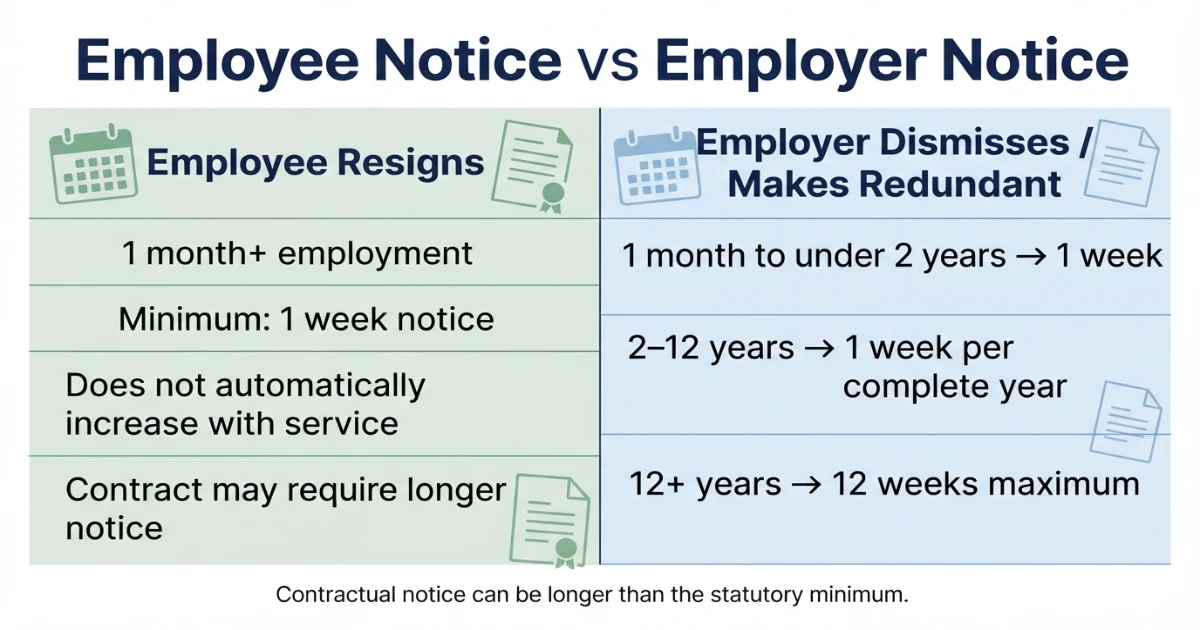
Employee Resigns
After one month of employment, the statutory minimum is generally one week.
It does not automatically rise with years of service.
Employer Dismisses or Makes Employee Redundant
Employer statutory notice can increase with service: 1 week, then one week per complete year between 2 and 12 years, capped at 12 weeks.
For employer notice rules, see: Statutory Notice Periods in the UK Explained .
When Does a Resignation Notice Period Start?
Your employment contract might state when notice starts.
If it does not, Acas guidance says the notice period normally starts on the day after you tell your employer you are resigning.
You tell your employer on Monday that you are resigning.
If your contract does not provide a different rule, your notice period normally starts on Tuesday.
Do You Have to Resign in Writing?
Not always.
GOV.UK says your contract will tell you whether notice must be given in writing. If the contract does not require written notice, resignation may potentially be given verbally.
However, written notice is normally the safer approach because it creates a clear record of:
- the date notice was given;
- the intended last working day;
- the length of notice; and
- what was communicated to the employer.
What Should a Resignation Notice Include?
A simple resignation notice should normally make it clear that you are resigning and state your proposed final day.
You may also wish to include:
- the date of the letter or email;
- your job title;
- your contractual notice period;
- your proposed last day;
- a request for confirmation; and
- any practical handover points.
What If You Have Worked for Less Than One Month?
If you have worked for less than one month and your written terms do not require notice, you generally do not have a statutory obligation to give notice.
However, your written statement or employment contract can still impose a notice requirement.
Always check the actual terms before leaving immediately.
What Is the Resignation Notice Period During Probation?
Probation does not create a separate universal statutory resignation notice.
The key questions remain:
- how long you have worked for the employer; and
- what your contract says.
A probation clause might require one week, two weeks or another period.
If you have completed at least one month and have employee status, the statutory minimum is generally one week even if your contract is silent.
What About Fixed-Term Employees?
A fixed-term employee may also have to give notice if they want to leave before the agreed end date.
GOV.UK says employees ending a fixed-term contract early must generally give one week’s notice if they have worked for the employer for at least one month, unless the contract requires more.
The contract should also be checked to see whether it can be ended early at all.
Can You Leave Before Your Notice Period Ends?
Potentially, but you should agree this with your employer.
If you want to leave early, you can ask your employer to:
- shorten your notice period;
- waive part of the notice;
- agree an earlier final day; or
- use another arrangement such as PILON where appropriate.
Get any agreement in writing.
What Happens If You Leave Without Giving Enough Notice?
If you leave without giving the required notice, you may be in breach of your employment contract.
GOV.UK states that an employer could potentially take legal action if you do not give enough notice or if you give notice in the wrong form where the contract requires writing.
In practice, the consequences depend on the contract and the losses involved.
Possible consequences
- breach-of-contract dispute;
- loss of certain contractual payments;
- issues with bonuses or commission;
- problems with references or handover;
- potential legal claim for losses in some cases.
Can You Resign Without Notice if the Employer Seriously Breaches the Contract?
Potentially.
Acas notes that the one-week minimum can be affected where the employer has seriously breached the employee’s contract.
Examples can be fact-specific, and leaving without notice on this basis can create legal risk.
Anyone considering resignation because of a serious contractual breach should consider taking individual employment-law advice before acting.
Do You Get Paid During Your Resignation Notice?
Usually, yes.
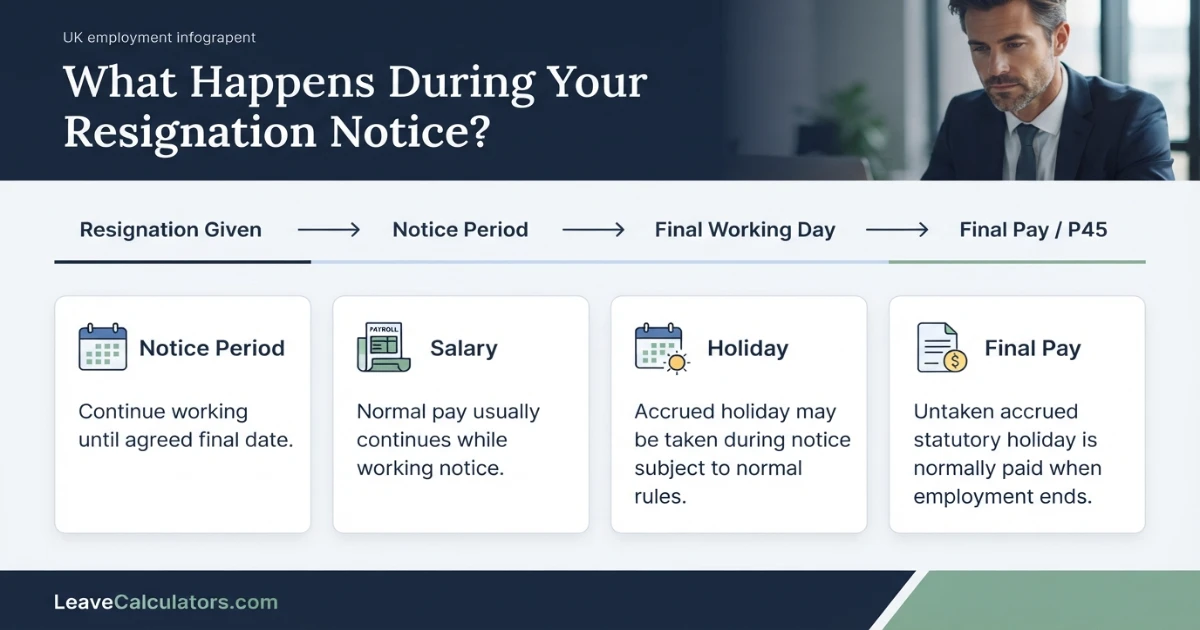
If you continue working normally during your notice period, you normally receive your usual pay.
GOV.UK also states that bonuses and commission remain payable during notice unless the contract says otherwise.
Special rules can affect notice pay if you are away from work during notice because of sickness, family leave or another reason.
Can You Take Holiday During Your Notice Period?
Potentially, yes.
You may be able to use accrued statutory holiday during your notice period, subject to the usual holiday-booking rules and any contractual arrangements.
An employer can also require holiday to be taken if the correct notice is given.
Any accrued statutory holiday that remains untaken when employment ends must normally be paid.
Can Your Employer Put You on Garden Leave After You Resign?
Potentially, yes, depending on the employment contract and circumstances.
On garden leave, you remain employed during the notice period but are told not to carry out your normal duties.
You normally continue receiving salary and contractual benefits during that period.
For more detail, see: Garden Leave vs PILON: What Is the Difference? .
Can Your Employer Pay You in Lieu After You Resign?
Potentially.
GOV.UK says your employer can ask you to leave immediately after you hand in your notice and may offer payment in lieu instead of requiring you to work the notice period.
PILON generally requires either:
- a contractual right; or
- your agreement.
PILON is normally taxable as employment earnings.
See: PILON Tax Explained: Pay in Lieu of Notice .
Can You Start a New Job During Your Notice Period?
Usually not before your existing employment has ended unless your employer agrees.
You remain employed during the notice period and are still bound by your employment contract.
This can include duties relating to:
- working hours;
- confidentiality;
- competition;
- conflicts of interest; and
- other contractual obligations.
If a new employer wants you to start sooner, ask your current employer for a written early-release agreement.
Can You Withdraw a Resignation?
Not automatically.
GOV.UK says that if you resign in the heat of the moment and later change your mind, you should tell your employer immediately.
The employer can decide whether to allow you to withdraw the resignation.
What If You Are Sick During Your Notice Period?
You can remain on sick leave during a resignation notice period, but the amount of pay due can depend on your contract and the relationship between your contractual dismissal notice and the statutory notice period.
Acas notes that notice-pay rules can become more complicated where an employee is absent because of sickness or family leave during a resignation notice.
Do not automatically assume normal salary will apply for every day of absence.
What If You Resign During Maternity or Other Family Leave?
The normal resignation-notice principles can still apply.
However, pay during the notice period can depend on the contract and whether you are receiving maternity, adoption, paternity or shared parental pay.
The timing can also affect:
- final salary;
- statutory family payments;
- holiday accrual;
- benefits; and
- the final employment date.
What Should Your Final Pay Include?
Depending on your circumstances, final pay may include:
- salary up to the leaving date;
- notice pay;
- payment for unused accrued holiday;
- bonuses or commission due under the contract;
- expenses owed; and
- other contractual payments.
You should also receive your P45 after leaving.
What If You Resign During a Redundancy Process?
This needs particular care.
Resigning before a redundancy dismissal takes effect can affect statutory redundancy-pay entitlement.
If you have already received redundancy notice and want to leave early for a new job, special counter-notice rules may be relevant instead of simply resigning.
For the employer-notice side, see: Statutory Notice Periods in the UK Explained .
Common Resignation Notice Mistakes
1. Assuming notice increases with years of service
For employee resignation, the statutory minimum remains one week after one month of service. A longer period usually comes from the contract.
2. Ignoring the employment contract
A contract may require one month, three months or another longer notice period.
3. Giving verbal notice when the contract requires writing
This can create a dispute over whether proper notice was given.
4. Starting a new job before the current employment ends
The employee remains bound by the existing employment contract throughout the notice period unless an early release is agreed.
5. Forgetting accrued holiday
Untaken accrued statutory holiday should normally be accounted for when the employment ends.
How to Check Your Resignation Notice Period
- Confirm that you have employee status.
- Check how long you have worked for the employer.
- Read your written statement and employment contract.
- Identify the contractual resignation notice period.
- Check whether notice must be given in writing.
- Work out when the notice period starts.
- Calculate your intended final employment date.
- Check holiday already taken and holiday still accrued.
- Check bonus, commission and benefits rules.
- Get any shortened-notice agreement in writing.
Leaving Because of Redundancy?
Resignation notice and employer redundancy notice are different. If your role is being made redundant, also check your statutory redundancy entitlement and notice rights before resigning early.
Use the UK Redundancy Pay CalculatorFrequently Asked Questions
How much notice do I have to give when resigning in the UK?
If you have been employed for at least one month, the statutory minimum is normally one week. Your employment contract can require a longer period.
Do I have to give notice if I have worked less than one month?
Generally there is no statutory resignation-notice requirement if you have worked for less than one month, unless your written terms require notice.
Does resignation notice increase with years of service?
No. The statutory employee resignation minimum remains one week after one month of employment. Longer notice usually comes from the employment contract.
When does my resignation notice start?
If your contract does not say otherwise, the notice period normally starts the day after you tell your employer that you are resigning.
Do I have to resign in writing?
Only if your contract or written terms require it, but written notice is usually best because it creates a clear record.
Can I leave before my notice period ends?
Yes, if your employer agrees to an earlier leaving date. Leaving without agreement can amount to breach of contract.
Can I take holiday during my notice period?
Potentially yes, subject to the normal holiday-booking rules and the employer’s right to control when leave is taken.
What happens to unused holiday when I resign?
Untaken accrued statutory holiday must normally be paid when employment ends.
Can my employer put me on garden leave after I resign?
Potentially yes, depending on the contract and circumstances. You normally remain employed and paid during garden leave.
Can my employer give me PILON after I resign?
Potentially. PILON may be used where the contract allows it or where you agree to it. The payment is normally taxable employment income.
Final Answer: Resignation Notice Periods in the UK
Resignation notice periods in the UK are simpler than employer dismissal notice rules.
If you are legally an employee and have worked for the employer for at least one month, the statutory minimum resignation notice is normally one week.
That one-week minimum does not automatically increase with years of service. However, your employment contract can require a longer notice period, and that contractual period will usually determine how much notice you need to give.
Your notice normally starts the day after you resign unless your contract says otherwise.
During the notice period, you normally remain employed and continue to have contractual obligations. Salary, holiday, benefits, garden leave, PILON and a new job start date can all depend on how the notice period is handled.
Before handing in your resignation, check your contract carefully, calculate your proposed final day and get any agreement to shorten the notice period in writing.