Redundancy Pay Weekly Pay Cap Explained
The statutory redundancy formula does not always use your full weekly salary. If you earn above the legal weekly limit, your redundancy calculation is capped. This guide explains exactly how the redundancy pay weekly pay cap works in 2026, who it affects, and what it can mean for your final payment.
Applies to statutory redundancy calculations in Great Britain from 6 April 2026.

If you are being made redundant, your normal salary is only one part of the calculation. Statutory redundancy pay is based on your age, qualifying years of continuous service and a figure known as a week’s pay. That weekly figure is subject to a legal maximum.
For redundancies taking effect on or after 6 April 2026, the maximum weekly pay that can be used in the statutory redundancy calculation in Great Britain is £751. The previous statutory limit was £719. Because the maximum number of qualifying years is 20 and the highest age multiplier is 1.5 weeks for each qualifying year, the maximum statutory redundancy payment is £22,530.
Redundancy Pay Weekly Pay Cap Explained for 2026
The weekly pay cap is the maximum amount of weekly earnings that can be used when calculating statutory redundancy pay. It does not mean your actual salary is capped, and it does not prevent your employer from providing a more generous redundancy package.
It simply limits the weekly amount used for the statutory minimum calculation.
For example, an employee earning £600 a week is below the 2026 cap, so £600 can normally be used. An employee earning £900 a week is above the cap, so the statutory calculation will generally use £751 instead of £900.
| Actual qualifying weekly pay | Weekly amount used for statutory calculation |
|---|---|
| £450 | £450 |
| £650 | £650 |
| £751 | £751 |
| £900 | £751 |
| £1,250 | £751 |
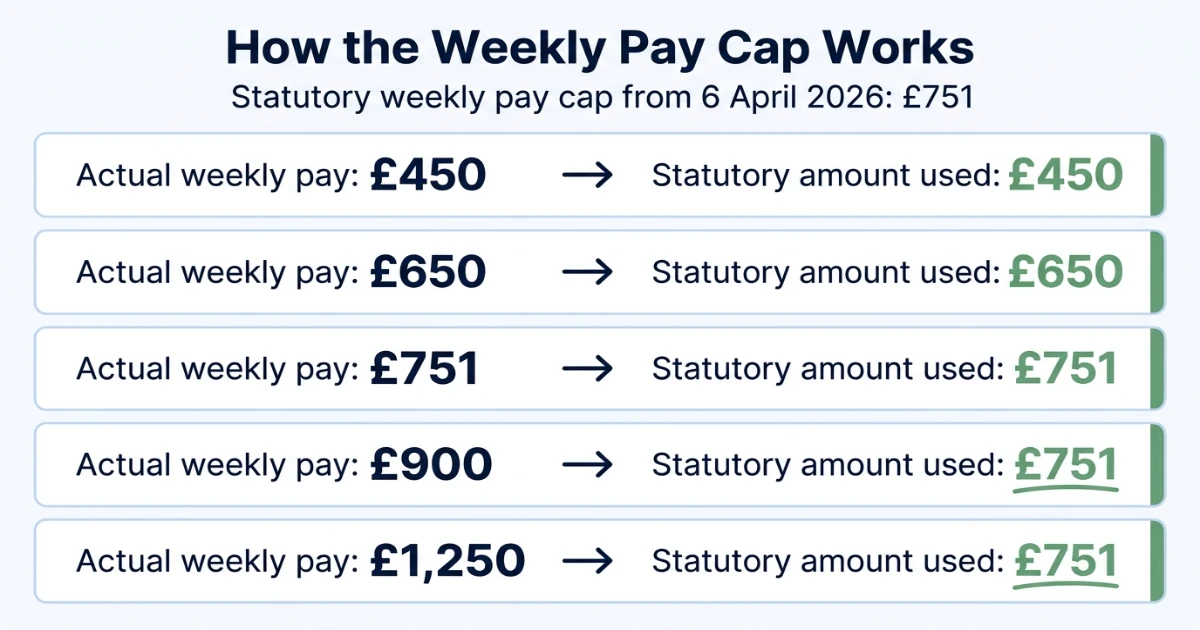
This is why higher earners can receive a statutory payment that is much lower than the amount they might expect if they simply multiplied their full salary by their qualifying years.
Why Is There a Weekly Pay Cap?
Statutory redundancy pay is designed to provide a legal minimum rather than to replace all lost earnings. The weekly limit creates a standard ceiling for the statutory scheme.
The cap can change over time. For redundancies taking effect on or after 6 April 2026, the maximum amount of a week’s pay used for the statutory redundancy calculation is £751.
That change matters because even a relatively small increase in the weekly limit can alter the final redundancy payment for someone with long qualifying service.
How the Weekly Pay Cap Fits Into the Redundancy Formula
Statutory redundancy pay is calculated using three main factors:
- your age during each complete qualifying year;
- your number of complete years of continuous employment, up to 20 years; and
- your qualifying weekly pay, subject to the statutory cap.
The age multipliers are:
| Age during qualifying year | Weeks of pay earned for that year |
|---|---|
| Under 22 | 0.5 week |
| 22 to 40 | 1 week |
| 41 or over | 1.5 weeks |
Qualifying service is capped at 20 years and weekly pay is capped at £751 for qualifying redundancies from 6 April 2026.
For a deeper explanation of the age multipliers, see How Age Affects Statutory Redundancy Pay .
Examples of How the £751 Weekly Cap Changes Redundancy Pay
Example 1: Weekly Pay Below the Cap
Assume an employee has 10 qualifying years that each attract one week’s pay and earns £600 per week.
10 × £600 = £6,000
Because £600 is below the £751 cap, the employee’s full qualifying weekly pay is used.
Example 2: Weekly Pay Above the Cap
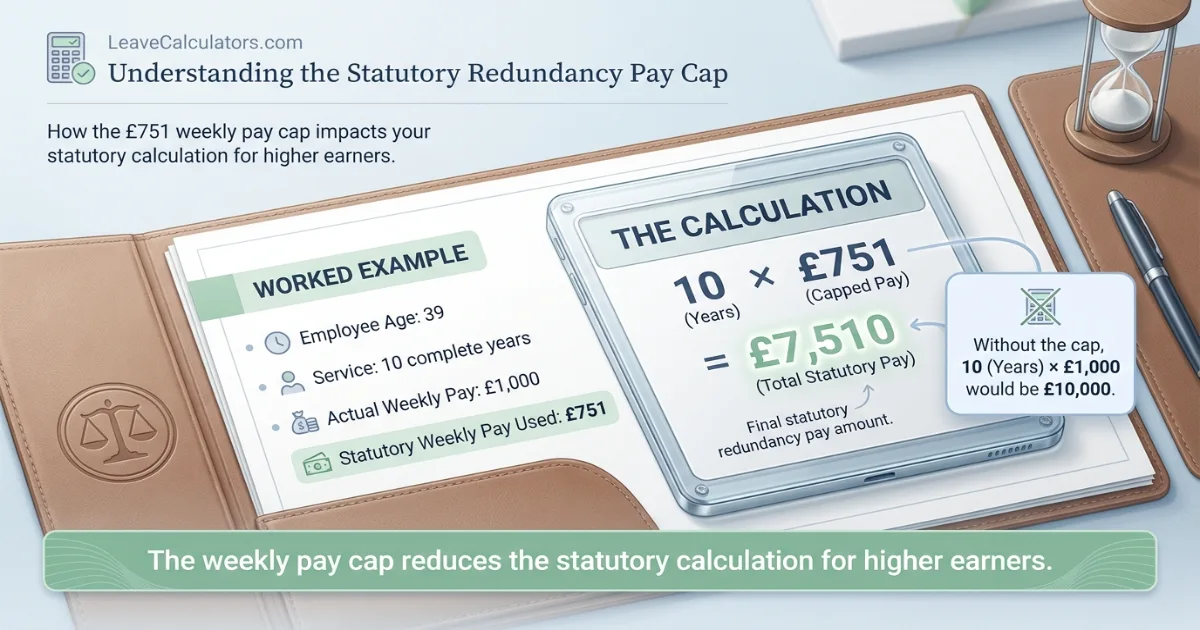
Assume another employee has the same 10 qualifying years but earns £1,000 per week.
The statutory calculation cannot use the full £1,000. It uses £751.
10 × £751 = £7,510
Example 3: Employee Aged 41 or Over
Suppose an employee has 10 complete qualifying years, all counted at the 1.5-week multiplier, and earns £900 per week.
The calculation uses the £751 statutory cap:
10 × 1.5 × £751 = £11,265
Example 4: Maximum Statutory Payment
The highest statutory calculation occurs where all 20 qualifying years attract the 1.5-week multiplier and the employee earns at least the weekly cap.
20 × 1.5 × £751 = £22,530
That is the maximum statutory redundancy payment under the 2026 Great Britain limits.
How Is Your Weekly Pay Worked Out?
If you have fixed hours and regular pay, working out your weekly figure can be straightforward. If your earnings vary, the calculation can be more complicated.
GOV.UK states that redundancy weekly pay is generally based on the average earned per week over the 12 weeks before the day you received redundancy notice.
If you are not paid weekly, your earnings can be converted into a weekly figure. Where earnings vary, an average may need to be used.
Can Overtime Be Included?
Contractual or guaranteed overtime can be relevant when determining a week’s pay. The exact treatment depends on the employment arrangement and the nature of the overtime.
Can Commission and Bonuses Be Included?
Contractual commission and bonuses may also form part of the weekly-pay calculation in some circumstances. The exact treatment depends on the terms of employment and the nature of the payment.
Even where these elements increase average weekly earnings, the statutory redundancy calculation remains subject to the £751 limit.
What Does the Weekly Cap Mean for High Earners?
The cap matters most to employees whose normal weekly earnings exceed £751.
Someone earning £1,200 per week might assume a redundancy calculation will use £1,200, but the statutory minimum is calculated using no more than £751 per week.
For example, 15 qualifying weeks at £1,200 would equal £18,000 if the full salary were used. Under the statutory cap, 15 weeks at £751 equals £11,265.
That is a difference of £6,735.
This does not necessarily mean the employee will receive only the statutory amount. Many employers provide an enhanced package, particularly where redundancy terms are set out in a contract, staff handbook, collective agreement or company policy.
Can an Employer Ignore the Cap and Pay More?
Yes. The weekly cap limits the statutory minimum calculation, not the maximum redundancy package an employer can offer.
An enhanced redundancy scheme could:
- use the employee’s actual weekly salary instead of £751;
- offer two or more weeks of pay for each qualifying year;
- use more generous service rules;
- offer redundancy pay before two years of service; or
- provide an additional severance payment.
Employees should compare the statutory calculation with their employer’s contractual or enhanced redundancy policy rather than assuming the statutory amount is the final figure.
Does the Weekly Pay Cap Apply If You Have Less Than Two Years’ Service?
Statutory redundancy pay normally requires at least two years of continuous employment. If you do not meet that qualifying period, the statutory redundancy calculation usually does not apply.
However, an employer can still offer contractual or enhanced redundancy pay with a shorter qualifying period. If that happens, the employer’s own scheme determines how the payment is calculated.
What Was the Redundancy Weekly Pay Cap Before April 2026?
Before 6 April 2026, the relevant statutory weekly limit was £719. From 6 April 2026, it increased to £751.
| Relevant period | Weekly statutory limit |
|---|---|
| Before 6 April 2026 | £719 |
| From 6 April 2026 | £751 |
The redundancy date matters. Do not automatically use the latest figure for an earlier redundancy.
Does the £751 Cap Also Apply to Notice Pay and Holiday Pay?
For ordinary statutory redundancy calculations, the £751 figure is specifically important as the cap on a week’s pay. Different rules can apply to other payments in a normal redundancy package.
Where an employer is insolvent and eligible claims are made through the Insolvency Service, statutory limits can also apply to certain unpaid wages, holiday pay and notice-related payments.
This insolvency framework should not be confused with how every solvent employer calculates contractual notice or ordinary holiday pay.
What Happens If Your Employer Is Insolvent?
If your employer becomes formally insolvent and cannot pay what you are owed, eligible employees may be able to claim certain amounts through the government’s Redundancy Payments Service.
For qualifying redundancies from 6 April 2026, statutory redundancy calculations remain subject to the £751 weekly cap and the 20-year service limit.
Common Mistakes When Using the Weekly Pay Cap
1. Using Monthly Salary Instead of Weekly Pay
The statutory calculation is based on a week’s pay. Monthly salary should not simply be inserted into a weekly formula without the proper conversion.
2. Using Full Salary When Earnings Exceed the Cap
If the qualifying weekly amount exceeds £751 for a redundancy taking effect on or after 6 April 2026, the statutory calculation should normally use £751.
3. Applying the Cap Before Working Out Weekly Pay
Where pay varies, first determine the appropriate weekly-pay figure and then apply the statutory limit if necessary.
4. Assuming Every Year Uses the Same Age Multiplier
The weekly cap is only one part of the formula. Age bands determine whether each qualifying year attracts half a week, one week or one and a half weeks of pay.
5. Counting More Than 20 Years
Statutory redundancy pay only counts a maximum of 20 qualifying years.
6. Treating the Statutory Cap as a Limit on Enhanced Redundancy
An employer can offer more generous contractual terms. The statutory limit does not prevent an employer from using a higher salary figure under an enhanced redundancy scheme.
How to Check Whether Your Redundancy Payment Is Correct
Before accepting the calculation, gather the information used to produce it.
- Confirm your exact continuous employment dates.
- Check how many complete years count, up to the 20-year maximum.
- Identify your age during each qualifying year.
- Work out the appropriate weekly pay figure.
- Apply the £751 cap if the redundancy takes effect on or after 6 April 2026.
- Check whether your employer offers enhanced redundancy terms.
- Compare redundancy pay separately from notice pay, holiday pay and outstanding wages.
Check Your Redundancy Estimate
Use the UK Redundancy Pay Calculator to estimate your statutory payment using your age, weekly pay and qualifying service.
Use the UK Redundancy Pay CalculatorRedundancy Weekly Pay Cap: 2026 Summary
| Rule | 2026 position |
|---|---|
| Weekly statutory pay cap | £751 from 6 April 2026 |
| Previous weekly cap | £719 |
| Minimum qualifying service | Normally 2 years |
| Maximum service counted | 20 complete years |
| Maximum age multiplier | 1.5 weeks for each qualifying year aged 41+ |
| Maximum statutory redundancy pay | £22,530 |
Frequently Asked Questions
What is the redundancy pay weekly pay cap in 2026?
The statutory weekly pay cap is £751 for redundancies taking effect on or after 6 April 2026 in Great Britain.
What if I earn less than £751 a week?
Your actual qualifying weekly pay will normally be used if it is below the statutory maximum.
What if I earn more than £751 a week?
The statutory redundancy calculation normally uses £751 rather than your higher weekly earnings. An enhanced company scheme can still pay more.
Is £751 the most an employer can pay me per week of redundancy?
No. It is the statutory calculation limit. Employers can provide enhanced redundancy packages using higher figures.
How is weekly pay calculated if my earnings vary?
Redundancy weekly pay is generally based on an average over the 12 weeks before redundancy notice. Contractual overtime, bonuses or commission can sometimes be relevant.
What is the maximum statutory redundancy payment in 2026?
The maximum statutory redundancy payment is £22,530 for qualifying redundancies from 6 April 2026 in Great Britain.
Does the redundancy weekly cap apply in Northern Ireland?
Northern Ireland has separate statutory redundancy rules and limits, so the Great Britain figures in this guide should not automatically be used for a Northern Ireland redundancy.
Final Takeaway
The redundancy pay weekly pay cap can have a major impact on statutory redundancy pay, particularly for employees earning above the legal weekly limit.
For redundancies taking effect from 6 April 2026 in Great Britain, statutory weekly pay is capped at £751. Even if you earn significantly more, the statutory calculation normally uses no more than that amount.
Combined with the 20-year service limit and the maximum 1.5-week age multiplier, this produces a maximum statutory redundancy payment of £22,530.
The key word is statutory. The cap sets the ceiling for the legal minimum calculation, but it does not stop an employer from offering a more generous redundancy package.