Redundancy Pay for Company Directors
Redundancy pay for company directors is not automatic simply because you hold a directorship. A director may qualify if they were also genuinely employed by the company under an employment contract. This guide explains the employee-status test, 2026 statutory limits, insolvency claims, evidence requirements and how director redundancy pay is calculated.

The question of redundancy pay for company directors is more complicated than an ordinary employee redundancy because a director can hold two different legal roles at the same time.
A director is an office holder of the company. But the same person can also be an employee working under a contract of employment.
That distinction matters because statutory redundancy rights belong to employees. A person who is only a director or shareholder, without employee status, will not normally qualify for statutory redundancy pay simply because the company closes or becomes insolvent.
However, a genuine director-employee can potentially have the same statutory redundancy rights as another eligible employee.
Can a Company Director Get Redundancy Pay?
Yes, potentially.
GOV.UK guidance for directors specifically confirms that a director, although an office holder, can also be an employee and may therefore qualify for redundancy-related payments.
The central question is not simply:
“Were you a director?”
The important question is: “Were you also genuinely employed by the company?”
If the answer is yes, statutory redundancy rights may apply.
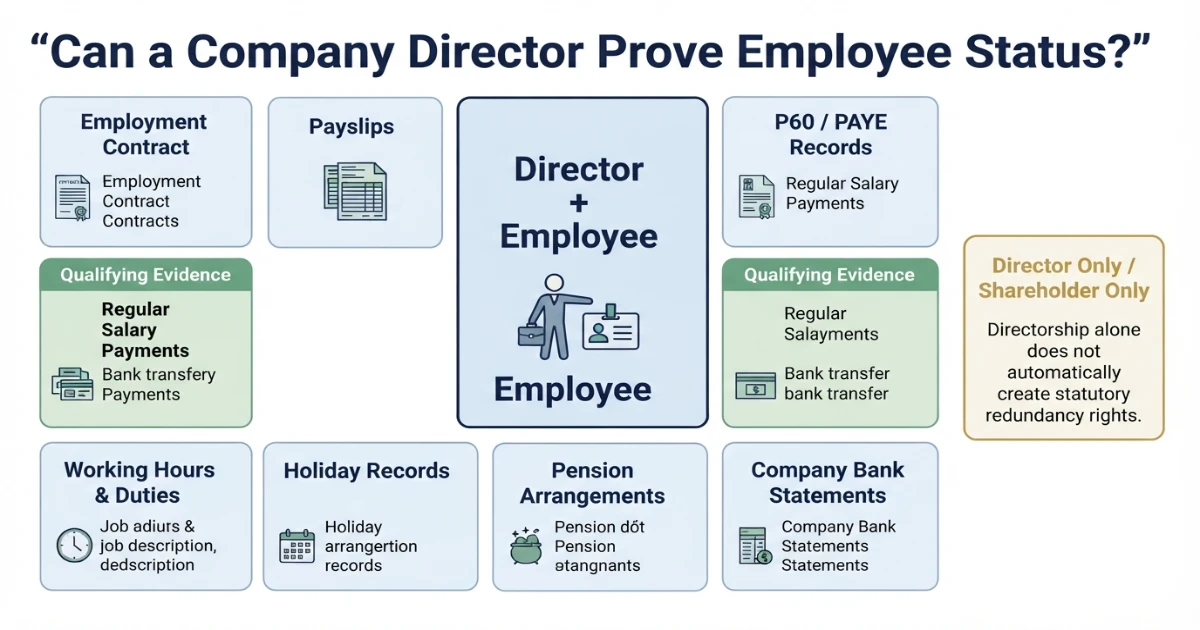
Director + Employee
A director who also works under a genuine employment relationship may qualify for statutory redundancy pay and other employment-related insolvency payments.
Director Only
A person who is only an office holder, shareholder or contractor and cannot establish employee status will not normally qualify for employee redundancy payments.
What Makes a Director an Employee?
There is no single document that automatically proves employee status in every case.
The Insolvency Service can consider the wider working relationship and whether a contract of employment existed. The contract may be written, verbal or implied by the way the relationship operated.
Evidence can include:
- a written employment contract;
- regular salary payments;
- PAYE records;
- P60s;
- payslips;
- working hours and duties;
- holiday arrangements;
- sick leave arrangements;
- workplace pension arrangements;
- disciplinary and grievance procedures; and
- the overall way the company treated the director’s employment.
This is particularly important in owner-managed limited companies where the director is also a shareholder.
What Evidence Can the Insolvency Service Ask a Director For?
When a director makes a redundancy-related claim after formal insolvency, the Insolvency Service may ask for additional information before deciding whether the claimant was an employee.
Its published director guidance says evidence may include:
- the company’s directorship and shareholding structure;
- the last three years’ P60s;
- the last three months’ wage slips;
- company bank statements showing regular salary payments;
- information about contracted hours and work actually performed;
- whether National Minimum Wage rules were relevant and followed;
- a copy of the employment contract;
- evidence that the contract’s terms were actually followed;
- dividends received;
- holiday arrangements;
- pension arrangements;
- sick-leave procedures; and
- grievance and disciplinary procedures.
A director should therefore avoid relying on one piece of evidence alone.
Can a Shareholder-Director Claim Redundancy?
Being a shareholder does not automatically prevent a director from being an employee.
Likewise, having significant control over the company does not automatically mean that employee status is impossible.
The question remains whether a genuine employment relationship existed.
For example, a director who owns shares but also works regular hours, receives PAYE salary, has defined employment duties and follows employment arrangements may have stronger evidence of employee status than someone who only draws dividends and operates solely as an office holder.
What If a Director Was Paid Mainly Through Dividends?
Many owner-directors take a combination of salary and dividends.
Dividends themselves are not employment salary. A high level of dividend income does not automatically destroy employee status, but the Insolvency Service can examine how the director was actually paid and whether regular employment remuneration existed.
This is one reason director claims can receive more scrutiny than ordinary employee claims.
Practical point
If your company paid you a small PAYE salary plus dividends, the statutory redundancy calculation is not automatically based on total dividends. Employee pay and the applicable definition of weekly pay need to be considered separately.
Do Company Directors Need Two Years’ Service?
For statutory redundancy pay, the usual qualifying rule applies.
A director who is also an employee will normally need at least two years of continuous employment to qualify for statutory redundancy pay.
Being a director for two years is not necessarily the same as proving two years of continuous employment.
The relevant question is how long the employment relationship lasted.
How Is Redundancy Pay for Company Directors Calculated?
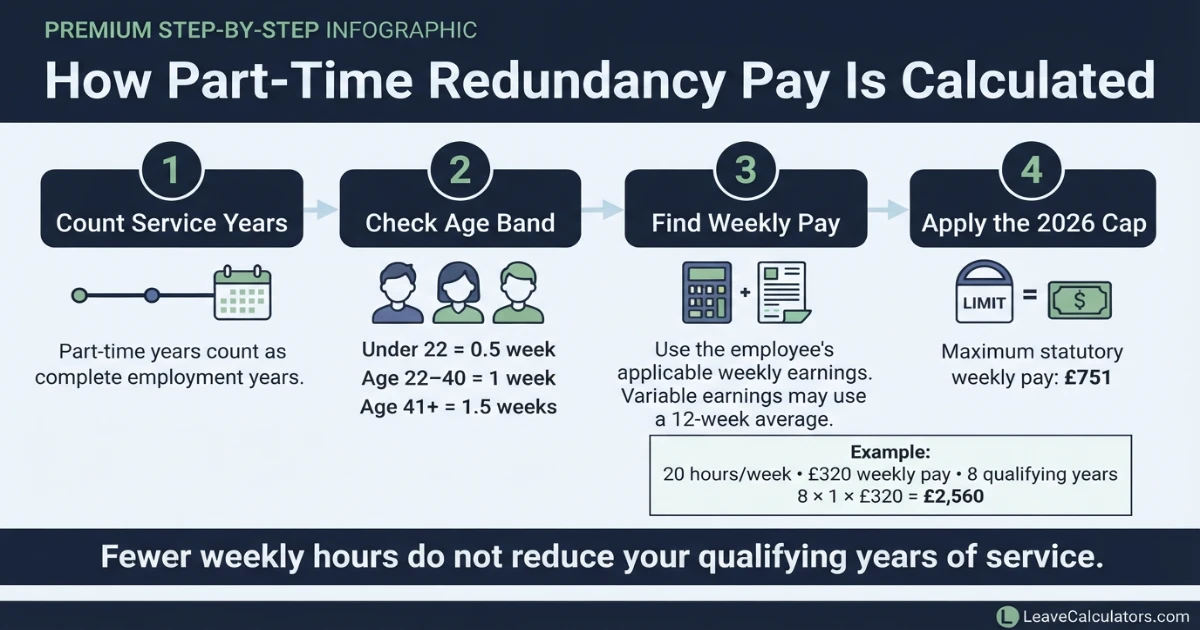
Once a director has established employee status and meets the usual eligibility requirements, the statutory calculation follows the normal redundancy formula.
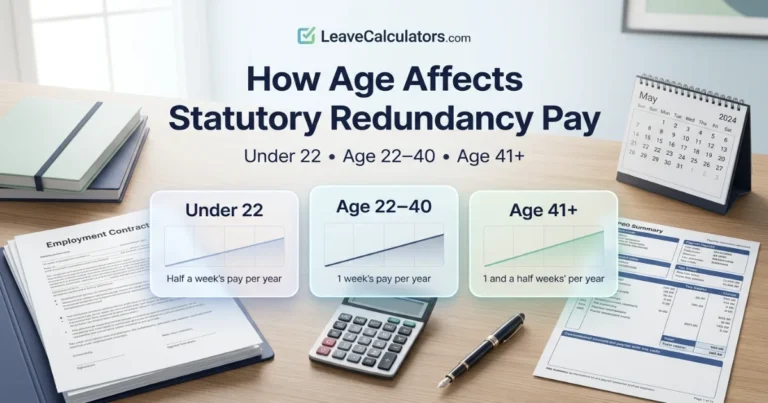
| Age During Qualifying Year | Statutory Entitlement |
|---|---|
| Under 22 | 0.5 week’s pay for each complete qualifying year |
| Age 22 to 40 | 1 week’s pay for each complete qualifying year |
| Age 41 or over | 1.5 weeks’ pay for each complete qualifying year |
Company Director Redundancy Pay Limits in 2026
For qualifying redundancies taking effect on or after 6 April 2026 in Great Britain:
- weekly pay is capped at £751;
- no more than 20 years of qualifying service can count; and
- maximum statutory redundancy pay is £22,530.
Maximum statutory formula:
20 years × 1.5 weeks × £751 =
£22,530
Worked Example: Director Who Is Also an Employee
Assume a company director:
- has a genuine employment contract;
- has 10 complete qualifying employee years;
- has all 10 years in the 41+ age band;
- has qualifying weekly pay of £900.
Actual weekly pay: £900
Statutory weekly amount used: £751
Estimated statutory redundancy pay: £11,265
This calculation only becomes relevant once the director has established that they were an employee and otherwise qualify for statutory redundancy pay.
What If the Company Is Still Solvent?
A director does not need the company to be insolvent before statutory redundancy rights can exist.
If a company genuinely makes a director-employee redundant while the company is still able to pay its debts, the company would normally be responsible for the redundancy payment in the same way as for another eligible employee.
The special Insolvency Service process becomes particularly important when the company enters formal insolvency and cannot make the payments itself.
What Happens If the Company Becomes Insolvent?
If the employer enters formal insolvency and cannot pay employees what they are owed, eligible employees may be able to claim from the National Insurance Fund through the Insolvency Service’s Redundancy Payments Service.
For a director, the key extra issue is proving employee status.
If the Insolvency Service accepts that the director was an employee, potential claims can include qualifying amounts for:
- statutory redundancy pay;
- certain unpaid wages;
- holiday pay;
- commission or other contractual sums in some circumstances; and
- statutory notice-related compensation.
Different statutory caps and limits apply to the different categories.
How Does a Director Claim From the Redundancy Payments Service?
The main redundancy and money-owed application is made through the GOV.UK redundancy claim service after the employer enters the relevant insolvency process.
You normally need information such as:
- the insolvency case reference number;
- your National Insurance number;
- your employment start and end dates;
- your redundancy date;
- your pay details;
- holiday entitlement;
- amounts owed by the company; and
- supporting correspondence.
Directors do not normally submit all employee-status evidence at the initial online stage. The Insolvency Service can contact the director afterwards and ask for the additional evidence it needs.
What Is the Director’s Questionnaire?
The Insolvency Service uses additional questions when it needs to assess whether a director who has made a claim was also an employee.
The director may therefore be asked for more detail about:
- their role in the company;
- share ownership;
- employment duties;
- working hours;
- salary;
- dividends;
- employment documents; and
- how the employment relationship operated in practice.
Can a Director Claim Notice Pay?
An eligible director-employee may also be able to claim statutory notice compensation if the company is insolvent and the relevant conditions are met.
The notice-pay application is separate from the primary redundancy claim.
The Insolvency Service can again examine the director’s employment status and may request additional information.
Can a Director Claim Unpaid Wages?
Potentially, yes, where the director was genuinely an employee and qualifying contractual wages are owed.
In formal insolvency, government limits apply to what can be paid from the National Insurance Fund.
For eligible claims, unpaid wages and certain other amounts are also subject to weekly statutory caps.
Can a Director Claim Holiday Pay?
A director who was also an employee may potentially have employee holiday rights and may be able to claim qualifying unpaid holiday pay following insolvency.
Evidence that the company actually operated holiday entitlement can also help support the wider argument that a genuine employment relationship existed.
What If There Is No Written Employment Contract?
A missing written contract does not necessarily end the claim.
The Insolvency Service’s own director guidance recognises that an employment contract can be express or implied.
However, proving the employment relationship can become harder without clear documents.
Useful evidence might include:
- PAYE records;
- salary transfers;
- payslips;
- P60s;
- emails describing employment duties;
- holiday records;
- pension contributions; and
- other evidence showing regular employment arrangements.
Does National Minimum Wage Matter?
The Insolvency Service may ask whether National Minimum Wage was paid and how the claimed hours compare with the work actually performed.
This does not mean that every director’s redundancy claim is automatically determined by one minimum-wage test.
Instead, it forms part of the broader examination of whether the claimed employment relationship was genuine.
Does Controlling the Company Prevent a Director Claim?
Not automatically.
A director can have substantial influence or control and still potentially be an employee.
The specific facts of the employment relationship matter.
This is why a director should not assume that being the sole director or a major shareholder automatically makes a redundancy claim impossible.
Is Company Director Redundancy Pay Taxable?
The tax treatment of redundancy pay for a qualifying director-employee follows the normal termination-payment rules.
The first combined £30,000 of qualifying statutory redundancy and additional severance or enhanced redundancy payments can generally benefit from the termination-payment Income Tax threshold.
However, salary, holiday pay, bonuses and notice-related earnings are normally taxed separately as employment earnings.
For more detail, see: Is Redundancy Pay Taxable in the UK?
What If a Director’s Claim Is Rejected?
The Insolvency Service can reject a claim if it is not satisfied that the director was an employee.
A rejected director should read the decision carefully and identify which part of the employee-status evidence was considered insufficient.
GOV.UK guidance explains that a director who disagrees with the decision may be able to take the issue to an employment tribunal.
Strict time limits can apply, and redundancy-pay claims have different timing rules from some other employment claims.
A claimant normally needs to notify Acas before starting an employment tribunal claim.
Documents a Director Should Gather
Before making or defending a claim, assemble as much contemporaneous evidence as possible.
| Document / Evidence | Why It May Help |
|---|---|
| Employment contract | Shows agreed employment duties and terms. |
| Payslips | Shows salary and payroll treatment. |
| P60s | Supports PAYE employment history. |
| Company bank statements | Can show regular salary payments. |
| Holiday records | May support genuine employee arrangements. |
| Pension records | Can support employee status. |
| Working-hour records | Shows actual work performed. |
| Board / company records | Helps distinguish director duties from employment duties. |
| Dividend records | Helps explain how remuneration was structured. |
Common Director Redundancy Pay Mistakes
1. Assuming being a director automatically creates redundancy rights
Statutory redundancy rights depend on employee status, not directorship alone.
2. Assuming being a shareholder automatically prevents a claim
Shareholding or control does not automatically prevent a director from also being an employee.
3. Having no evidence of an employment relationship
A director claim can be difficult if there are no contracts, payslips, PAYE records or evidence of employment arrangements.
4. Treating dividends as weekly employee pay
Dividends and employment salary are different. The statutory redundancy calculation is based on the relevant employee-pay rules.
5. Assuming company closure automatically means redundancy
The person still needs to satisfy the employee and statutory eligibility requirements.
How to Check Whether You May Qualify
- Confirm whether you were a director, employee or both.
- Check whether a genuine employment contract existed.
- Confirm your continuous employee service dates.
- Check that you have at least two qualifying years for statutory redundancy pay.
- Gather PAYE, P60 and payslip evidence.
- Gather proof of regular salary payments.
- Review holiday, pension and employment procedures.
- Calculate your statutory redundancy entitlement.
- If the company is insolvent, obtain the insolvency case reference.
- Be prepared to answer additional Insolvency Service questions about employee status.
Estimate Your Statutory Redundancy Pay
If you were a company director and also a genuine employee, calculate the statutory baseline using your age, weekly pay and qualifying service.
Use the UK Redundancy Pay CalculatorFrequently Asked Questions
Can a company director claim redundancy pay?
Potentially, yes. A company director can qualify if they were also genuinely employed by the company and meet the normal statutory redundancy requirements.
Does being a director automatically make you an employee?
No. A director is an office holder. Employee status must be established separately from the directorship.
Can a sole director claim redundancy pay?
Potentially, yes. Being the sole director does not automatically prevent a claim, but the director must still establish genuine employee status and meet the statutory eligibility conditions.
Can a shareholder-director get redundancy pay?
Potentially. Shareholding does not automatically prevent employee status. The actual employment relationship and supporting evidence are important.
How much redundancy pay can a company director receive in 2026?
For an eligible director-employee in Great Britain, statutory weekly pay is capped at £751 for qualifying redundancies from 6 April 2026, service is capped at 20 years and maximum statutory redundancy pay is £22,530.
Do directors need two years’ service for redundancy pay?
Statutory redundancy pay normally requires at least two years of continuous employment. The director must therefore establish qualifying employment service, not merely the length of the directorship.
Can a director claim if the company is insolvent?
Yes, potentially. If the company is formally insolvent and the director was also an employee, they may be able to claim qualifying redundancy-related payments through the Insolvency Service.
What evidence does a director need for a redundancy claim?
Evidence can include an employment contract, P60s, payslips, regular salary payments, company bank statements, working-hour records, holiday and pension arrangements and other information showing a genuine employment relationship.
Can a director claim redundancy without a written employment contract?
Potentially. The Insolvency Service recognises that a contract may be express or implied, although proving employee status can be more difficult without clear written evidence.
Final Answer: Redundancy Pay for Company Directors
Redundancy pay for company directors depends first on whether the director was also an employee.
Holding a directorship, owning shares or controlling a company does not by itself create statutory redundancy rights. However, it also does not automatically prevent a director from qualifying.
A director who worked under a genuine employment relationship and meets the usual statutory conditions may qualify for redundancy pay using the same age, service and weekly-pay formula as other employees.
For qualifying redundancies from 6 April 2026 in Great Britain, weekly pay is capped at £751, no more than 20 years of service can count and the maximum statutory redundancy payment is £22,530.
Where the company is formally insolvent, the Insolvency Service can pay qualifying claims from the National Insurance Fund, but directors can be asked to provide additional evidence proving their employee status.
The stronger your employment records are, the easier it is to demonstrate that your role was more than simply that of an office holder.