PILON Tax Explained: Pay in Lieu of Notice
PILON tax can be confusing because notice pay and redundancy compensation are taxed differently. This guide explains how pay in lieu of notice works, why PILON is normally subject to Income Tax and National Insurance, how Post-Employment Notice Pay (PENP) works, and why the £30,000 redundancy threshold usually does not apply to notice-equivalent earnings.

When employment ends without an employee working all of their notice period, the employer may pay them instead. This is commonly called payment in lieu of notice, or PILON.
The payment can appear alongside statutory redundancy pay, enhanced severance, holiday pay and final salary. That is where confusion often begins.
The crucial point is that PILON and genuine redundancy compensation are not normally taxed in the same way.
Understanding PILON tax explained properly therefore requires separating notice-related earnings from qualifying termination compensation.
What Is Pay in Lieu of Notice?
PILON is a payment made when employment ends without the employee working all or part of the notice period they would otherwise have been entitled to.
Instead of remaining employed and receiving normal salary throughout notice, the employee may leave immediately or earlier and receive a payment reflecting some or all of the notice pay.
Simple example
An employee is entitled to 8 weeks’ notice but their employer wants employment to end immediately.
Instead of asking them to work the eight weeks, the employer pays an amount in lieu of that notice.
That payment is PILON.
Is PILON Taxable in the UK?
Yes, generally.
HMRC treats notice-equivalent pay as employment earnings.
That means PILON is normally subject to:
- Income Tax through PAYE; and
- Class 1 National Insurance contributions.
Key tax rule: Money that represents what you would have earned during your notice period is normally taxable as earnings rather than treated as tax-free redundancy compensation.
Does the £30,000 Tax-Free Redundancy Threshold Apply to PILON?
Normally, no.
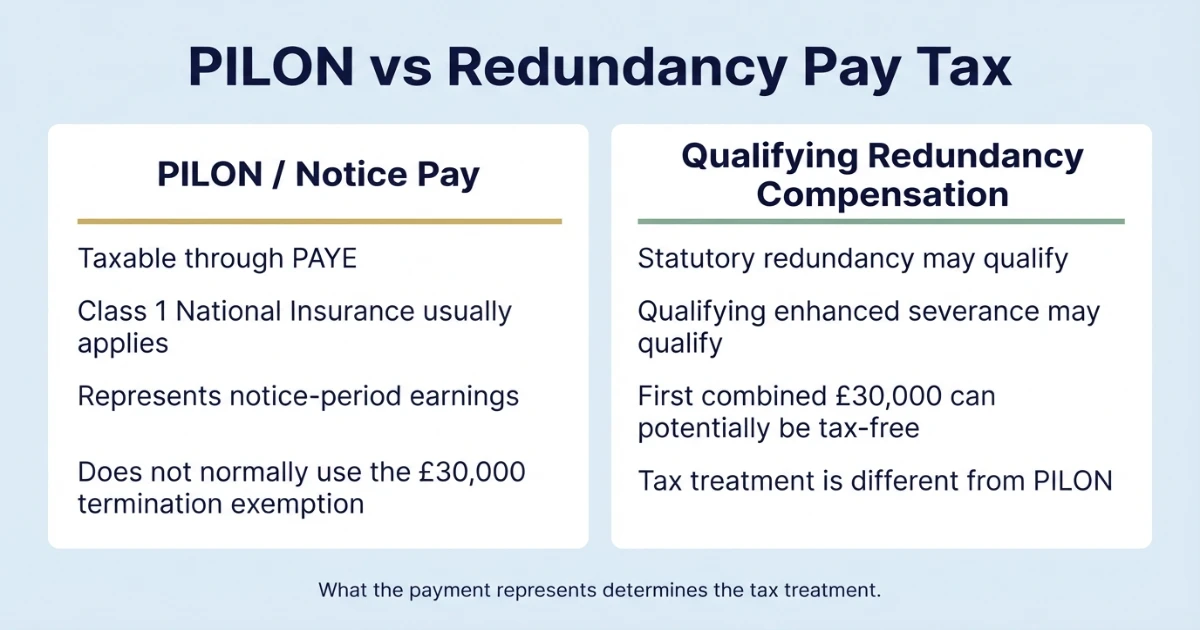
The first combined £30,000 of qualifying statutory redundancy pay and certain additional severance or enhanced redundancy payments can generally benefit from the termination-payment Income Tax threshold.
PILON is different.
Because it represents notice-related earnings, it is generally taxed as employment income and does not simply become tax-free because the total termination package is below £30,000.
PILON / Notice Earnings
- Normally taxable through PAYE.
- Normally subject to Class 1 NICs.
- Does not normally use the £30,000 exemption.
- Represents notice-period earnings.
Qualifying Redundancy Compensation
- Can potentially use the combined £30,000 threshold.
- Statutory redundancy can fall within the exemption.
- Qualifying enhanced severance can also count.
- Different tax treatment from PILON.
What Is Post-Employment Notice Pay (PENP)?
Post-Employment Notice Pay, usually abbreviated to PENP, is a tax concept used to identify the part of a termination award that effectively represents basic pay for an unworked notice period.
The rules are designed to prevent notice-equivalent earnings from being relabelled as tax-free termination compensation.
PENP can arise where an employee:
- receives no notice;
- receives less notice than they are entitled to; or
- receives a wider termination package containing an amount that effectively replaces notice pay.
The PENP amount is treated as general earnings and does not benefit from the £30,000 termination-payment threshold.
PILON vs PENP: What’s the Difference?
PILON and PENP are related but not identical concepts.
| Term | What It Means | Typical Tax Treatment |
|---|---|---|
| PILON | A payment made instead of the employee working all or part of notice. | Normally taxable as earnings. |
| PENP | The tax calculation identifying basic pay attributable to unworked notice within a termination award. | Taxable as earnings and outside the £30,000 exemption. |
In straightforward cases, a contractual PILON may already be taxed as ordinary earnings.
The PENP rules are especially important where a payment is not already fully taxable as ordinary notice pay but part of the wider termination award still represents unworked notice.
Is Contractual PILON Taxable?
Yes.
A contractual PILON is one provided for by the employee’s contractual arrangements, such as:
- the employment contract;
- a side letter;
- a staff handbook;
- a letter of appointment; or
- a redundancy agreement.
HMRC treats contractual PILON as earnings from employment.
It is therefore normally subject to PAYE Income Tax and Class 1 National Insurance.
Is Non-Contractual PILON Taxable?
Since the termination-payment reforms applying from April 2018, the practical tax result is that notice-equivalent pay is still brought into tax even where there is no simple contractual PILON clause.
An employer may therefore need to calculate PENP to identify the amount of basic pay relating to the unworked notice period.
That amount is taxed as employment earnings.
Important: The absence of a PILON clause does not automatically make notice-related pay tax-free.
PILON Tax Example
Assume an employee receives the following termination package:
- statutory redundancy pay: £12,000;
- qualifying enhanced redundancy compensation: £8,000;
- PILON: £6,000;
- unused holiday pay: £2,000.
Qualifying redundancy compensation:
Assuming those amounts qualify, the £20,000 redundancy compensation remains below the combined £30,000 termination threshold.
But:
The employee should not treat the entire £28,000 package as tax-free merely because it is below £30,000.
Do You Pay National Insurance on PILON?
Yes, normally.
Notice-equivalent earnings, including amounts treated as PENP, are generally subject to Class 1 National Insurance in the same way as other employment earnings.
This differs from qualifying termination compensation above £30,000, where employer Class 1A National Insurance can apply to the qualifying termination award above that threshold.
The two NIC treatments should not be confused.
How Is Tax on PILON Deducted?
The employer normally processes taxable PILON through payroll.
PAYE Income Tax and any Class 1 National Insurance due are deducted before the employee receives the net amount.
If the PILON is included in the final payroll before the P45 is issued, the employer normally processes it alongside the employee’s other final taxable earnings.
What If PILON Is Paid After Your P45?
A taxable termination payment can sometimes be paid after the employee has already received their P45.
In that situation, HMRC guidance says the employer generally uses tax code 0T on a week 1 or month 1 basis, with the equivalent Scottish or Welsh code where applicable.
This means no Personal Allowance is allocated to that payment for the PAYE calculation.
The initial tax deduction can therefore look higher than expected.
That deduction does not necessarily represent the employee’s final tax liability for the whole tax year.
Is Garden Leave the Same as PILON?
No.
With garden leave, the employee remains employed during their notice period but does not normally attend work or perform their usual duties.
Salary continues because employment continues.
With PILON, the employment can end and the employer pays money instead of requiring the employee to work through notice.
| Feature | Garden Leave | PILON |
|---|---|---|
| Employment continues? | Normally yes | Can end immediately |
| Employee works? | Usually no, but remains employed | No work during the paid notice period |
| Salary treatment | Normal employment earnings | Notice-equivalent earnings |
| Tax | Taxable | Taxable |
| NICs | Normally Class 1 NICs | Normally Class 1 NICs |
How Does PILON Work in Redundancy?
PILON is common in redundancy because an employer may not want an employee to continue working after the redundancy decision has been made.
The final package might therefore include:
- statutory redundancy pay;
- enhanced redundancy compensation;
- PILON;
- unused holiday pay;
- final salary;
- bonus or commission; and
- other contractual amounts.
These amounts should be separated because they can have different tax treatments.
Can PILON Increase Statutory Redundancy Pay?
Potentially, yes.
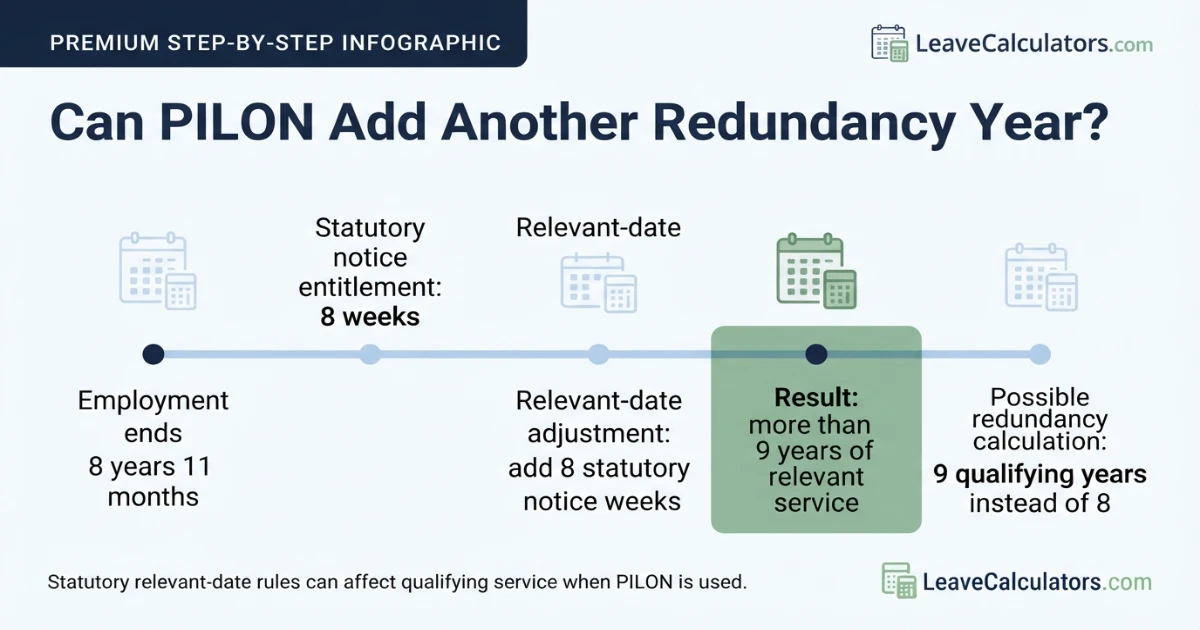
For statutory redundancy calculations, qualifying service is determined using a statutory relevant date.
Where PILON is paid, Acas explains that the relevant date can include the statutory notice period the employee would have worked.
This can sometimes move an employee into another complete year of service.
Employee service when employment ends immediately: 8 years and 11 months
Statutory notice entitlement: 8 weeks
The employee may therefore have statutory redundancy pay calculated using 9 qualifying years rather than 8.
What If Contractual Notice Is Longer Than Statutory Notice?
This can make the redundancy-service calculation more complex.
Acas specifically distinguishes between statutory notice and longer contractual notice when working out the redundancy relevant date.
Employees with contractual notice longer than the statutory minimum should not automatically assume that every contractual notice week is added in the same way for statutory redundancy service.
The relevant-date rules should be checked carefully.
Does PILON Include Benefits?
It depends on the employment contract and the employer’s PILON clause.
A contractual PILON might specify whether the payment includes:
- basic salary;
- car allowance;
- commission;
- bonus;
- pension contributions;
- private medical cover; or
- other contractual benefits.
Some clauses only provide basic salary. Others include additional contractual amounts.
The contract should therefore be checked rather than assuming PILON always equals the full value of the notice period.
Does PILON Include Holiday Pay?
Not automatically.
Accrued unused holiday pay is generally a separate entitlement when employment ends.
Holiday pay is normally taxable employment income and should usually appear as a separate item in the final payment breakdown.
Does PILON Include Bonus or Commission?
Again, this depends on the contract and the nature of the payment.
A PILON clause might include certain contractual earnings, while bonus or commission arrangements can have separate eligibility rules.
Employees should check:
- the PILON clause;
- bonus rules;
- commission terms;
- the employment termination date; and
- whether the payment had already been earned.
How Is PILON Treated in a Settlement Agreement?
A settlement agreement does not automatically make PILON tax-free.
Where part of a settlement represents unworked notice, HMRC’s rules can treat that notice-equivalent amount as taxable earnings.
The agreement should normally distinguish between:
- PILON or PENP;
- statutory redundancy pay;
- qualifying additional termination compensation;
- holiday pay;
- salary and bonuses; and
- other settlement amounts.
Can PILON Push You Into a Higher Tax Band?
Potentially.
Because PILON is taxable earnings, it contributes to taxable income for the tax year.
A large PILON payment combined with salary, bonus or other taxable income can affect the amount of Income Tax due overall.
The final position depends on the employee’s total taxable income and personal circumstances for that tax year.
Can You Get a Tax Refund on PILON?
Possibly, but not because PILON itself is tax-free.
A refund can arise if PAYE deductions during the year exceed the final amount of Income Tax actually due.
This can happen, for example, where:
- a large payment is taxed after a P45 using 0T;
- the employee has little income for the rest of the tax year;
- the tax code used did not reflect the final annual position; or
- other adjustments apply.
Employees who think too much tax has been deducted should check their full-year position or contact HMRC.
What Payments Are Not PILON?
Not every payment received when employment ends is notice pay.
| Payment | Is It PILON? | Typical Treatment |
|---|---|---|
| Statutory redundancy pay | No | Can potentially use the £30,000 threshold |
| Enhanced redundancy compensation | Not necessarily | Qualifying amount can potentially use the £30,000 threshold |
| Unused holiday pay | No | Taxable employment income |
| Final salary | No | Taxable employment income |
| Notice-equivalent lump sum | Usually yes / subject to PENP rules | Taxable earnings |
Common PILON Tax Mistakes
1. Assuming PILON is covered by the £30,000 redundancy exemption
Notice-equivalent earnings are normally taxed separately from qualifying termination compensation.
2. Assuming non-contractual PILON is automatically tax-free
The PENP rules can bring notice-equivalent basic pay into tax even where there is no straightforward contractual PILON clause.
3. Combining PILON and redundancy pay into one figure
The components should be separated because their tax treatment differs.
4. Forgetting National Insurance
PILON and PENP are generally subject to Class 1 National Insurance as well as Income Tax.
5. Assuming the PAYE deduction after P45 is the final tax liability
A post-leaving payment can be taxed using 0T, which may create a high initial deduction. The final tax position depends on total income for the tax year.
How to Check a PILON Calculation
- Check your contractual notice period.
- Check your statutory notice entitlement.
- Confirm the actual employment termination date.
- Read the PILON clause in your contract.
- Confirm whether PILON covers basic salary only or other contractual benefits.
- Check whether PENP has been calculated.
- Separate notice pay from redundancy compensation.
- Separate holiday pay, salary, bonuses and commission.
- Check Income Tax and National Insurance deductions.
- If paid after P45, check whether the correct post-leaving PAYE treatment was used.
Also Check Your Statutory Redundancy Pay
PILON is separate from redundancy compensation. Use the UK Redundancy Pay Calculator to estimate your statutory redundancy entitlement based on age, weekly pay and qualifying service.
Use the UK Redundancy Pay CalculatorFrequently Asked Questions
Is PILON taxable in the UK?
Yes. PILON is generally treated as employment earnings and is normally subject to Income Tax and Class 1 National Insurance.
Is PILON covered by the £30,000 tax-free redundancy allowance?
Normally, no. Notice-equivalent earnings are taxed separately and do not normally use the £30,000 termination-payment threshold.
What is PENP?
PENP means Post-Employment Notice Pay. It identifies basic pay relating to an unworked notice period within a termination award and is taxable as employment earnings.
Do you pay National Insurance on PILON?
Yes, PILON and amounts treated as PENP are generally subject to Class 1 National Insurance.
Is non-contractual PILON tax-free?
No. The absence of a contractual PILON clause does not automatically make the payment tax-free. PENP rules can still bring notice-equivalent pay into tax.
Can PILON increase redundancy pay?
Potentially. The statutory redundancy relevant-date rules can include the statutory notice period where PILON is paid, which can sometimes create another complete qualifying year.
Is garden leave the same as PILON?
No. On garden leave the employee normally remains employed and paid during notice. With PILON, employment can end and the employee receives money instead of working the notice period.
What happens if PILON is paid after my P45?
Taxable post-leaving payments are generally processed using tax code 0T on a week 1 or month 1 basis, with the equivalent Scottish or Welsh code where appropriate.
Can PILON push me into a higher tax band?
Potentially. PILON is taxable income, so it can increase total taxable earnings for the tax year and affect the employee’s overall Income Tax position.
Final Answer: PILON Tax Explained
PILON tax is generally straightforward once notice-related earnings are separated from genuine redundancy compensation.
Pay in lieu of notice normally represents the earnings an employee would have received had they worked their notice period.
For that reason, PILON is generally subject to Income Tax and Class 1 National Insurance.
It does not normally benefit from the combined £30,000 termination-payment threshold that can apply to statutory redundancy pay and qualifying additional severance compensation.
The PENP rules reinforce this distinction by identifying basic pay attributable to unworked notice and taxing that amount as general earnings.
PILON can also matter for redundancy calculations. Where the statutory notice period is added when determining the redundancy relevant date, an employee who is close to another complete year of service may gain an additional qualifying year.
The safest approach is to obtain a written termination breakdown separating:
- PILON or PENP;
- statutory redundancy pay;
- enhanced severance;
- holiday pay;
- final salary;
- bonus or commission; and
- other termination amounts.
That makes it much easier to check both the tax deductions and the statutory redundancy calculation.