What to Do if Your Employer Is Not Paying Redundancy
If your employer is not paying redundancy pay, do not leave the issue unresolved. Check what you are owed, write to your employer, keep evidence and act before the relevant legal deadline. The correct route depends on whether your employer is refusing to pay, cannot afford to pay or is formally insolvent.

When Should Redundancy Pay Be Paid?
Acas guidance says redundancy pay should normally be paid when your employment ends or on your final pay date.
You and your employer can agree to a later payment date, but that arrangement should be confirmed in writing.
Your employer should also explain how the payment will be made, for example as part of your final payroll payment or as a separate transfer.
If the expected payment date has passed, contact the employer promptly and create a written record.
What to Do if Your Employer Is Not Paying Redundancy
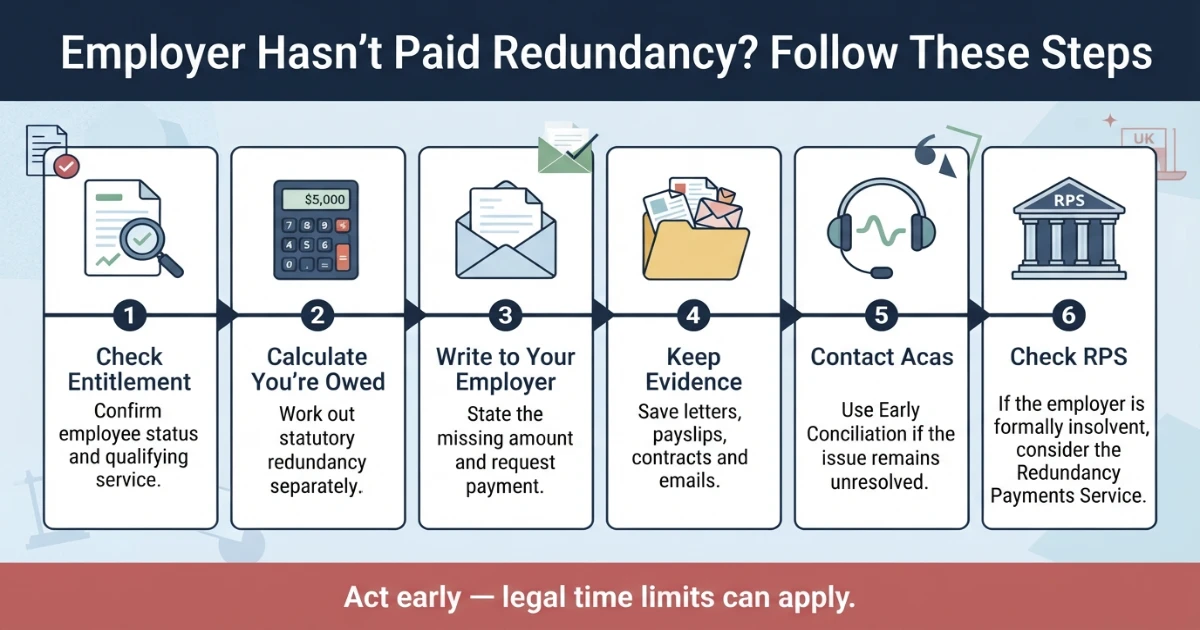
Check That You Are Entitled to Redundancy Pay
Statutory redundancy pay normally requires employee status and at least two years of continuous employment.
Check your redundancy letter, employment dates and the calculation supplied by your employer.
Calculate What You Should Have Received
Work out your statutory redundancy entitlement separately from salary, holiday pay, notice pay and other final amounts.
Write to Your Employer
Tell the employer what you believe you are entitled to and that the redundancy payment has not been received.
Include copies of supporting evidence and ask for payment by a reasonable specific date.
Keep Evidence
Save your redundancy letter, employment contract, payslips, calculation, emails, payroll messages and any written promises about the payment date.
Contact Acas if the Issue Is Not Resolved
If the employer still does not pay, consider the employment tribunal route. Acas Early Conciliation is an important part of the tribunal process and strict deadlines apply.
Use the RPS Route if the Employer Is Insolvent
If the employer is formally insolvent and cannot pay, eligible employees can apply through the Redundancy Payments Service for statutory amounts.
How to Write to an Employer About Unpaid Redundancy Pay
Acas recommends writing to your employer as soon as possible if the redundancy payment does not arrive.
Your message should clearly identify:
- your employment end date;
- the date redundancy pay was expected;
- the amount you believe is due;
- how the amount was calculated;
- supporting documents;
- the fact that payment has not been received; and
- a reasonable deadline for payment.
Evidence to Attach
Useful evidence can include payslips, your redundancy letter, your employment contract, written confirmation of your start date and a redundancy-pay calculation.
Check Your Statutory Redundancy Entitlement First
For qualifying redundancies taking effect on or after 6 April 2026 in Great Britain:
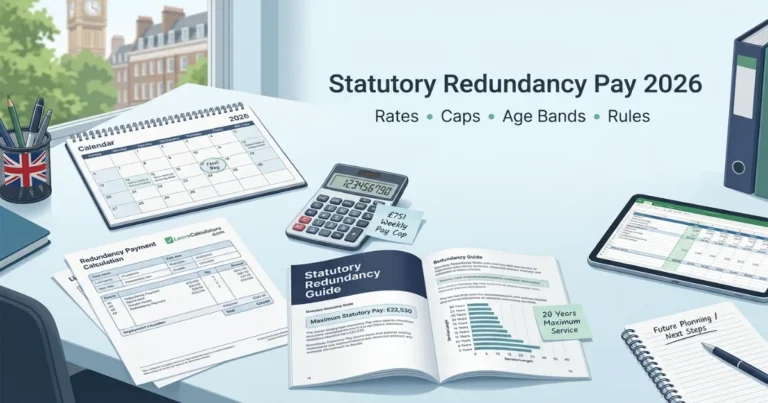
- weekly statutory pay is capped at £751;
- maximum qualifying service is 20 years; and
- maximum statutory redundancy pay is £22,530.
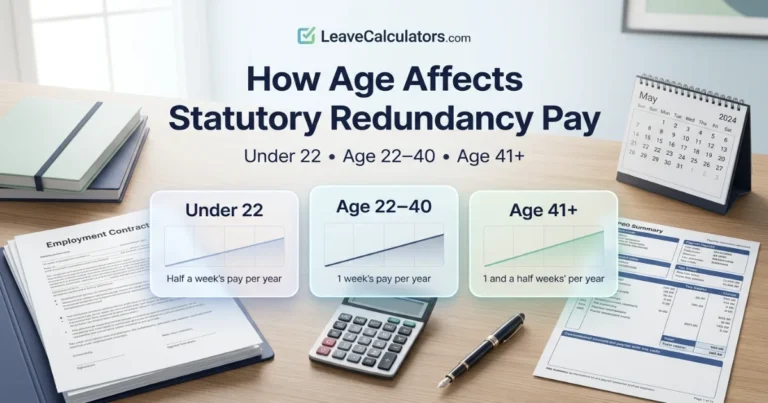
The age multipliers are:
| Age During Qualifying Year | Entitlement |
|---|---|
| Under 22 | 0.5 week’s pay per complete qualifying year |
| Age 22 to 40 | 1 week’s pay per complete qualifying year |
| Age 41 or over | 1.5 weeks’ pay per complete qualifying year |
Check How Much Redundancy Pay You Are Owed
Calculate your statutory amount before challenging a missing or incorrect payment.
Use the UK Redundancy Pay CalculatorHow Long Do You Have to Claim Unpaid Redundancy Pay?
Do not delay.
Acas currently states that the employment tribunal time limit for a statutory redundancy pay claim is normally 6 months minus 1 day from the date your employment ends.
A claim about contractual redundancy pay can have a shorter tribunal time limit of 3 months minus 1 day.
Contact Acas early rather than waiting until the deadline. The Early Conciliation process can affect how tribunal time limits are calculated.
Can You Take an Employer to an Employment Tribunal?
Potentially, yes.
If you have written to the employer and they still refuse or fail to pay your statutory redundancy entitlement, you can potentially bring a claim to an employment tribunal.
You should normally tell Acas before submitting an employment tribunal claim. Acas can offer Early Conciliation to try to resolve the dispute without a full tribunal hearing.
What if the Employer Paid the Wrong Redundancy Amount?
A dispute does not have to involve a completely missing payment.
You may also need to challenge the calculation if your employer:
- used the wrong service dates;
- used the wrong weekly-pay figure;
- applied the wrong age multiplier;
- ignored qualifying years;
- incorrectly used a lower weekly salary;
- applied the statutory cap incorrectly; or
- failed to apply a contractual enhanced scheme.
Ask for a written breakdown showing exactly how the figure was calculated.
What if the Employer Says It Cannot Afford Redundancy Pay?
An employer’s financial problems do not automatically remove your statutory redundancy entitlement.
Where an employer is not formally insolvent but genuinely cannot afford the statutory redundancy payments, the employer itself can apply to the Redundancy Payments Service for financial assistance.
Under this scheme, the employer must show that it has exhausted other funding options. If approved, the RPS can make statutory redundancy payments directly to eligible employees.
The employer remains liable for the money and the payment creates a debt owed by the employer to the government.
Important distinction: If the business is still solvent but cannot afford redundancy, the employer applies for this RPS financial assistance.
If the employer is formally insolvent, the employee can usually make the relevant RPS claim directly.
What if Your Employer Is Insolvent?
If your employer is formally insolvent and cannot pay what you are owed, eligible employees can apply to the government’s Redundancy Payments Service.
The RPS can potentially pay qualifying amounts for:
- statutory redundancy pay;
- up to 8 weeks of qualifying unpaid wages and other contractual money;
- up to 6 weeks of qualifying holiday pay; and
- statutory notice pay, subject to the relevant rules.
For qualifying 2026 claims, several of these payments are subject to the £751 weekly statutory cap.
How to Claim Through the Redundancy Payments Service
The GOV.UK online service is used when an employer is unable to pay, for example because it is insolvent.
You may need:
- the employer’s insolvency case reference or CN number;
- your National Insurance number;
- bank details;
- employment start and end dates;
- your redundancy date;
- pay details;
- details of money owed;
- holiday entitlement and holiday taken;
- letters exchanged with the employer or tribunal; and
- details of any money you owe the employer.
What if the Employer Has Stopped Trading but Is Not Formally Insolvent?
This can be particularly frustrating.
Acas says that where an employer has stopped trading but has not legally registered as insolvent, an employee may need to:
- consider an employment tribunal claim; or
- contact the RPS if the employer later becomes formally insolvent.
You should not assume that a company disappearing or shutting its doors is the same thing as formal insolvency.
What if You Were Promised Enhanced Redundancy Pay?
Statutory redundancy pay and contractual or enhanced redundancy pay are not always the same.
An employer may have agreed to pay more than the statutory minimum under:
- your employment contract;
- a company redundancy policy;
- a collective agreement;
- a settlement agreement; or
- a specific written redundancy offer.
If enhanced redundancy is unpaid, different legal issues and shorter tribunal deadlines can arise.
Read: Enhanced vs Statutory Redundancy Pay .
What if Salary and Holiday Pay Are Also Missing?
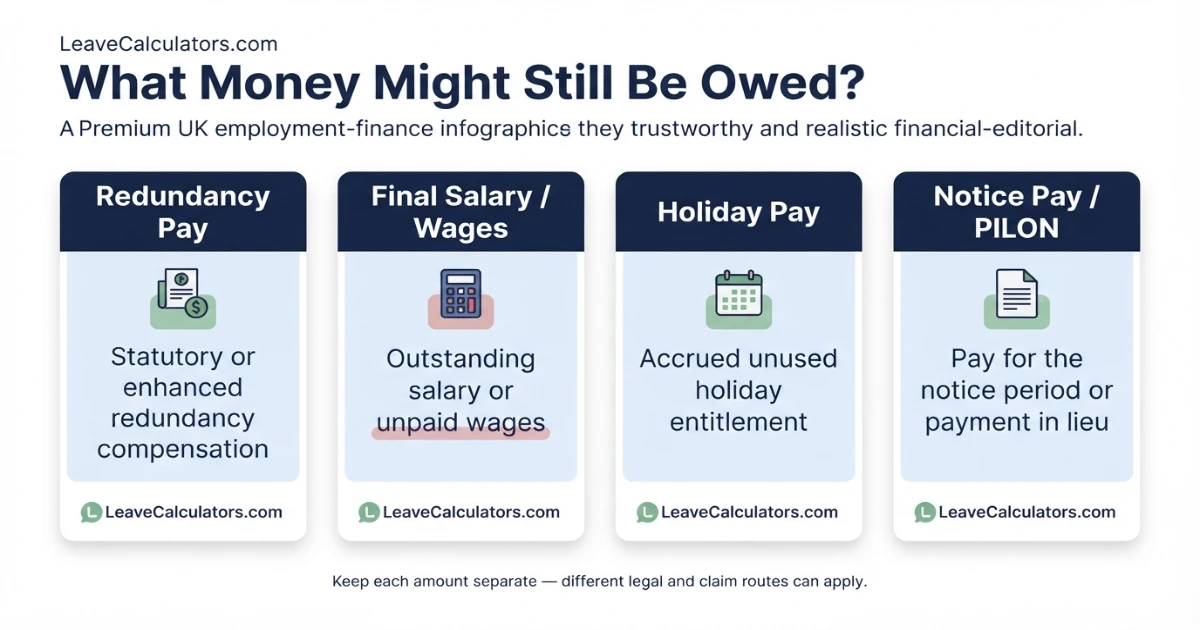
Redundancy pay is separate from other money due when employment ends.
Your final package can include:
- statutory redundancy pay;
- enhanced redundancy pay;
- final salary;
- unpaid wages;
- holiday pay;
- commission;
- bonuses; and
- notice-related payments.
Do not combine all of these into one figure when challenging the employer. Identify each unpaid amount separately.
Documents You Should Keep
| Document | Why It Matters |
|---|---|
| Redundancy letter | Shows the redundancy date and employer’s stated position. |
| Employment contract | Helps establish service, pay and contractual redundancy terms. |
| Payslips | Support your weekly-pay calculation. |
| P60 / payroll records | Support employment and earnings history. |
| Redundancy calculation | Shows what the employer says you are owed. |
| Emails and letters | Provide evidence of requests and payment promises. |
| Bank statements | Can demonstrate that the expected payment did not arrive. |
| Enhanced redundancy policy | Useful if more than statutory redundancy was promised. |
What if You Win at Tribunal and the Employer Still Does Not Pay?
Winning a tribunal claim does not always guarantee that payment appears immediately.
GOV.UK says that if a tribunal award is not paid, enforcement options can be available. These can include asking the relevant enforcement service to pursue the payment or using court enforcement procedures.
If the employer becomes insolvent, a separate insolvency claim may become relevant for eligible amounts.
Common Mistakes When Redundancy Pay Has Not Been Paid
1. Waiting for months without writing to the employer
Raise the missing payment promptly and create a written evidence trail.
2. Missing the tribunal deadline
Do not assume negotiations with the employer automatically protect your legal time limit.
3. Using the RPS route before formal insolvency without understanding the process
Where an employer is merely financially distressed but not formally insolvent, the employer may need to apply for RPS financial assistance itself.
4. Mixing redundancy pay with salary and holiday pay
Keep each category separate because different payment and claim rules can apply.
5. Challenging the amount without calculating the statutory baseline
Calculate what you should receive before sending the employer a formal request.
Unpaid Redundancy Pay Checklist
- Check whether you qualify for statutory redundancy pay.
- Calculate the amount you believe you are owed.
- Check the agreed payment date.
- Write to the employer immediately if payment is late.
- Attach evidence and give a reasonable payment deadline.
- Keep copies of all correspondence.
- Find out whether the employer is still solvent or formally insolvent.
- If solvent and refusing to pay, consider Acas and tribunal options.
- If insolvent, check your eligibility for the RPS claim service.
- Do not allow the relevant legal deadline to expire while negotiating.
Frequently Asked Questions
What should I do if my employer has not paid my redundancy?
Write to your employer as soon as possible, explain what you are owed, provide supporting evidence and give them a reasonable date to make payment. If the issue is not resolved, consider contacting Acas and checking the employment tribunal deadline.
When should redundancy pay normally be paid?
Redundancy pay should normally be made when employment ends or on the final pay date unless you and the employer agree another payment date in writing.
How long do I have to claim unpaid statutory redundancy pay?
Acas currently states that a statutory redundancy pay employment tribunal claim normally has a time limit of 6 months minus 1 day from the date the job ends. Different or shorter limits can apply to other types of claim.
Can I take my employer to tribunal for unpaid redundancy?
Potentially, yes. If you are entitled to redundancy pay and your employer does not pay after you have raised the issue, an employment tribunal claim may be possible. Acas Early Conciliation normally comes before a tribunal claim.
What happens if my employer cannot afford redundancy pay?
If the employer is not formally insolvent but cannot afford statutory redundancy payments, the employer can potentially apply to the Redundancy Payments Service for financial assistance.
What happens if my employer is insolvent?
Eligible employees can potentially claim statutory redundancy pay and certain other qualifying amounts through the Redundancy Payments Service.
What is the statutory weekly pay cap in 2026?
For qualifying redundancies from 6 April 2026 in Great Britain, statutory weekly pay is capped at £751.
Can I claim unpaid holiday pay as well as redundancy pay?
Yes, potentially. If the employer is insolvent, qualifying holiday pay can be claimed through the RPS subject to statutory limits. If the employer is not insolvent, other employment-law claim routes may apply.
Final Answer: What to Do if Your Employer Is Not Paying Redundancy
If your employer is not paying redundancy, start by confirming what you are entitled to and when payment was due.
Write to the employer immediately, explain the missing payment, provide your evidence and set a reasonable payment deadline.
If the employer remains solvent but refuses to pay, you may need to use the Acas Early Conciliation and employment tribunal route. Do not ignore the legal time limit.
If the employer is formally insolvent, eligible employees can instead claim statutory redundancy and certain other qualifying amounts from the Redundancy Payments Service.
If the employer is not insolvent but simply cannot afford statutory redundancy payments, the employer itself may be able to request financial assistance from the RPS.
The most important practical point is to act early. Keep written evidence, calculate the statutory amount accurately and do not allow negotiations or promises of future payment to cause you to miss a claim deadline.